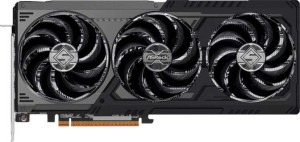
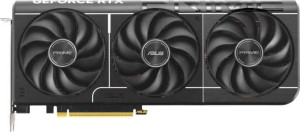
The raw throughput numbers tell a compelling story here. The ASRock Radeon RX 9070 XT Steel Legend Dark delivers 48.6 TFLOPS of floating-point performance against the Asus Prime RTX 5070's 30.87 TFLOPS — a roughly 57% advantage in compute throughput. This directly translates to more geometry and shader work processed per second, which matters in complex, heavily shaded scenes. Similarly, the RX 9070 XT's texture rate of 760.3 GTexels/s nearly doubles the RTX 5070's 482.3 GTexels/s, meaning it can apply textures to surfaces significantly faster — a real benefit in high-resolution or texture-heavy workloads. The pixel rate gap is even wider: 380.2 GPixel/s versus 201 GPixel/s, driven by the RX 9070 XT's higher ROP count (128 vs. 80), which directly impacts fill rate and frame output throughput at high resolutions.
The clock speed story is nuanced. The RTX 5070 runs a higher base clock at 2325 MHz, while the RX 9070 XT starts lower at 1660 MHz but turbos dramatically to 2970 MHz — a much wider boost window. The RTX 5070's turbo of only 2512 MHz is comparatively modest. Interestingly, the RTX 5070 has more shading units (6144 vs. 4096), yet produces less compute throughput — this reflects architectural and clock scaling differences between AMD's RDNA 4 and Nvidia's Blackwell designs, where raw unit count doesn't map linearly to real-world output. The RX 9070 XT also has a faster memory interface operating at 2518 MHz versus 1750 MHz, reducing potential memory bottlenecks in bandwidth-hungry scenarios. Both cards support Double Precision Floating Point, relevant mainly for professional compute tasks.
Based strictly on the provided specs, the ASRock Radeon RX 9070 XT Steel Legend Dark holds a clear performance edge in this group. It leads across every major throughput metric — compute, texturing, pixel fill rate, and memory speed — by substantial margins. Users prioritizing raw rasterization horsepower will find it the stronger performer on paper.