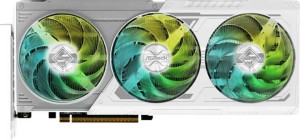
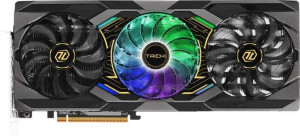
At the hardware level, both the Steel Legend and the Taichi OC share identical rendering pipelines: 4096 shading units, 256 TMUs, and 128 ROPs. This means any performance difference between the two cannot be attributed to architectural advantages — it comes down entirely to clock speeds. The Taichi OC ships with a notably higher base clock of 1870 MHz versus the Steel Legend's 1660 MHz, and that gap carries through to boost, where the Taichi OC reaches 3100 MHz compared to 2970 MHz. Both cards also share the same 2518 MHz memory speed, so memory bandwidth is not a differentiator here.
Because the derived performance metrics — pixel rate, texture rate, and floating-point throughput — are calculated directly from clock speed and fixed unit counts, the Taichi OC leads across all three. Its 50.79 TFLOPS of floating-point performance versus the Steel Legend's 48.66 TFLOPS represents roughly a 4.4% theoretical compute advantage. In practice, this translates to a modest but measurable edge in GPU-bound scenarios: slightly higher average framerates at the same settings, or marginally better headroom in compute-intensive workloads. The gap is real but not transformative — users will not experience a night-and-day difference in day-to-day gaming.
The Taichi OC holds a clear performance edge in this group, driven purely by its factory overclock. Both cards support Double Precision Floating Point, so there is no distinction there. If raw clock-for-clock throughput is the priority, the Taichi OC is the stronger performer; however, buyers who are less sensitive to a ~4–5% performance delta may find the Steel Legend's lower clocks an acceptable trade-off depending on other factors like price or acoustics.