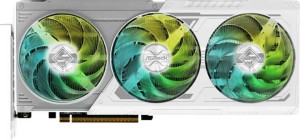
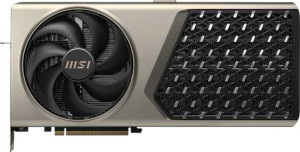
At first glance, the raw compute numbers favor the MSI GeForce RTX 5080 Expert OC: its 58.38 TFLOPS of floating-point performance and 912.2 GTexels/s texture rate outpace the ASRock Radeon RX 9070 XT Steel Legend's 48.66 TFLOPS and 760.3 GTexels/s by roughly 20%. The RTX 5080 also carries a dramatically larger shader array — 10,752 shading units versus just 4,096 on the RX 9070 XT — which underpins its advantage in heavily parallelized workloads like AI-accelerated rendering and compute tasks.
The picture shifts when you look at clock speeds and rasterization output. The RX 9070 XT hits a remarkable 2970 MHz GPU turbo, compared to the RTX 5080's 2715 MHz peak. That higher clock, combined with a larger ROP count (128 vs. 112), gives the RX 9070 XT a superior pixel fill rate of 380.2 GPixel/s against the RTX 5080's 304.1 GPixel/s — meaning the AMD card can theoretically push more pixels per second in traditional rasterized rendering, which matters for high-resolution, high-framerate gaming scenarios. The RX 9070 XT also sports notably faster GPU memory at 2518 MHz versus the RTX 5080's 1875 MHz, which can reduce memory latency in bandwidth-sensitive workloads.
In summary, the RTX 5080 holds a clear edge in raw throughput — compute, texturing, and sheer parallelism — making it the stronger choice for GPGPU tasks, AI workloads, and texture-heavy rendering pipelines. The RX 9070 XT Steel Legend punches back with a higher boost clock, more ROPs, and faster memory, giving it a meaningful advantage specifically in pixel fill rate. Both cards support Double Precision Floating Point, so neither has a differentiated edge there. Overall, the RTX 5080 leads on paper for general performance headroom, but the RX 9070 XT's rasterization throughput is a genuine counterpoint that should not be overlooked for traditional gaming use cases.