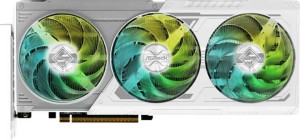
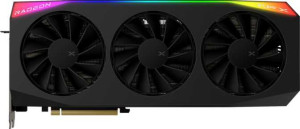
Both the ASRock Steel Legend and the XFX Mercury share identical underlying GPU silicon: the same 4096 shading units, 256 TMUs, and 128 ROPs. This means any performance difference between the two cards comes purely from clock speeds, not architectural advantages. Both also match on 2518 MHz memory speed and support Double Precision Floating Point, so those factors do not differentiate them.
Where they diverge is in how aggressively each card is factory-tuned. The XFX Mercury runs a notably higher base clock of 1870 MHz versus the Steel Legend's 1660 MHz — a gap of 210 MHz at the floor. At boost, the XFX reaches 3100 MHz compared to 2970 MHz on the ASRock, a 130 MHz lead. These clock advantages translate directly into every derived throughput metric: the XFX edges ahead with 50.79 TFLOPS of floating-point performance versus 48.66 TFLOPS, and a texture rate of 793.6 GTexels/s against 760.3 GTexels/s. In practice, this roughly 4% compute advantage can narrow the gap to the next GPU tier in bandwidth-heavy or shader-intensive workloads, though real-world gaming frame rates rarely scale linearly with compute throughput alone.
The XFX Mercury holds a clear, if modest, performance edge in this group strictly based on its higher factory clock speeds and the resulting throughput gains across every measurable metric. The ASRock Steel Legend is not a slow card — both are high-performance RX 9070 XT variants — but if raw out-of-box performance is the priority and all else is equal, the XFX is the stronger performer on paper.