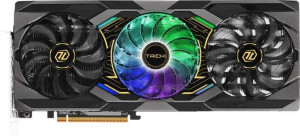
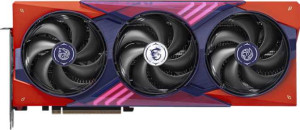
At first glance, the MSI RTX 5070 Ti's 8,960 shading units versus the ASRock RX 9070 XT's 4,096 looks like a decisive hardware advantage — more than double the shader count. In practice, however, raw shader count is only meaningful in the context of clock speed and architectural efficiency. The RX 9070 XT's boost clock reaches 3,100 MHz, compared to the RTX 5070 Ti's 2,572 MHz, and that gap is large enough to flip the overall compute picture entirely. The result is that the RX 9070 XT delivers 50.79 TFLOPS of floating-point performance against the RTX 5070 Ti's 46.09 TFLOPS — a clear win in raw throughput despite far fewer shaders.
The ASRock card extends its lead across the rasterization pipeline as well. Its pixel rate of 396.8 GPixel/s is roughly 60% higher than the RTX 5070 Ti's 246.9 GPixel/s, driven both by its higher clock and its larger ROP count (128 vs. 96). A higher pixel rate directly benefits high-resolution rendering and anti-aliasing workloads, meaning the RX 9070 XT can push more finished pixels per second to the display. Similarly, the texture rate of 793.6 GTexels/s versus 720.2 GTexels/s gives the ASRock a measurable edge in texture-heavy scenes. Memory bandwidth potential also favors the RX 9070 XT, whose memory runs at 2,518 MHz versus 1,750 MHz on the MSI — faster memory feeds the GPU's pipeline more efficiently, reducing stalls in memory-bound scenarios.
Both cards support Double Precision Floating Point (DPFP), which matters for compute and professional workloads but is rarely a differentiator in gaming. Overall, based strictly on the provided performance specs, the ASRock RX 9070 XT Taichi OC holds a clear advantage: it leads in computed TFLOPS, pixel fill rate, texture throughput, and memory speed. The RTX 5070 Ti's much higher shader count is offset by its lower boost clock and architectural differences, leaving it behind on every key throughput metric presented here.