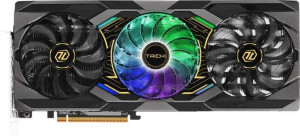
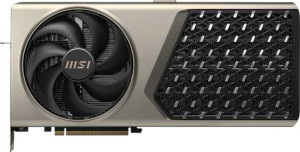
The most striking contrast in this group lies in how each GPU achieves its performance. The ASRock Radeon RX 9070 XT Taichi OC relies on an aggressive clock strategy: its base clock of 1870 MHz is modest, but it boosts all the way to 3100 MHz — a massive +1230 MHz swing. The MSI GeForce RTX 5080 Expert OC takes the opposite approach, running a tighter 2295–2715 MHz range with far more raw hardware underneath, including 10,752 shading units versus just 4,096 on the RX 9070 XT. This architectural difference is fundamental: AMD is squeezing more frequency out of fewer units, while NVIDIA deploys a much wider compute engine running at more conservative clocks.
In terms of raw throughput metrics, the picture is split. The RTX 5080 leads in floating-point performance at 58.38 TFLOPS versus 50.79 TFLOPS, and in texture throughput (912.2 GTexels/s vs 793.6 GTexels/s), both reflecting its sheer unit count. However, the RX 9070 XT counters with a notably higher pixel fill rate of 396.8 GPixel/s — versus 304.1 GPixel/s — driven by its 128 ROPs outpacing the RTX 5080's 112, combined with its higher peak clock. This gives the RX 9070 XT a real-world edge in pixel-bound scenarios such as high-resolution rasterization. Its memory clock of 2518 MHz also outpaces the RTX 5080's 1875 MHz, which can benefit memory-bandwidth-sensitive workloads.
Overall, neither card dominates universally across this group. The RTX 5080 Expert OC holds the edge in compute and texture throughput, making it better suited for workloads that scale with shader count — such as ray tracing, AI-accelerated rendering, and compute tasks. The RX 9070 XT Taichi OC has the advantage in pixel output and memory clock speed, which translates to competitive rasterization performance at high resolutions. The choice between them in this group comes down to workload: NVIDIA leads in raw FLOPS and texturing, while AMD punches back with superior fill rate and faster memory.