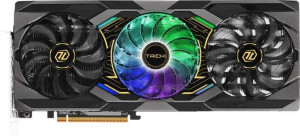
On paper, the most striking paradox here is that the Nvidia RTX 5070 Ti contains more than twice the shading units (8960 vs. 4096), yet the ASRock RX 9070 XT Taichi OC leads in nearly every throughput metric. The explanation lies in clock speed: the Taichi OC's GPU turbo of 3100 MHz dwarfs the RTX 5070 Ti's 2450 MHz peak, and those extreme frequencies translate directly into a higher pixel rate (396.8 vs. 235.2 GPixel/s), a higher texture rate (793.6 vs. 686.6 GTexels/s), and a superior floating-point throughput of 50.79 TFLOPS vs. 43.94 TFLOPS. In practice, pixel rate governs how fast a GPU can fill the screen with rendered output — a meaningful edge at high resolutions — while texture rate determines how efficiently complex surface detail is applied. Both favor the AMD card by a significant margin.
The RTX 5070 Ti counters with architectural breadth: more TMUs (280 vs. 256) provide a modest texturing pipeline advantage independent of clocks, and its higher shading unit count could give Nvidia's driver and compiler stack more flexibility for workloads that scale with parallelism rather than raw frequency. However, the Taichi OC answers with a faster memory speed of 2518 MHz vs. 1750 MHz and more ROPs (128 vs. 96) — the latter directly accelerating anti-aliasing and blending operations, which matter in GPU-bound, high-fidelity rendering scenarios.
Based strictly on the provided specs, the ASRock RX 9070 XT Taichi OC holds a clear performance edge in this group. Its combination of a dramatically higher turbo clock, superior pixel and texture fill rates, faster memory, and greater TFLOPS gives it a theoretical throughput advantage across the board. The RTX 5070 Ti's larger shader array is a meaningful architectural asset, but it is not enough to overcome the frequency-driven leads the AMD card demonstrates across the key computed metrics in this category.