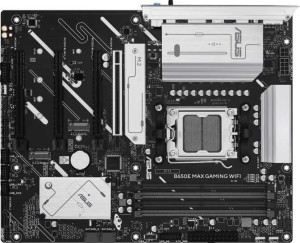
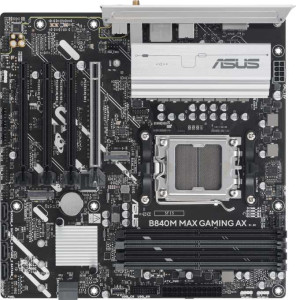
Both boards share the same AM5 socket, identical 3-year warranty, Bluetooth 5.3, overclocking support, and RGB lighting, making them equally capable on those fronts. The most immediately practical difference is form factor: the B650E Max Gaming Wi-Fi is a full ATX board (305 × 244 mm), while the B840M Max Gaming AX shrinks to Micro-ATX (244 × 244 mm). This matters for build planning — the ATX board fits more expansion slots and typically offers more VRM headroom, while the Micro-ATX suits smaller cases or space-constrained setups without sacrificing the AM5 platform.
On wireless connectivity, the B650E edges ahead with Wi-Fi 6E (802.11ax) support, which unlocks the less congested 6 GHz band for lower latency and higher throughput in compatible environments. The B840M tops out at Wi-Fi 6, which is still excellent for most users but lacks that 6 GHz headroom — a meaningful gap if you have a Wi-Fi 6E router and demand peak wireless performance.
Where the B840M punches back is in BIOS resilience: it offers both easy BIOS reset and a dual BIOS chip, providing a hardware-level safety net if a flash goes wrong — a feature the B650E entirely lacks. For overclockers or enthusiasts who flash firmware frequently, this is a genuine reliability advantage. Overall, the B650E holds an edge for users prioritizing wireless range and ATX expandability, while the B840M is the safer, more compact choice with better BIOS recovery options.