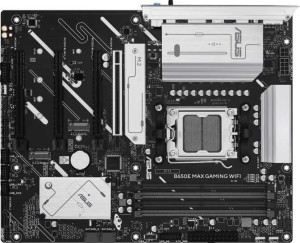
Asus B650E Max Gaming Wi-Fi
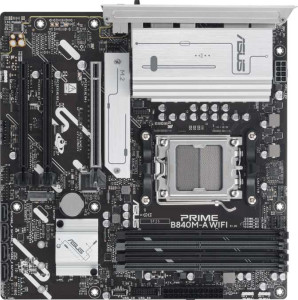
Asus Prime B840M-A WiFi

Asus B650E Max Gaming Wi-Fi Asus Prime B840M-A WiFi

Overview

Welcome to this in-depth specification comparison between the Asus B650E Max Gaming Wi-Fi and the Asus Prime B840M-A WiFi — two AM5 motherboards that share a solid foundation yet diverge in meaningful ways. While both boards offer DDR5 memory support, Wi-Fi 6E, and Bluetooth 5.3, the key battlegrounds lie in their form factor, expansion capabilities, and overclocking headroom. Read on to discover which board best suits your build.

Common Features

  • Both products use the AM5 CPU socket.
  • Wi-Fi is supported on both products, with versions Wi-Fi 4 (802.11n), Wi-Fi 5 (802.11ac), Wi-Fi 6 (802.11ax), and Wi-Fi 6E (802.11ax).
  • Bluetooth 5.3 is available on both products.
  • Both products feature HDMI 2.1 output.
  • Overclocking is supported on both products.
  • RGB lighting is present on both products.
  • Both products support a maximum memory amount of 256GB.
  • Both products have 4 memory slots.
  • Both products use DDR5 memory.
  • Both products support 2 memory channels.
  • ECC memory is not supported on either product.
  • Neither product has USB 3.2 Gen 1 ports (USB-C), USB 3.2 Gen 2x2 ports, USB 4 40Gbps ports, USB 4 20Gbps ports, Thunderbolt 4 ports, or Thunderbolt 3 ports.
  • Both products have an HDMI output.
  • Both products have 1 RJ45 port.
  • Both products provide 2 USB 3.2 Gen 1 ports through expansion and 2 USB 3.0 ports through expansion.
  • Both products have 4 SATA 3 connectors.
  • Both products have 4 fan headers.
  • Both products have 3 M.2 sockets.
  • A TPM connector is present on both products.
  • Neither product has a U.2 socket or an mSATA connector.
  • Both products have 1 PCIe 4.0 x16 slot and 2 PCIe 3.0 x16 slots, with no PCIe x1, PCI, PCIe 2.0 x16, PCIe x4, or PCIe x8 slots.
  • Both products support 7.1 audio channels with 3 audio connectors.
  • S/PDIF Out port is not available on either product.
  • Both products support RAID 0, RAID 1, RAID 5, and RAID 10 (1+0), but neither supports RAID 0+1.

Main Differences

  • The Asus B650E Max Gaming Wi-Fi has an ATX form factor, while the Asus Prime B840M-A WiFi has a Micro-ATX form factor.
  • The width is 305 mm on the Asus B650E Max Gaming Wi-Fi and 244 mm on the Asus Prime B840M-A WiFi.
  • Easy BIOS reset is available on the Asus Prime B840M-A WiFi but not on the Asus B650E Max Gaming Wi-Fi.
  • Dual BIOS is present on the Asus Prime B840M-A WiFi but not on the Asus B650E Max Gaming Wi-Fi.
  • Maximum overclocked RAM speed is 8000 MHz on the Asus B650E Max Gaming Wi-Fi and 7600 MHz on the Asus Prime B840M-A WiFi.
  • USB 3.2 Gen 2 ports (USB-A) number 3 on the Asus B650E Max Gaming Wi-Fi and 2 on the Asus Prime B840M-A WiFi.
  • USB 3.2 Gen 1 ports (USB-A) number 2 on the Asus B650E Max Gaming Wi-Fi and 1 on the Asus Prime B840M-A WiFi.
  • A USB 3.2 Gen 2 port (USB-C) is present on the Asus B650E Max Gaming Wi-Fi but not available on the Asus Prime B840M-A WiFi.
  • USB 2.0 ports number 2 on the Asus B650E Max Gaming Wi-Fi and 4 on the Asus Prime B840M-A WiFi.
  • DisplayPort outputs number 1 on the Asus B650E Max Gaming Wi-Fi and 2 on the Asus Prime B840M-A WiFi.
  • USB 2.0 ports through expansion number 6 on the Asus B650E Max Gaming Wi-Fi and 4 on the Asus Prime B840M-A WiFi.
  • A PCIe 5.0 x16 slot is present on the Asus B650E Max Gaming Wi-Fi but not available on the Asus Prime B840M-A WiFi.
Specs Comparison
Asus B650E Max Gaming Wi-Fi

Asus B650E Max Gaming Wi-Fi

Asus Prime B840M-A WiFi

Asus Prime B840M-A WiFi

General info:
CPU socket AM5 AM5
form factor ATX Micro-ATX
release date March 2025 January 2025
supports Wi-Fi
Wi-Fi version Wi-Fi 4 (802.11n), Wi-Fi 5 (802.11ac), Wi-Fi 6 (802.11ax), Wi-Fi 6E (802.11ax) Wi-Fi 4 (802.11n), Wi-Fi 5 (802.11ac), Wi-Fi 6 (802.11ax), Wi-Fi 6E (802.11ax)
Has Bluetooth
Bluetooth version 5.3 5.3
HDMI version HDMI 2.1 HDMI 2.1
Easy to overclock
has RGB lighting
Easy to reset BIOS
Has dual BIOS
has aptX
CPU sockets 1 1
Has integrated graphics
warranty period 3 years 3 years
height 244 mm 244 mm
width 305 mm 244 mm
Has integrated CPU

Both boards share the same AM5 socket, making them compatible with the same AMD Ryzen 7000/8000 series processors, and both include Wi-Fi 6E, Bluetooth 5.3, and HDMI 2.1 — a strong baseline feature set for modern builds. Neither integrates a CPU or graphics solution, and both carry a 3-year warranty, so on paper they target the same platform with similar connectivity ambitions.

The most meaningful distinction in this group is form factor. The B650E Max Gaming Wi-Fi is a full ATX board (305 × 244 mm), while the Prime B840M-A WiFi is Micro-ATX (244 × 244 mm). This matters practically: the ATX board offers more physical space for expansion slots, VRM cooling headroom, and cable management, whereas the Micro-ATX fits smaller cases and tighter budgets on space. Neither is objectively superior — it depends entirely on your chassis and build goals.

Where the Prime B840M-A WiFi earns a clear advantage in this group is BIOS resilience: it supports both easy BIOS reset and a dual BIOS chip, meaning a failed flash or corrupted firmware can be recovered without tools or sending the board in for service. The B650E Max Gaming Wi-Fi lacks both features, which is a meaningful reliability gap — especially for overclockers who push firmware limits. If BIOS safety and long-term serviceability matter to you, the Prime B840M-A WiFi holds the edge here.

Memory:
maximum memory amount 256GB 256GB
overclocked RAM speed 8000 MHz 7600 MHz
memory slots 4 4
DDR memory version 5 5
memory channels 2 2
Supports ECC memory

On the fundamentals, these two boards are identical: both support DDR5 memory across 4 slots in a dual-channel configuration, with a 256GB ceiling and no ECC support. For the vast majority of desktop users — gamers, content creators, and enthusiasts alike — this shared foundation is more than sufficient, and neither board will bottleneck you on capacity or channel bandwidth.

The single differentiator here is overclocked RAM speed. The B650E Max Gaming Wi-Fi reaches up to 8000 MHz, while the Prime B840M-A WiFi tops out at 7600 MHz. In practice, the gap between these frequencies is narrow in most workloads — real-world gains from pushing DDR5 beyond 6000–6400 MHz are typically marginal in gaming and productivity tasks. However, for users who specifically want to push memory to its limits — competitive overclockers or those chasing maximum benchmark scores — the B650E Max Gaming Wi-Fi′s higher ceiling is the relevant advantage.

For anyone building a straightforward high-performance system without extreme memory overclocking ambitions, the memory specs of both boards are effectively equivalent. The B650E Max Gaming Wi-Fi holds a narrow technical edge here, but only for those who will actually exploit the extra headroom.

Ports:
USB 3.2 Gen 2 ports (USB-A) 3 2
USB 3.2 Gen 1 ports (USB-A) 2 1
USB 3.2 Gen 2 ports (USB-C) 1 0
USB 3.2 Gen 1 ports (USB-C) 0 0
USB 2.0 ports 2 4
USB 3.2 Gen 2x2 ports 0 0
USB 4 40Gbps ports 0 0
USB 4 20Gbps ports 0 0
Thunderbolt 4 ports 0 0
Thunderbolt 3 ports 0 0
has an HDMI output
DisplayPort outputs 1 2
RJ45 ports 1 1
Has USB Type-C
eSATA ports 0 0
DVI outputs 0 0
has a VGA connector
PS/2 ports 0 0

The rear I/O tells two different stories about intended use. The B650E Max Gaming Wi-Fi leans heavily into high-speed USB connectivity, offering more USB 3.2 Gen 2 (10Gbps) Type-A ports and — critically — a USB 3.2 Gen 2 Type-C port that the Prime B840M-A WiFi lacks entirely. That Type-C port matters for users connecting modern peripherals, fast external SSDs, or newer controllers and headsets that have moved to USB-C. The Prime compensates with 4 USB 2.0 ports versus the B650E′s 2, which is useful for legacy devices like keyboards, mice, and dongles that don′t need speed — but USB 2.0 is rarely a limiting factor in modern builds.

On the display output side, the positions reverse. The Prime B840M-A WiFi offers 2 DisplayPort outputs alongside its HDMI, while the B650E Max Gaming Wi-Fi provides only 1 DisplayPort plus HDMI. For users relying on integrated graphics to drive a multi-monitor setup — particularly in a compact office or productivity build — that extra DisplayPort on the Prime is a tangible advantage. Both boards share HDMI 2.1 and a single RJ45 ethernet port, and neither offers Thunderbolt of any kind.

Overall, the B650E Max Gaming Wi-Fi has the edge for users prioritizing fast, modern USB connectivity — especially the USB-C Gen 2 port. The Prime B840M-A WiFi counters with superior multi-monitor display output. The better choice depends squarely on your peripheral ecosystem: USB-C-heavy and speed-focused users benefit from the B650E, while those needing multiple display connections will find the Prime more accommodating.

Connectors:
USB 3.2 Gen 1 ports (through expansion) 2 2
USB 2.0 ports (through expansion) 6 4
SATA 3 connectors 4 4
fan headers 4 4
USB 3.0 ports (through expansion) 2 2
M.2 sockets 3 3
Has TPM connector
U.2 sockets 0 0
Has mSATA connector
SATA 2 connectors 0 0

Internally, these two boards are remarkably close. Both provide 4 SATA 3 connectors, 3 M.2 sockets, 4 fan headers, and identical expansion USB headers — making them functionally equivalent for storage builds and cooling configurations. The presence of 3 M.2 slots on both is worth highlighting: it means users can run multiple NVMe drives simultaneously without sacrificing any SATA ports, which is a practical advantage for content creators or anyone building a fast multi-drive system.

The only measurable difference in this group is the number of internal USB 2.0 expansion headers: the B650E Max Gaming Wi-Fi offers 6 versus the Prime B840M-A WiFi′s 4. These headers typically feed front-panel USB ports, USB hubs, and internal devices like RGB controllers or AIO pump hubs. In a heavily populated ATX case with multiple USB-connected internals, two extra headers can eliminate the need for a splitter — a minor but real convenience advantage.

Taken as a whole, this group is essentially a tie. The B650E Max Gaming Wi-Fi′s slight lead in internal USB 2.0 headers is the only differentiator, and it will only matter in builds with a high density of internal USB devices. For the vast majority of users, the connector specs of both boards are interchangeable.

Expansion slots:
PCIe 4.0 x16 slots 1 1
PCIe 5.0 x16 slots 1 0
PCIe 3.0 x16 slots 2 2
PCIe x1 slots 0 0
PCI slots 0 0
PCIe 2.0 x16 slots 0 0
PCIe x4 slots 0 0
PCIe x8 slots 0 0

The Asus B650E Max Gaming Wi-Fi and Asus Prime B840M-A WiFi both offer PCIe slots for expansion, but they differ slightly in their configurations. The B650E Max Gaming Wi-Fi features 1 PCIe 4.0 x16 slot, 1 PCIe 5.0 x16 slot, and 2 PCIe 3.0 x16 slots, while the Prime B840M-A WiFi offers 1 PCIe 4.0 x16 slot and 2 PCIe 3.0 x16 slots, but does not include a PCIe 5.0 x16 slot. Both motherboards lack PCIe x1, PCI, PCIe 2.0 x16, PCIe x4, and PCIe x8 slots, so there are no significant differences in their slot types beyond the PCIe 5.0 x16 support on the B650E Max Gaming Wi-Fi.

Both boards provide similar overall flexibility in terms of PCIe expansion, with both having the same number of PCIe 3.0 x16 slots and no support for legacy PCI slots. The addition of a PCIe 5.0 x16 slot on the B650E Max Gaming Wi-Fi provides future-proofing for next-generation GPUs or expansion cards, which the Prime B840M-A WiFi lacks.

Overall, the main difference between the two boards in terms of expansion slots is the inclusion of the PCIe 5.0 x16 slot on the B650E Max Gaming Wi-Fi, offering a slight advantage for users looking to leverage the latest PCIe technologies.

Audio:
audio channels 7.1 7.1
Has S/PDIF Out port
audio connectors 3 3

Both the Asus B650E Max Gaming Wi-Fi and the Asus Prime B840M-A WiFi support 7.1 audio channels, offering similar surround sound capabilities. Neither motherboard includes an S/PDIF Out port, so both lack optical audio output. Both motherboards also feature 3 audio connectors, providing essential audio input/output functionality for standard audio devices.

In terms of audio specifications, there are no differences between the two products. Both have the same number of audio channels, connectors, and the absence of an S/PDIF Out port.

Overall, the audio features are almost identical on both motherboards, with no significant distinction in performance or available connections in this area.

Storage:
Supports RAID 1
Supports RAID 10 (1+0)
Supports RAID 5
Supports RAID 0
Supports RAID 0+1

The Asus B650E Max Gaming Wi-Fi and Asus Prime B840M-A WiFi both support the same RAID configurations, including RAID 1, RAID 10 (1+0), RAID 5, and RAID 0. Neither motherboard supports RAID 0+1, but otherwise, their storage capabilities are identical in terms of RAID support.

Both boards offer the same flexibility for RAID configurations, allowing users to set up different levels of redundancy and performance, such as RAID 1 for mirroring or RAID 5 for a combination of speed and redundancy. The absence of RAID 0+1 is the only common limitation between the two products in this category.

Overall, the storage features of both motherboards are essentially the same, with no differences in RAID support.

Comparison Summary & Verdict

After examining every specification, it is clear that these two boards serve different types of builders. The Asus B650E Max Gaming Wi-Fi stands out for enthusiasts who demand maximum performance: it offers a PCIe 5.0 x16 slot, higher overclocked RAM speeds of up to 8000 MHz, more high-speed USB ports including a USB 3.2 Gen 2 USB-C, and additional USB 2.0 expansion headers — all in a full ATX layout. By contrast, the Asus Prime B840M-A WiFi appeals to compact build enthusiasts and users who value reliability features, thanks to its Micro-ATX form factor, dual BIOS, easy BIOS reset functionality, and two DisplayPort outputs. Both boards share the same AM5 socket, DDR5 support, 256 GB memory ceiling, and comprehensive RAID options, making either a capable foundation. Choose the Asus B650E Max Gaming Wi-Fi for a high-performance ATX gaming rig, and the Asus Prime B840M-A WiFi for a compact, resilient everyday or small-form-factor build.

Asus B650E Max Gaming Wi-Fi
Buy Asus B650E Max Gaming Wi-Fi if...

Buy the Asus B650E Max Gaming Wi-Fi if you want a full ATX board with a PCIe 5.0 x16 slot, faster RAM overclocking up to 8000 MHz, and more high-speed USB connectivity for a top-tier gaming or workstation build.

Asus Prime B840M-A WiFi
Buy Asus Prime B840M-A WiFi if...

Buy the Asus Prime B840M-A WiFi if you prefer a compact Micro-ATX build and value reliability features like dual BIOS and easy BIOS reset, along with two DisplayPort outputs for a versatile multi-monitor setup.