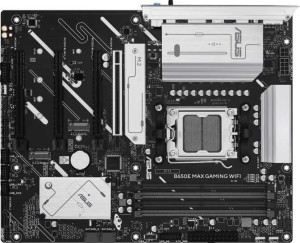
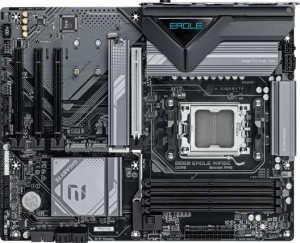
At their core, both the Asus B650E Max Gaming Wi-Fi and the Gigabyte B850 Eagle WiFi6E share the same fundamental profile: ATX form factor with identical 244×305 mm dimensions, an AM5 socket, full Wi-Fi 6E and Bluetooth 5.3 support, HDMI 2.1 output, overclocking support, and a 3-year warranty. For most users, these shared traits mean either board will slot into the same cases, support the same AMD CPUs, and deliver equivalent wireless connectivity out of the box.
The chipset difference is the most consequential distinction: the Gigabyte uses a B850 chipset versus the Asus's B650. The B850 is a newer platform revision, which generally implies improved I/O lane allocation and better support for next-generation peripherals and storage standards — a meaningful advantage for users planning a longer-term build. Complementing this, the Gigabyte also includes dual BIOS, a hardware-level safety net that allows the board to recover from a failed BIOS flash automatically, something the Asus lacks. For enthusiasts who update firmware frequently or overclock aggressively, this is a genuine reliability edge.
On the other side, the Asus counters with RGB lighting, which the Gigabyte omits entirely — a differentiator that matters primarily for aesthetics. In terms of pure platform capability and resilience, the Gigabyte B850 Eagle WiFi6E holds the advantage in this group, thanks to its newer chipset and dual BIOS protection, while the Asus appeals to builders who prioritize visual customization.