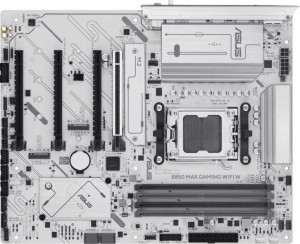
Asus B850 Max Gaming Wi-Fi W
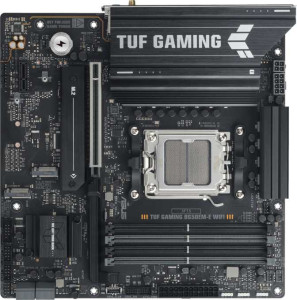
Asus TUF Gaming B650EM-E Wi-Fi

Asus B850 Max Gaming Wi-Fi W Asus TUF Gaming B650EM-E Wi-Fi

Overview

Welcome to our head-to-head specification comparison between the Asus B850 Max Gaming Wi-Fi W and the Asus TUF Gaming B650EM-E Wi-Fi. Both boards share the AMD AM5 platform with DDR5 memory support, Wi-Fi, and Bluetooth, but they diverge significantly in form factor, chipset generation, and connectivity options. Whether you are planning a full-tower build or a compact workstation, this comparison will help you pinpoint which board truly fits your needs.

Common Features

  • Both boards use the AM5 CPU socket.
  • Wi-Fi connectivity is available on both products.
  • Bluetooth is supported on both products.
  • Both feature HDMI 2.1 output.
  • Overclocking is supported on both products.
  • RGB lighting is present on both products.
  • aptX audio support is not available on either product.
  • Both boards have a single CPU socket.
  • Both support a maximum memory capacity of 256 GB.
  • Both support an overclocked RAM speed of up to 8000 MHz.
  • Both feature 4 memory slots across 2 memory channels.
  • Both use DDR5 memory.
  • ECC memory is not supported on either product.
  • Both provide 2 USB 3.2 Gen 1 ports (USB-A) on the rear panel.
  • Both provide 1 USB 3.2 Gen 2 port (USB-C) on the rear panel.
  • Both offer 4 SATA 3 connectors and 3 M.2 sockets for storage.
  • Both boards support 2 USB 3.2 Gen 1 ports and 2 USB 3.0 ports through expansion headers.
  • Both feature a single PCIe 5.0 x16 slot.
  • Both deliver 7.1-channel audio with 3 audio connectors.
  • S/PDIF output is not available on either product.
  • Both support RAID 0, RAID 1, RAID 5, and RAID 10, but neither supports RAID 0+1.

Main Differences

  • The chipset is B850 on Asus B850 Max Gaming Wi-Fi W and B650 on Asus TUF Gaming B650EM-E Wi-Fi.
  • The form factor is ATX on Asus B850 Max Gaming Wi-Fi W and Micro-ATX on Asus TUF Gaming B650EM-E Wi-Fi.
  • Asus B850 Max Gaming Wi-Fi W supports Wi-Fi 6E (802.11ax) in addition to Wi-Fi 4, 5, and 6, while Asus TUF Gaming B650EM-E Wi-Fi supports only Wi-Fi 4, 5, and 6.
  • The Bluetooth version is 5.3 on Asus B850 Max Gaming Wi-Fi W and 5.2 on Asus TUF Gaming B650EM-E Wi-Fi.
  • Easy BIOS reset is supported on Asus B850 Max Gaming Wi-Fi W but not available on Asus TUF Gaming B650EM-E Wi-Fi.
  • Dual BIOS is present on Asus B850 Max Gaming Wi-Fi W but not available on Asus TUF Gaming B650EM-E Wi-Fi.
  • The board width is 305 mm on Asus B850 Max Gaming Wi-Fi W and 244 mm on Asus TUF Gaming B650EM-E Wi-Fi.
  • USB 3.2 Gen 2 ports (USB-A) number 3 on Asus B850 Max Gaming Wi-Fi W and 1 on Asus TUF Gaming B650EM-E Wi-Fi.
  • Rear-panel USB 2.0 ports number 2 on Asus B850 Max Gaming Wi-Fi W and 4 on Asus TUF Gaming B650EM-E Wi-Fi.
  • DisplayPort outputs number 1 on Asus B850 Max Gaming Wi-Fi W and 2 on Asus TUF Gaming B650EM-E Wi-Fi.
  • A PS/2 port is absent on Asus B850 Max Gaming Wi-Fi W but present on Asus TUF Gaming B650EM-E Wi-Fi.
  • USB 2.0 expansion headers support 6 ports on Asus B850 Max Gaming Wi-Fi W and 4 ports on Asus TUF Gaming B650EM-E Wi-Fi.
  • Fan headers number 6 on Asus B850 Max Gaming Wi-Fi W and 4 on Asus TUF Gaming B650EM-E Wi-Fi.
  • A TPM connector is present on Asus B850 Max Gaming Wi-Fi W but not available on Asus TUF Gaming B650EM-E Wi-Fi.
  • PCIe 4.0 x16 slots number 1 on Asus B850 Max Gaming Wi-Fi W and 0 on Asus TUF Gaming B650EM-E Wi-Fi.
  • PCIe 3.0 x16 slots number 2 on Asus B850 Max Gaming Wi-Fi W and 0 on Asus TUF Gaming B650EM-E Wi-Fi.
  • PCIe x1 slots number 0 on Asus B850 Max Gaming Wi-Fi W and 1 on Asus TUF Gaming B650EM-E Wi-Fi.
Specs Comparison
Asus B850 Max Gaming Wi-Fi W

Asus B850 Max Gaming Wi-Fi W

Asus TUF Gaming B650EM-E Wi-Fi

Asus TUF Gaming B650EM-E Wi-Fi

General info:
CPU socket AM5 AM5
chipset B850 B650
form factor ATX Micro-ATX
release date April 2025 June 2025
supports Wi-Fi
Wi-Fi version Wi-Fi 4 (802.11n), Wi-Fi 5 (802.11ac), Wi-Fi 6 (802.11ax), Wi-Fi 6E (802.11ax) Wi-Fi 4 (802.11n), Wi-Fi 5 (802.11ac), Wi-Fi 6 (802.11ax)
Has Bluetooth
Bluetooth version 5.3 5.2
HDMI version HDMI 2.1 HDMI 2.1
Easy to overclock
has RGB lighting
Easy to reset BIOS
Has dual BIOS
has aptX
CPU sockets 1 1
Has integrated graphics
warranty period 3 years 3 years
height 244 mm 244 mm
width 305 mm 244 mm
Has integrated CPU

Both boards share the same AM5 socket, making them compatible with the same range of AMD processors, and both carry a 3-year warranty, Wi-Fi, Bluetooth, RGB lighting, and HDMI 2.1 output. They are also equally rated for overclocking. However, the Asus B850 Max Gaming Wi-Fi W uses the newer B850 chipset, which succeeds the B650 found on the TUF Gaming B650EM-E Wi-Fi — a meaningful difference in platform longevity, PCIe lane availability, and future feature support.

The connectivity gap reinforces this generational divide. The B850 Max Gaming adds Wi-Fi 6E (802.11ax) support, opening access to the less congested 6 GHz band for lower latency and higher throughput in dense environments, while the TUF B650EM-E tops out at Wi-Fi 6. The Bluetooth advantage is smaller — 5.3 vs 5.2 — but 5.3 brings improved connection stability and energy efficiency. The B850 Max Gaming also includes dual BIOS and an easy BIOS reset mechanism, both of which are absent on the TUF board; dual BIOS in particular is a meaningful safeguard for overclockers or anyone flashing firmware updates.

Form factor is the key practical trade-off: the B850 Max Gaming is a full-size ATX board (305 × 244 mm) offering more expansion slots and VRM real estate, while the TUF B650EM-E is Micro-ATX (244 × 244 mm), suiting smaller cases and tighter builds. If compact size is the priority, the TUF board holds its ground, but on almost every other dimension — chipset generation, wireless connectivity, and BIOS resilience — the B850 Max Gaming Wi-Fi W has a clear overall advantage.
Memory:
maximum memory amount 256GB 256GB
overclocked RAM speed 8000 MHz 8000 MHz
memory slots 4 4
DDR memory version 5 5
memory channels 2 2
Supports ECC memory

Across every memory specification in this group, the two boards are in complete lockstep. Both support DDR5 memory with 4 slots across a dual-channel configuration, cap out at 256 GB of maximum RAM, and push overclocked speeds up to 8000 MHz. For the vast majority of users — gamers, content creators, and workstation builders alike — this ceiling is more than sufficient and leaves ample headroom for future memory upgrades.

The shared dual-channel architecture is worth noting: pairing two or four sticks of RAM to fill both channels meaningfully widens memory bandwidth compared to a single-channel setup, which translates to smoother performance in bandwidth-sensitive workloads like video editing and large game worlds. The 8000 MHz overclocked ceiling is competitive at this tier, though realizing those speeds depends on the quality of the memory kit and XMP/EXPO profile support — neither board has an edge here. The absence of ECC support on both is expected at this consumer chipset level and is only relevant to those building mission-critical or professional workstation systems.

This group is a clear tie. There is no memory-related reason to choose one board over the other — the decision should rest entirely on the differentiators found in other specification categories.

Ports:
USB 3.2 Gen 2 ports (USB-A) 3 1
USB 3.2 Gen 1 ports (USB-A) 2 2
USB 3.2 Gen 2 ports (USB-C) 1 1
USB 3.2 Gen 1 ports (USB-C) 0 0
USB 2.0 ports 2 4
USB 3.2 Gen 2x2 ports 0 0
USB 4 40Gbps ports 0 0
USB 4 20Gbps ports 0 0
Thunderbolt 4 ports 0 0
Thunderbolt 3 ports 0 0
has an HDMI output
DisplayPort outputs 1 2
RJ45 ports 1 1
Has USB Type-C
eSATA ports 0 0
DVI outputs 0 0
has a VGA connector
PS/2 ports 0 1

The most telling difference here is in high-speed USB-A throughput. The B850 Max Gaming Wi-Fi W offers three USB 3.2 Gen 2 ports on the rear panel — each capable of 10 Gbps — compared to just one on the TUF B650EM-E. For users who routinely connect fast external SSDs, high-resolution webcams, or USB audio interfaces, this gap has real-world consequences: more devices can run at full speed simultaneously without resorting to a hub or sacrificing bandwidth.

The TUF B650EM-E counters in two areas. It provides two DisplayPort outputs versus the B850 Max Gaming's single one — a practical advantage for anyone driving multiple monitors directly off the board's integrated display outputs without a discrete GPU. It also includes a PS/2 port, a legacy connector that matters almost exclusively to users with older mechanical keyboards or KVM setups that rely on it. The TUF's four USB 2.0 ports outnumber the B850 Max Gaming's two, but at 480 Mbps those are best suited for low-bandwidth peripherals like mice and keyboards, making the raw count less impactful than it appears.

On balance, the B850 Max Gaming Wi-Fi W has the edge for most modern use cases thanks to its substantially richer roster of fast USB-A ports. The TUF B650EM-E's dual DisplayPort outputs are a genuine advantage for multi-monitor setups relying on integrated display output, but that is a narrower scenario — making the B850 Max Gaming the stronger choice for the majority of users prioritizing rear I/O versatility.

Connectors:
USB 3.2 Gen 1 ports (through expansion) 2 2
USB 2.0 ports (through expansion) 6 4
SATA 3 connectors 4 4
fan headers 6 4
USB 3.0 ports (through expansion) 2 2
M.2 sockets 3 3
Has TPM connector
U.2 sockets 0 0
Has mSATA connector
SATA 2 connectors 0 0

For internal storage and expansion, the two boards are well matched. Both offer 3 M.2 sockets and 4 SATA 3 connectors, giving builders identical options for NVMe SSDs and traditional drives — a solid foundation for either a compact gaming rig or a more storage-heavy workstation setup. Internal USB expansion headers are also equivalent, with the same number of USB 3.2 Gen 1 and USB 3.0 pass-through ports on both boards.

The meaningful separations emerge in two areas. The B850 Max Gaming Wi-Fi W provides 6 fan headers versus the TUF B650EM-E's 4, which matters considerably in larger ATX cases with complex cooling arrangements — more headers means more fans or pump heads can be controlled directly from the board without splitters that can complicate monitoring and PWM tuning. The B850 Max Gaming also edges ahead on internal USB 2.0 expansion, offering 6 ports compared to 4 on the TUF, useful for front-panel hubs or integrated case lighting controllers. Additionally, only the B850 Max Gaming includes a TPM connector, which is relevant for enterprise environments or users with hardware-level security requirements.

The B850 Max Gaming Wi-Fi W holds a clear advantage in this category. Its extra fan headers alone make it the more capable board for thermal management in enthusiast builds, and the TPM connector adds a layer of security flexibility that the TUF B650EM-E simply cannot match.

Expansion slots:
PCIe 4.0 x16 slots 1 0
PCIe 5.0 x16 slots 1 1
PCIe 3.0 x16 slots 2 0
PCIe x1 slots 0 1
PCI slots 0 0
PCIe 2.0 x16 slots 0 0
PCIe x8 slots 0 0

Both boards lead with a single PCIe 5.0 x16 slot as the primary GPU lane — the current gold standard for discrete graphics cards, delivering up to 128 GB/s of bandwidth and ensuring compatibility with present and next-generation GPUs. That shared foundation matters, but the similarity largely ends there.

Where the B850 Max Gaming Wi-Fi W pulls ahead is in secondary expansion. It adds a PCIe 4.0 x16 slot and two PCIe 3.0 x16 slots, giving builders meaningful options for a second GPU, a high-speed capture card, a 10GbE networking card, or other PCIe add-in cards — all without sacrificing the primary GPU lane. The TUF B650EM-E, constrained by its Micro-ATX footprint, offers only a single PCIe x1 slot alongside the main PCIe 5.0 x16, which limits additional expansion to low-bandwidth cards. A PCIe x1 slot is fine for a sound card or basic network adapter, but it cannot accommodate most performance-oriented add-in cards that require x4 or x16 physical connectors.

The B850 Max Gaming Wi-Fi W has a decisive advantage here. For users who anticipate needing more than one high-bandwidth expansion card, the TUF B650EM-E's slot layout is a hard ceiling. The B850 Max Gaming's broader slot configuration directly reflects its ATX form factor and makes it the far more versatile platform for complex or evolving builds.

Audio:
audio channels 7.1 7.1
Has S/PDIF Out port
audio connectors 3 3

Audio is another category where these two boards arrive at exactly the same destination. Both deliver 7.1-channel surround sound support through 3 analog audio connectors, and neither includes an S/PDIF optical output. The 7.1 configuration is a solid offering for gaming headsets and mid-range speaker setups, covering the full surround sound spectrum that most consumer audio equipment targets.

The absence of S/PDIF on both boards is worth flagging for users who rely on optical connections to a receiver or DAC — in those cases, an external USB audio interface or a discrete sound card would be required regardless of which board is chosen. With only 3 analog jacks rather than the 5 or 6 found on some higher-end boards, simultaneous use of both surround output and independent input channels may require some compromise, but this is consistent with what each board's market tier typically offers.

This group is a complete tie. Every audio specification is identical, so there is no audio-related basis to favor one board over the other. Users with demanding audio requirements should factor in external solutions equally for both.

Storage:
Supports RAID 1
Supports RAID 10 (1+0)
Supports RAID 5
Supports RAID 0
Supports RAID 0+1

RAID support is identical across both boards. Each one covers the four configurations that matter most to consumer and prosumer builders: RAID 0 for striped performance, RAID 1 for mirrored redundancy, RAID 5 for distributed parity across three or more drives, and RAID 10 for the combined speed and fault-tolerance of striping plus mirroring. Neither board supports RAID 0+1, though in practice RAID 10 serves the same purpose more efficiently and its absence is inconsequential.

The practical value of this RAID coverage is meaningful for users who want on-board data protection or performance scaling across multiple SATA or NVMe drives without investing in a dedicated RAID controller. RAID 5 in particular is notable — it offers a reasonable balance of storage efficiency and redundancy that suits small NAS-style setups or local backup arrays, and not every board at this price tier includes it.

With no differences whatsoever between the two, this group is a complete tie. Storage configuration flexibility is equally available on both boards, and this spec alone should carry no weight in a purchasing decision.

Comparison Summary & Verdict

After examining every specification, these two boards serve clearly distinct audiences. The Asus B850 Max Gaming Wi-Fi W stands out with its newer B850 chipset, Wi-Fi 6E support, Bluetooth 5.3, dual BIOS, easy BIOS reset, a TPM connector, more USB 3.2 Gen 2 Type-A ports, additional fan headers, and extra PCIe slots, making it the stronger choice for enthusiasts who want a future-ready ATX build with robust connectivity. The Asus TUF Gaming B650EM-E Wi-Fi, on the other hand, offers a Micro-ATX form factor with two DisplayPort outputs and a PS/2 port, making it better suited for compact builds or users who need legacy input support. Both boards share identical memory capabilities and storage options, so the decision ultimately comes down to build size, feature depth, and connectivity ambitions.

Asus B850 Max Gaming Wi-Fi W
Buy Asus B850 Max Gaming Wi-Fi W if...

Choose the Asus B850 Max Gaming Wi-Fi W if you want an ATX board with a newer chipset, Wi-Fi 6E, dual BIOS, more USB ports, and greater expansion slot flexibility for a high-end build.

Asus TUF Gaming B650EM-E Wi-Fi
Buy Asus TUF Gaming B650EM-E Wi-Fi if...

Choose the Asus TUF Gaming B650EM-E Wi-Fi if you are building a compact Micro-ATX system and value dual DisplayPort outputs or require a PS/2 port for legacy peripherals.