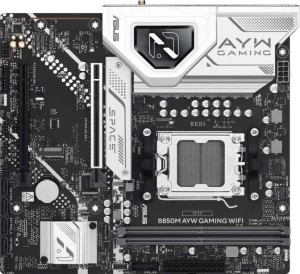
Asus B850M AYW Gaming Wi-Fi
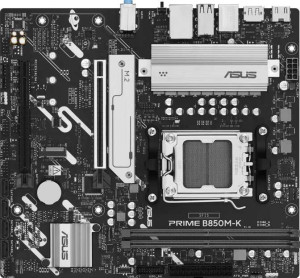
Asus Prime B850M-K

Asus B850M AYW Gaming Wi-Fi Asus Prime B850M-K

Overview

Welcome to our detailed spec comparison between the Asus B850M AYW Gaming Wi-Fi and the Asus Prime B850M-K — two Micro-ATX motherboards built on the B850 chipset for the AM5 platform. While they share a strong foundation of common features, the key battlegrounds between these two boards lie in their wireless connectivity options and display output configurations. Read on to discover which board aligns best with your build requirements.

Common Features

  • Both products use the AM5 CPU socket.
  • Both products feature the B850 chipset.
  • Both products use the Micro-ATX form factor.
  • Both products support HDMI 2.1.
  • Overclocking is supported on both products.
  • RGB lighting is present on both products.
  • Easy BIOS reset is not available on either product.
  • Both products feature dual BIOS.
  • Both products support a maximum memory amount of 128GB.
  • Both products support overclocked RAM speeds up to 8400 MHz.
  • Both products have 2 memory slots.
  • Both products use DDR5 memory.
  • Both products support 2 memory channels.
  • ECC memory is not supported on either product.
  • Both products have 2 USB 3.2 Gen 2 ports (USB-A) and 2 USB 3.2 Gen 1 ports (USB-A).
  • Neither product has USB 3.2 Gen 2 (USB-C), USB 3.2 Gen 1 (USB-C), USB 3.2 Gen 2x2, USB 4 40Gbps, or USB 4 20Gbps ports.
  • Both products have 4 USB 2.0 ports.
  • Both products have 4 SATA 3 connectors, 2 M.2 sockets, and 4 fan headers.
  • Neither product has an mSATA connector or U.2 sockets.
  • Both products feature 1 PCIe 5.0 x16 slot and 1 PCIe 4.0 x16 slot.
  • Both products support 7.1 audio channels with 3 audio connectors.
  • S/PDIF Out port is not present on either product.
  • Both products support RAID 0, RAID 1, RAID 5, and RAID 10, but neither supports RAID 0+1.

Main Differences

  • Wi-Fi support is present on Asus B850M AYW Gaming Wi-Fi but not available on Asus Prime B850M-K.
  • Bluetooth support is present on Asus B850M AYW Gaming Wi-Fi but not available on Asus Prime B850M-K.
  • DisplayPort output is available on Asus Prime B850M-K (1 port) but not present on Asus B850M AYW Gaming Wi-Fi.
  • A TPM connector is present on Asus Prime B850M-K but not available on Asus B850M AYW Gaming Wi-Fi.
Specs Comparison
Asus B850M AYW Gaming Wi-Fi

Asus B850M AYW Gaming Wi-Fi

Asus Prime B850M-K

Asus Prime B850M-K

General info:
CPU socket AM5 AM5
chipset B850 B850
form factor Micro-ATX Micro-ATX
release date April 2025 April 2025
supports Wi-Fi
Has Bluetooth
HDMI version HDMI 2.1 HDMI 2.1
Easy to overclock
has RGB lighting
Easy to reset BIOS
Has dual BIOS
CPU sockets 1 1
Has integrated graphics
warranty period 3 years 3 years
height 221 mm 221 mm
width 244 mm 244 mm
Has integrated CPU

Both the Asus B850M AYW Gaming Wi-Fi and the Asus Prime B850M-K share the same foundational platform: an AM5 socket, B850 chipset, and Micro-ATX form factor with identical dimensions of 244 × 221 mm. They both support overclocking, feature dual BIOS for firmware recovery, include RGB lighting, carry a 3-year warranty, and output video via HDMI 2.1. For users prioritizing the core build experience, these two boards start from essentially the same foundation.

The single but significant differentiator in this group is wireless connectivity. The AYW Gaming Wi-Fi includes built-in Wi-Fi and Bluetooth, while the Prime B850M-K has neither. In practical terms, this means the Prime B850M-K requires a dedicated PCIe Wi-Fi card or USB adapter if wireless connectivity is needed — adding cost and potentially occupying an expansion slot. For desktop builds near a router, this may be irrelevant, but for those in environments where running an Ethernet cable is impractical, the omission is a real constraint.

In this general info category, the AYW Gaming Wi-Fi holds a clear edge purely due to its integrated wireless capabilities. All other specs in this group are identical, so the decision here comes down to whether onboard Wi-Fi and Bluetooth matter for your specific setup. If they do, the AYW Gaming Wi-Fi is the straightforward choice; if you are hardwired and indifferent to wireless, the Prime B850M-K is functionally equivalent on every other metric in this group.
Memory:
maximum memory amount 128GB 128GB
overclocked RAM speed 8400 MHz 8400 MHz
memory slots 2 2
DDR memory version 5 5
memory channels 2 2
Supports ECC memory

On memory, these two boards are completely identical across every specified metric. Both support DDR5 RAM with a maximum capacity of 128 GB across 2 slots running in dual-channel configuration, and both can handle overclocked speeds up to 8400 MHz. Neither supports ECC memory, which is expected at this chipset tier — ECC is typically reserved for workstation and server platforms.

The dual-channel setup is worth highlighting: running two sticks rather than one unlocks significantly higher memory bandwidth, which has a meaningful impact on performance in CPU-intensive workloads and games that benefit from fast data throughput. The 128 GB ceiling is also generous for a Micro-ATX board, comfortably covering gaming, content creation, and even moderately demanding virtualization use cases. The 8400 MHz overclocking ceiling, achieved via EXPO or XMP profiles, puts both boards at the high end of consumer DDR5 support.

This group is a complete tie. There is no differentiator whatsoever between the AYW Gaming Wi-Fi and the Prime B850M-K on memory capability — whichever board you choose, your RAM options and theoretical performance ceiling are exactly the same.

Ports:
USB 3.2 Gen 2 ports (USB-A) 2 2
USB 3.2 Gen 1 ports (USB-A) 2 2
USB 3.2 Gen 2 ports (USB-C) 0 0
USB 3.2 Gen 1 ports (USB-C) 0 0
USB 2.0 ports 4 4
USB 3.2 Gen 2x2 ports 0 0
USB 4 40Gbps ports 0 0
USB 4 20Gbps ports 0 0
Thunderbolt 4 ports 0 0
Thunderbolt 3 ports 0 0
has an HDMI output
DisplayPort outputs 0 1
RJ45 ports 1 1
Has USB Type-C
eSATA ports 0 0
DVI outputs 0 0
has a VGA connector
PS/2 ports 0 0

The rear I/O port layout is nearly identical across both boards. Each offers the same USB spread — two USB 3.2 Gen 2 (10 Gbps) Type-A ports, two USB 3.2 Gen 1 (5 Gbps) Type-A ports, and four USB 2.0 ports — along with a single RJ45 Ethernet jack. Neither board includes a USB-C rear port, nor any Thunderbolt or USB4 connectivity, which is typical for this chipset and price tier.

The one meaningful divergence is video output. Both boards include HDMI, but the Asus Prime B850M-K adds a DisplayPort output that the AYW Gaming Wi-Fi lacks entirely. For users relying on integrated graphics — or pairing the board with an APU down the line — this matters: DisplayPort generally supports higher refresh rates and is the preferred connection for many modern monitors. Having both HDMI and DisplayPort simultaneously also enables a dual-monitor setup without a discrete GPU.

For this group, the Prime B850M-K holds a narrow but practical edge thanks to its additional DisplayPort output. Users who plan on using a dedicated graphics card and never intend to use the board's video output will find this irrelevant, but for anyone who values display flexibility from the motherboard itself, the Prime B850M-K offers more options.

Connectors:
USB 3.2 Gen 1 ports (through expansion) 2 2
USB 2.0 ports (through expansion) 4 4
SATA 3 connectors 4 4
fan headers 4 4
USB 3.0 ports (through expansion) 2 2
M.2 sockets 2 2
Has TPM connector
U.2 sockets 0 0
Has mSATA connector
SATA 2 connectors 0 0

Internal connectivity is largely identical between the two boards. Both provide 2 M.2 sockets for NVMe storage, 4 SATA 3 connectors for traditional drives, 4 fan headers for cooling management, and the same expansion USB headers — enough to satisfy a typical Micro-ATX build without leaving obvious gaps.

The sole differentiator here is the presence of a TPM connector on the Prime B850M-K, which the AYW Gaming Wi-Fi omits. A TPM (Trusted Platform Module) header allows a discrete TPM chip to be installed, enabling hardware-level security features such as drive encryption, secure boot attestation, and compliance with enterprise or organizational security policies. While Windows 11 already leverages the firmware TPM built into AMD's AM5 platform, a dedicated hardware TPM via this connector can offer stronger isolation and is sometimes required in corporate or government deployment scenarios.

For mainstream home users, the missing TPM header on the AYW Gaming Wi-Fi is unlikely to matter in practice. However, for anyone building a workstation that needs to meet stricter security standards or IT policy requirements, the Prime B850M-K has a clear advantage in this group by virtue of that single but purposeful connector.

Expansion slots:
PCIe 4.0 x16 slots 1 1
PCIe 5.0 x16 slots 1 1
PCIe 3.0 x16 slots 0 0
PCIe x1 slots 0 0
PCI slots 0 0
PCIe 2.0 x16 slots 0 0
PCIe x4 slots 0 0
PCIe x8 slots 0 0

Expansion slot configurations are identical on both boards: one PCIe 5.0 x16 slot and one PCIe 4.0 x16 slot, with no additional x1, x4, or legacy PCI slots. For a Micro-ATX form factor, this is a sensible and clean layout — the primary PCIe 5.0 x16 slot is positioned for the main GPU, while the PCIe 4.0 x16 slot serves as a secondary expansion lane for add-in cards such as a dedicated network adapter, capture card, or additional storage controller.

The PCIe 5.0 x16 primary slot is the headline feature here, offering double the bandwidth of PCIe 4.0 — relevant for current high-end GPUs that can begin to saturate PCIe 4.0 under certain workloads, and increasingly important for next-generation graphics cards. The secondary PCIe 4.0 x16 slot provides meaningful headroom for any supplementary card without bottlenecking modern peripherals.

This group is a complete tie. Neither board offers any expansion slot advantage over the other — the layout, generations, and slot count are perfectly matched, so this category plays no role in differentiating the two.

Audio:
audio channels 7.1 7.1
Has S/PDIF Out port
audio connectors 3 3

Audio capabilities are identical across both boards. Each delivers 7.1-channel surround sound support through 3 analog audio connectors — a standard arrangement that covers the line-in, line-out, and microphone jacks typical of motherboard rear I/O audio panels. Neither board includes an S/PDIF optical output, which means users requiring a direct digital audio connection to an AV receiver or external DAC via optical will need to route audio through HDMI or invest in a discrete sound card.

The 7.1-channel capability is worth contextualizing: while the specification confirms the onboard codec can process and output a full surround sound signal, realizing true 7.1 analog output typically requires additional splitter headers or a front panel audio connector in conjunction with the rear jacks. For most users with stereo headsets or 2.1 speakers, this distinction is academic — but for home theater or multi-speaker setups, the physical connector count is the practical ceiling.

As with the memory and expansion slot groups, this is a complete tie. The audio subsystem presents no differentiating factor between the AYW Gaming Wi-Fi and the Prime B850M-K, and neither holds any advantage here.

Storage:
Supports RAID 1
Supports RAID 10 (1+0)
Supports RAID 5
Supports RAID 0
Supports RAID 0+1

RAID support is identical on both boards. Each covers the four most practically useful configurations: RAID 0 for striping (maximum performance), RAID 1 for mirroring (data redundancy), RAID 5 for distributed parity (a balance of performance and fault tolerance), and RAID 10 for a combined stripe-and-mirror setup. Neither board supports RAID 0+1, though this omission is inconsequential for most users since RAID 10 accomplishes a similar outcome with better fault tolerance characteristics.

The breadth of RAID support here is notable for boards at this tier — RAID 5 in particular is a meaningful inclusion, as it allows users with three or more drives to gain redundancy without sacrificing as much usable capacity as a pure mirror. That said, RAID at the consumer level is increasingly complemented or replaced by software solutions, so the practical value depends heavily on the specific workflow.

This group is a complete tie. Every supported and unsupported RAID mode is mirrored exactly between the AYW Gaming Wi-Fi and the Prime B850M-K, leaving no storage configuration advantage on either side.

Comparison Summary & Verdict

Both the Asus B850M AYW Gaming Wi-Fi and the Asus Prime B850M-K deliver a solid AM5 platform with DDR5 support, PCIe 5.0, and up to 128GB of RAM, making either a capable foundation for a modern build. The Asus B850M AYW Gaming Wi-Fi stands out for users who need built-in Wi-Fi and Bluetooth, eliminating the need for additional adapters — a clear advantage for cable-free or space-constrained setups. The Asus Prime B850M-K, on the other hand, appeals to users who require a dedicated DisplayPort output for monitor connectivity and a TPM connector for enhanced security compliance. If wireless freedom matters most, go with the AYW Gaming Wi-Fi. If wired display flexibility and security features are your priority, the Prime B850M-K is the more fitting choice.

Asus B850M AYW Gaming Wi-Fi
Buy Asus B850M AYW Gaming Wi-Fi if...

Buy the Asus B850M AYW Gaming Wi-Fi if you want built-in Wi-Fi and Bluetooth without needing extra adapters, keeping your build clean and cable-free.

Asus Prime B850M-K
Buy Asus Prime B850M-K if...

Buy the Asus Prime B850M-K if you need a dedicated DisplayPort output for your monitor setup or require a TPM connector for security and compliance purposes.