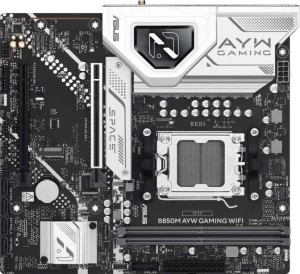
Asus B850M AYW Gaming Wi-Fi
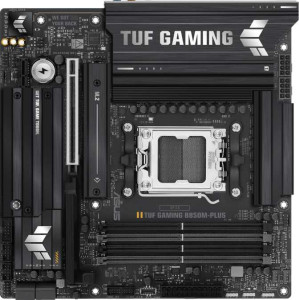
Asus TUF Gaming B850M-Plus

Asus B850M AYW Gaming Wi-Fi Asus TUF Gaming B850M-Plus

Overview

Welcome to our detailed spec comparison of the Asus B850M AYW Gaming Wi-Fi and the Asus TUF Gaming B850M-Plus — two Micro-ATX motherboards sharing the AM5 socket and B850 chipset. While they have much in common, key battlegrounds emerge around wireless connectivity, memory capacity, expansion options, and rear I/O versatility. Read on to see which board better matches your build requirements.

Common Features

  • Both motherboards use the AM5 CPU socket.
  • Both motherboards feature the B850 chipset.
  • Both motherboards have a Micro-ATX form factor.
  • Both motherboards support HDMI 2.1.
  • Overclocking is supported on both motherboards.
  • RGB lighting is present on both motherboards.
  • Easy BIOS reset is not available on either motherboard.
  • Dual BIOS is present on both motherboards.
  • Both motherboards support DDR5 memory.
  • Both motherboards have 2 memory channels.
  • ECC memory is not supported on either motherboard.
  • Neither motherboard has USB 3.2 Gen 2 ports in USB-C format.
  • Neither motherboard has USB 3.2 Gen 1 ports in USB-C format.
  • Both motherboards have 4 USB 2.0 ports.
  • Neither motherboard has USB 4 40Gbps, USB 4 20Gbps, Thunderbolt 4, or Thunderbolt 3 ports.
  • Both motherboards have an HDMI output.
  • Both motherboards provide 2 USB 3.2 Gen 1 ports and 4 USB 2.0 ports through expansion.
  • Both motherboards have 4 SATA 3 connectors and no SATA 2 connectors.
  • Neither motherboard has a TPM connector, U.2 socket, or mSATA connector.
  • Both motherboards have 1 PCIe 5.0 x16 slot and no PCIe 3.0 x16, PCIe 2.0 x16, PCIe x4, or PCIe x8 slots.
  • Both motherboards support 7.1 audio channels.
  • Both motherboards support RAID 0, RAID 1, RAID 5, and RAID 10, but neither supports RAID 0+1.

Main Differences

  • Wi-Fi is present on Asus B850M AYW Gaming Wi-Fi but not available on Asus TUF Gaming B850M-Plus.
  • Bluetooth is present on Asus B850M AYW Gaming Wi-Fi but not available on Asus TUF Gaming B850M-Plus.
  • Board height is 221 mm on Asus B850M AYW Gaming Wi-Fi and 244 mm on Asus TUF Gaming B850M-Plus.
  • Maximum supported memory is 128 GB on Asus B850M AYW Gaming Wi-Fi and 192 GB on Asus TUF Gaming B850M-Plus.
  • Maximum overclocked RAM speed is 8400 MHz on Asus B850M AYW Gaming Wi-Fi and 8000 MHz on Asus TUF Gaming B850M-Plus.
  • Memory slots number 2 on Asus B850M AYW Gaming Wi-Fi and 4 on Asus TUF Gaming B850M-Plus.
  • USB 3.2 Gen 2 ports (USB-A) count is 2 on Asus B850M AYW Gaming Wi-Fi and 3 on Asus TUF Gaming B850M-Plus.
  • USB 3.2 Gen 1 ports (USB-A) count is 2 on Asus B850M AYW Gaming Wi-Fi and 4 on Asus TUF Gaming B850M-Plus.
  • A USB 3.2 Gen 2x2 port is present on Asus TUF Gaming B850M-Plus but not available on Asus B850M AYW Gaming Wi-Fi.
  • A DisplayPort output is present on Asus TUF Gaming B850M-Plus but not available on Asus B850M AYW Gaming Wi-Fi.
  • A USB Type-C port is present on Asus TUF Gaming B850M-Plus but not available on Asus B850M AYW Gaming Wi-Fi.
  • Fan headers number 4 on Asus B850M AYW Gaming Wi-Fi and 5 on Asus TUF Gaming B850M-Plus.
  • M.2 sockets number 2 on Asus B850M AYW Gaming Wi-Fi and 3 on Asus TUF Gaming B850M-Plus.
  • A PCIe 4.0 x16 slot is present on Asus B850M AYW Gaming Wi-Fi but not available on Asus TUF Gaming B850M-Plus.
  • A PCIe x1 slot is present on Asus TUF Gaming B850M-Plus but not available on Asus B850M AYW Gaming Wi-Fi.
  • An S/PDIF Out port is present on Asus TUF Gaming B850M-Plus but not available on Asus B850M AYW Gaming Wi-Fi.
  • Audio connectors number 3 on Asus B850M AYW Gaming Wi-Fi and 5 on Asus TUF Gaming B850M-Plus.
Specs Comparison
Asus B850M AYW Gaming Wi-Fi

Asus B850M AYW Gaming Wi-Fi

Asus TUF Gaming B850M-Plus

Asus TUF Gaming B850M-Plus

General info:
CPU socket AM5 AM5
chipset B850 B850
form factor Micro-ATX Micro-ATX
release date April 2025 January 2025
supports Wi-Fi
Has Bluetooth
HDMI version HDMI 2.1 HDMI 2.1
Easy to overclock
has RGB lighting
Easy to reset BIOS
Has dual BIOS
CPU sockets 1 1
Has integrated graphics
warranty period 3 years 3 years
height 221 mm 244 mm
width 244 mm 244 mm
Has integrated CPU

Both the Asus B850M AYW Gaming Wi-Fi and the Asus TUF Gaming B850M-Plus share the same foundational platform: the AM5 socket, B850 chipset, and Micro-ATX form factor, making them direct competitors targeting the same class of AMD builds. They also match on overclock support, dual BIOS, HDMI 2.1 output, RGB lighting, and a 3-year warranty — so neither board has a structural advantage in terms of platform capability or build quality assurances.

The single most meaningful differentiator in this group is connectivity: the B850M AYW Gaming Wi-Fi includes integrated Wi-Fi and Bluetooth, while the TUF Gaming B850M-Plus has neither. In practice, this means the AYW is ready for wireless networking and peripheral pairing out of the box — no add-in card or USB dongle required. For a compact Micro-ATX build where PCIe slots are limited and cable management matters, having wireless built in is a genuine convenience advantage. The TUF, by contrast, commits the user to a wired Ethernet setup unless they add hardware separately.

There is also a subtle physical difference: the AYW is 221 mm tall versus the TUF's 244 mm, while both share a 244 mm width. The AYW's shorter height could offer slightly better clearance in tighter cases. Overall, the B850M AYW Gaming Wi-Fi holds a clear edge in this group purely due to its integrated wireless connectivity — a feature that costs nothing extra and eliminates a real-world limitation of the TUF for users who want or need cable-free networking.
Memory:
maximum memory amount 128GB 192GB
overclocked RAM speed 8400 MHz 8000 MHz
memory slots 2 4
DDR memory version 5 5
memory channels 2 2
Supports ECC memory

The memory configurations of these two boards diverge in ways that reflect different design priorities. The TUF Gaming B850M-Plus ships with 4 DIMM slots and a maximum capacity of 192GB, while the B850M AYW Gaming Wi-Fi offers only 2 slots capped at 128GB. For a Micro-ATX board, 4 slots is the more generous layout — it allows users to start with a modest kit and upgrade incrementally, whereas the AYW's 2-slot design means you are essentially locked into your final configuration from the start, since there is no room to add sticks later.

Where the AYW fights back is on raw speed: it supports overclocked DDR5 up to 8400 MHz, compared to the TUF's ceiling of 8000 MHz. That 400 MHz gap matters most to enthusiasts chasing peak memory bandwidth in latency-sensitive workloads or benchmarks, though real-world gains at this tier are incremental rather than transformative. Both boards run dual-channel DDR5 with no ECC support, so the underlying architecture is identical.

The verdict here depends on use case. The TUF Gaming B850M-Plus holds the advantage for most users — its 4-slot design offers greater upgrade flexibility and a substantially higher memory ceiling, which future-proofs the platform more effectively. The AYW's higher OC speed cap is a meaningful perk only for a narrow audience of memory overclockers, and it comes at the cost of long-term expandability.

Ports:
USB 3.2 Gen 2 ports (USB-A) 2 3
USB 3.2 Gen 1 ports (USB-A) 2 4
USB 3.2 Gen 2 ports (USB-C) 0 0
USB 3.2 Gen 1 ports (USB-C) 0 0
USB 2.0 ports 4 4
USB 3.2 Gen 2x2 ports 0 1
USB 4 40Gbps ports 0 0
USB 4 20Gbps ports 0 0
Thunderbolt 4 ports 0 0
Thunderbolt 3 ports 0 0
has an HDMI output
DisplayPort outputs 0 1
RJ45 ports 1 1
Has USB Type-C
eSATA ports 0 0
DVI outputs 0 0
has a VGA connector
PS/2 ports 0 0

Rear I/O density is one of the most practical measures of a motherboard's day-to-day usability, and here the TUF Gaming B850M-Plus pulls ahead meaningfully. It offers a total of 7 USB-A ports across Gen 1 and Gen 2 speeds versus the AYW's 4, plus it adds a USB 3.2 Gen 2x2 port capable of 20Gbps — useful for the fastest external SSDs on the market. The AYW carries no equivalent high-bandwidth USB option, which is a notable omission for users who regularly move large files to external storage.

The display output story also favors the TUF. It provides both HDMI and a DisplayPort output, enabling dual-monitor setups driven directly from the board's video output — handy when using AMD's integrated graphics on compatible CPUs. The AYW is limited to HDMI only, meaning a second display would require a discrete GPU. Additionally, the TUF includes a USB-C port on the rear panel, accommodating modern peripherals and accessories that have largely moved away from USB-A, while the AYW offers no rear USB-C connectivity at all.

Across nearly every dimension of this category, the TUF Gaming B850M-Plus holds a clear and well-rounded advantage — more USB ports, faster USB throughput, an extra display output, and a USB-C connection that the AYW entirely lacks. For users who prioritize a well-equipped rear panel, the TUF is the stronger choice here by a significant margin.

Connectors:
USB 3.2 Gen 1 ports (through expansion) 2 2
USB 2.0 ports (through expansion) 4 4
SATA 3 connectors 4 4
fan headers 4 5
USB 3.0 ports (through expansion) 2 2
M.2 sockets 2 3
Has TPM connector
U.2 sockets 0 0
Has mSATA connector
SATA 2 connectors 0 0

Internal connectors tell the story of a build's expandability ceiling, and on most fronts these two boards are closely matched. Both offer 4 SATA 3 connectors, identical internal USB headers, and no legacy storage interfaces to clutter the picture. The meaningful gaps are in M.2 sockets and fan headers — two specs that matter quite a bit in practice.

The TUF Gaming B850M-Plus edges ahead with 3 M.2 sockets compared to the AYW's 2. That extra slot is significant for users building NVMe-centric systems, as it allows three high-speed SSDs without consuming any SATA ports — ideal for content creators or anyone juggling large fast-access storage pools. The TUF also provides 5 fan headers versus 4 on the AYW, a small but relevant advantage for builds with more demanding thermal setups, such as multi-radiator cooling configurations or systems with several case fans requiring direct motherboard control.

On balance, the TUF Gaming B850M-Plus has the edge in this category. Neither lead is dramatic, but an additional M.2 slot is a concrete storage expandability gain that the AYW simply cannot match, and the extra fan header adds useful headroom for cooling-heavy configurations. Users who anticipate a multi-SSD build or a complex cooling layout will find the TUF's internal connector layout more accommodating.

Expansion slots:
PCIe 4.0 x16 slots 1 0
PCIe 5.0 x16 slots 1 1
PCIe 3.0 x16 slots 0 0
PCIe x1 slots 0 1
PCI slots 0 0
PCIe 2.0 x16 slots 0 0
PCIe x4 slots 0 0
PCIe x8 slots 0 0

Expansion slot layouts on Micro-ATX boards are always a compromise, but the two boards take noticeably different approaches beyond their shared PCIe 5.0 x16 primary slot — which both provide for the main GPU, keeping them on equal footing for graphics card compatibility and bandwidth.

The divergence lies in the secondary slot. The B850M AYW Gaming Wi-Fi pairs its primary slot with a PCIe 4.0 x16 slot, while the TUF Gaming B850M-Plus offers a PCIe x1 slot instead. In physical terms, an x16-sized slot — even running at PCIe 4.0 — can accept a far wider range of expansion cards than an x1 slot, including capture cards, multi-port network adapters, storage controllers, and other full-length cards that simply will not fit in an x1 slot. The TUF's x1 is functionally limited to narrow, low-bandwidth add-in cards.

For expansion flexibility, the B850M AYW Gaming Wi-Fi holds a clear advantage. A secondary PCIe 4.0 x16 slot is a more versatile option that keeps more upgrade paths open — particularly relevant in a compact Micro-ATX form factor where slot count is already at a premium. Users who anticipate adding any full-sized expansion card beyond a GPU will find the AYW's layout significantly more accommodating.

Audio:
audio channels 7.1 7.1
Has S/PDIF Out port
audio connectors 3 5

Audio is not always a headline spec for motherboards, but the differences here are worth noting for users who care about analog or digital output flexibility. Both boards support 7.1 surround sound, so neither has an advantage in terms of channel configuration — multi-speaker setups are equally supported on paper.

Where they diverge is in physical connectivity. The TUF Gaming B850M-Plus provides 5 analog audio connectors versus the AYW's 3, which is directly relevant to users running a full 7.1 analog speaker array, as more connectors allow more speaker channels to be hooked up simultaneously without adapters. The TUF also includes an S/PDIF optical output, which the AYW omits entirely. S/PDIF is the standard interface for connecting to AV receivers, soundbars, and external DACs via optical cable — its absence on the AYW means users who rely on digital audio passthrough to external equipment will need an alternative solution.

The TUF Gaming B850M-Plus holds a clear advantage in this category. More analog connectors and the addition of S/PDIF output make it the stronger choice for users with dedicated audio setups, home theater configurations, or external DAC/receiver chains. The AYW's audio implementation is more basic and better suited to straightforward headset or stereo use.

Storage:
Supports RAID 1
Supports RAID 10 (1+0)
Supports RAID 5
Supports RAID 0
Supports RAID 0+1

On storage configuration support, these two boards are in complete lockstep. Both the B850M AYW Gaming Wi-Fi and the TUF Gaming B850M-Plus support RAID 0, 1, 5, and 10, covering the full practical range of RAID modes relevant to consumer and prosumer builds — from pure performance striping to mirrored redundancy and the balanced protection of RAID 10. Neither board supports RAID 0+1, but that omission is identical across both and rarely impacts real-world decision-making at this tier.

This is a straightforward tie. There is no differentiator to analyze in this group — every supported and unsupported RAID mode is shared identically between the two products. Users planning multi-drive arrays for redundancy or performance will find equal capability on either board, so storage configuration support should play no role in choosing between them.

Comparison Summary & Verdict

Both boards deliver a solid AM5 and B850 foundation with DDR5 support, PCIe 5.0, and RAID compatibility, but their differences cater to distinct builders. The Asus B850M AYW Gaming Wi-Fi stands out with built-in Wi-Fi and Bluetooth and a higher overclocked RAM speed of 8400 MHz, making it ideal for compact builds that demand wireless connectivity out of the box. The Asus TUF Gaming B850M-Plus, on the other hand, wins on raw expandability with 4 memory slots supporting up to 192 GB, 3 M.2 sockets, a USB-C port, an additional DisplayPort output, and a richer audio setup with 5 connectors and S/PDIF Out. Choose the AYW Gaming Wi-Fi for a streamlined wireless-ready build; opt for the TUF Gaming B850M-Plus if maximum storage, memory, and I/O expansion are your top priorities.

Asus B850M AYW Gaming Wi-Fi
Buy Asus B850M AYW Gaming Wi-Fi if...

Buy the Asus B850M AYW Gaming Wi-Fi if you want built-in Wi-Fi and Bluetooth without extra adapters, and prefer a slightly more compact board with faster overclocked RAM support.

Asus TUF Gaming B850M-Plus
Buy Asus TUF Gaming B850M-Plus if...

Buy the Asus TUF Gaming B850M-Plus if you need maximum expandability, with 4 memory slots for up to 192 GB RAM, 3 M.2 sockets, a USB-C port, and a richer audio and display output selection.