Asus B860M-E
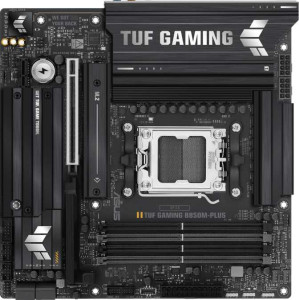
Asus TUF Gaming B850M-Plus

Asus B860M-E Asus TUF Gaming B850M-Plus

Overview

Welcome to our in-depth specification comparison between the Asus B860M-E and the Asus TUF Gaming B850M-Plus, two Micro-ATX motherboards that share a surprising amount of common ground yet diverge in some critical areas. Both boards support DDR5 memory, dual BIOS, and overclocking, but their CPU socket ecosystems, expansion capabilities, and connectivity options tell very different stories. Whether you are building around an Intel or AMD platform, or weighing storage and USB flexibility against raw memory capacity, this comparison will help you find the right fit for your next build.

Common Features

  • Both boards use the Micro-ATX form factor.
  • Neither board includes Wi-Fi support.
  • Neither board includes Bluetooth support.
  • Both boards support overclocking.
  • Both boards feature a dual BIOS.
  • Each board has a single CPU socket.
  • Neither board has integrated graphics.
  • Both boards come with a 3-year warranty.
  • Both boards use DDR5 memory.
  • Both boards support dual-channel memory.
  • Neither board supports ECC memory.
  • Neither board has USB 3.2 Gen 2 ports with a USB-C connector.
  • Neither board has USB 3.2 Gen 1 ports with a USB-C connector.
  • Neither board includes USB 4 40Gbps ports.
  • Neither board includes USB 4 20Gbps ports.
  • Neither board includes Thunderbolt 3 or Thunderbolt 4 ports.
  • Both boards have an HDMI output.
  • Each board has one RJ45 port.
  • Both boards provide 2 USB 3.2 Gen 1 ports through expansion.
  • Both boards provide 4 USB 2.0 ports through expansion.
  • Both boards include 4 SATA 3 connectors.
  • Neither board has a TPM connector.
  • Neither board has an mSATA connector.
  • No SATA 2 connectors are present on either board.
  • Both boards support 7.1 audio channels.
  • Both boards support RAID 0, RAID 1, RAID 5, and RAID 10.
  • Neither board supports RAID 0+1.

Main Differences

  • The CPU socket is LGA 1851 on Asus B860M-E and AM5 on Asus TUF Gaming B850M-Plus.
  • The chipset is B860 on Asus B860M-E and B850 on Asus TUF Gaming B850M-Plus.
  • The HDMI version is 1.4 on Asus B860M-E and 2.1 on Asus TUF Gaming B850M-Plus.
  • RGB lighting is present on Asus TUF Gaming B850M-Plus but not available on Asus B860M-E.
  • Easy BIOS reset is supported on Asus B860M-E but not available on Asus TUF Gaming B850M-Plus.
  • The board height is 222 mm on Asus B860M-E and 244 mm on Asus TUF Gaming B850M-Plus.
  • Maximum supported memory is 128 GB on Asus B860M-E and 192 GB on Asus TUF Gaming B850M-Plus.
  • Overclocked RAM speed reaches 8800 MHz on Asus B860M-E and 8000 MHz on Asus TUF Gaming B850M-Plus.
  • Memory slots number 2 on Asus B860M-E and 4 on Asus TUF Gaming B850M-Plus.
  • USB 3.2 Gen 2 Type-A ports number 1 on Asus B860M-E and 3 on Asus TUF Gaming B850M-Plus.
  • USB 3.2 Gen 1 Type-A ports number 2 on Asus B860M-E and 4 on Asus TUF Gaming B850M-Plus.
  • USB 2.0 ports number 3 on Asus B860M-E and 4 on Asus TUF Gaming B850M-Plus.
  • A USB 3.2 Gen 2x2 port is present on Asus TUF Gaming B850M-Plus but not available on Asus B860M-E.
  • A DisplayPort output is present on Asus TUF Gaming B850M-Plus but absent on Asus B860M-E.
  • A USB Type-C port is present on Asus TUF Gaming B850M-Plus but not available on Asus B860M-E.
  • Fan headers number 3 on Asus B860M-E and 5 on Asus TUF Gaming B850M-Plus.
  • M.2 sockets number 1 on Asus B860M-E and 3 on Asus TUF Gaming B850M-Plus.
  • A PCIe 4.0 x16 slot is present on Asus B860M-E but not available on Asus TUF Gaming B850M-Plus.
  • A PCIe 5.0 x16 slot is present on Asus TUF Gaming B850M-Plus but not available on Asus B860M-E.
  • PCIe x1 slots number 2 on Asus B860M-E and 1 on Asus TUF Gaming B850M-Plus.
  • An S/PDIF Out port is present on Asus TUF Gaming B850M-Plus but not available on Asus B860M-E.
  • Audio connectors number 3 on Asus B860M-E and 5 on Asus TUF Gaming B850M-Plus.
Specs Comparison
Asus B860M-E

Asus B860M-E

Asus TUF Gaming B850M-Plus

Asus TUF Gaming B850M-Plus

General info:
CPU socket LGA 1851 AM5
chipset B860 B850
form factor Micro-ATX Micro-ATX
release date January 2025 January 2025
supports Wi-Fi
Has Bluetooth
HDMI version HDMI 1.4 HDMI 2.1
Easy to overclock
has RGB lighting
Easy to reset BIOS
Has dual BIOS
CPU sockets 1 1
Has integrated graphics
warranty period 3 years 3 years
height 222 mm 244 mm
width 244 mm 244 mm
Has integrated CPU

The most fundamental distinction between these two boards is their CPU socket: the B860M-E uses LGA 1851 for Intel processors, while the TUF Gaming B850M-Plus uses AM5 for AMD Ryzen. This means the two boards are not interchangeable — your CPU choice dictates which board is even an option. Both pair their socket with a mid-range chipset (B860 and B850 respectively), and both share the same Micro-ATX form factor, making them suitable for compact builds without sacrificing too many expansion slots.

Beyond the platform split, a few practical differences stand out. The TUF Gaming B850M-Plus outputs video over HDMI 2.1, which supports 4K at high refresh rates and even 8K, whereas the B860M-E is limited to HDMI 1.4 — a noticeably older standard that caps out at 4K/30Hz. For users relying on integrated graphics or a display connection from the motherboard itself, this is a real-world limitation on the Intel board. The TUF also includes RGB lighting, which adds aesthetic flexibility for case builds. On the other hand, the B860M-E offers an easier BIOS reset process, which can be a genuine convenience during troubleshooting or when recovering from a failed overclock. Both boards support dual BIOS and are rated as easy to overclock — a slight oddity for the B860 chipset, which Intel typically restricts more heavily than Z-series, but listed as such in the provided data.

In terms of general info, neither board includes Wi-Fi, Bluetooth, or integrated graphics, and both carry a 3-year warranty. The B860M-E is marginally shorter (222 mm vs 244 mm tall), which could matter in very tight cases. Overall, platform compatibility aside, the TUF Gaming B850M-Plus holds a clear edge in this group thanks to its significantly superior HDMI 2.1 output and the added BIOS redundancy parity — making it the stronger general package if the AMD platform suits your build.

Memory:
maximum memory amount 128GB 192GB
overclocked RAM speed 8800 MHz 8000 MHz
memory slots 2 4
DDR memory version 5 5
memory channels 2 2
Supports ECC memory

The Asus B860M-E and Asus TUF Gaming B850M-Plus have notable differences when it comes to memory specifications. The B860M-E supports a maximum memory amount of 128GB, while the TUF Gaming B850M-Plus supports a higher maximum of 192GB. Both motherboards use DDR5 memory and operate with dual memory channels, but the B860M-E has 2 memory slots, whereas the B850M-Plus provides 4 memory slots.

In terms of overclocked RAM speed, the B860M-E supports up to 8800 MHz, which is slightly faster than the B850M-Plus, which supports up to 8000 MHz. Neither motherboard supports ECC memory, so they are not designed for error-correcting code memory.

These memory-related specifications highlight the TUF Gaming B850M-Plus’s advantage in terms of capacity and expansion potential with its 4 memory slots, though the B860M-E offers a marginally higher overclocked RAM speed.

Ports:
USB 3.2 Gen 2 ports (USB-A) 1 3
USB 3.2 Gen 1 ports (USB-A) 2 4
USB 3.2 Gen 2 ports (USB-C) 0 0
USB 3.2 Gen 1 ports (USB-C) 0 0
USB 2.0 ports 3 4
USB 3.2 Gen 2x2 ports 0 1
USB 4 40Gbps ports 0 0
USB 4 20Gbps ports 0 0
Thunderbolt 4 ports 0 0
Thunderbolt 3 ports 0 0
has an HDMI output
DisplayPort outputs 0 1
RJ45 ports 1 1
Has USB Type-C
eSATA ports 0 0
DVI outputs 0 0
has a VGA connector
PS/2 ports 0 0

The Asus B860M-E and Asus TUF Gaming B850M-Plus both offer a range of ports, though with some differences in the number and types available. The B860M-E features 1 USB 3.2 Gen 2 port (USB-A), 2 USB 3.2 Gen 1 ports (USB-A), and 3 USB 2.0 ports. It also has 1 RJ45 port for Ethernet connectivity and an HDMI output, but lacks USB Type-C ports, USB 3.2 Gen 2x2, Thunderbolt ports, and DisplayPort outputs.

On the other hand, the TUF Gaming B850M-Plus offers more USB ports in total, with 3 USB 3.2 Gen 2 ports (USB-A), 4 USB 3.2 Gen 1 ports (USB-A), and 4 USB 2.0 ports. Additionally, it includes a USB Type-C port and a USB 3.2 Gen 2x2 port, which the B860M-E lacks. The TUF Gaming B850M-Plus also features a DisplayPort output and an HDMI output, similar to the B860M-E, and has 1 RJ45 port for Ethernet. Like the B860M-E, it does not include Thunderbolt ports, eSATA, DVI, or VGA connectors.

While both motherboards support HDMI outputs and RJ45 ports, the TUF Gaming B850M-Plus provides more overall USB ports, including the added USB Type-C and the faster USB 3.2 Gen 2x2 port, offering greater flexibility in connectivity.

Connectors:
USB 3.2 Gen 1 ports (through expansion) 2 2
USB 2.0 ports (through expansion) 4 4
SATA 3 connectors 4 4
fan headers 3 5
USB 3.0 ports (through expansion) 2 2
M.2 sockets 1 3
Has TPM connector
U.2 sockets 0 0
Has mSATA connector
SATA 2 connectors 0 0

The Asus B860M-E and the Asus TUF Gaming B850M-Plus both offer a range of connectors, with some differences in the number of available slots and headers. Both motherboards provide 2 USB 3.2 Gen 1 ports (through expansion), 4 USB 2.0 ports (through expansion), and 2 USB 3.0 ports (through expansion). They also each offer 4 SATA 3 connectors and lack U.2 and mSATA connectors, as well as SATA 2 connectors. However, the B860M-E includes 3 fan headers, while the TUF Gaming B850M-Plus has 5 fan headers, offering more options for cooling management.

In terms of M.2 sockets, the B860M-E has 1 M.2 socket, whereas the TUF Gaming B850M-Plus has 3 M.2 sockets, providing more flexibility for storage expansion. Neither motherboard includes a TPM connector, which may be relevant for certain security setups.

Overall, the TUF Gaming B850M-Plus offers more M.2 sockets and fan headers, making it potentially more suited for users with higher storage or cooling demands.

Expansion slots:
PCIe 4.0 x16 slots 1 0
PCIe 5.0 x16 slots 0 1
PCIe 3.0 x16 slots 0 0
PCIe x1 slots 2 1
PCI slots 0 0
PCIe 2.0 x16 slots 0 0
PCIe x4 slots 0 0
PCIe x8 slots 0 0

The Asus B860M-E and Asus TUF Gaming B850M-Plus offer different configurations for expansion slots. The B860M-E includes 1 PCIe 4.0 x16 slot and 2 PCIe x1 slots, while the TUF Gaming B850M-Plus features 1 PCIe 5.0 x16 slot and 1 PCIe x1 slot. Notably, the B860M-E supports PCIe 4.0, whereas the TUF Gaming B850M-Plus offers the newer PCIe 5.0 for faster data transfer speeds, although both motherboards lack PCIe x8, PCIe x4, PCIe 2.0 x16, and PCI slots.

While both motherboards provide PCIe x1 slots for expansion cards, the B860M-E has 2 such slots, offering slightly more flexibility in this regard. In comparison, the TUF Gaming B850M-Plus only has 1 PCIe x1 slot.

Overall, the key difference lies in the PCIe slot generation, with the TUF Gaming B850M-Plus supporting PCIe 5.0, while the B860M-E supports PCIe 4.0. The B860M-E also provides more PCIe x1 slots, making it potentially more suitable for users with multiple expansion cards.

Audio:
audio channels 7.1 7.1
Has S/PDIF Out port
audio connectors 3 5

Both the Asus B860M-E and Asus TUF Gaming B850M-Plus support 7.1 audio channels, ensuring high-quality sound output. However, the TUF Gaming B850M-Plus includes an S/PDIF Out port, which the B860M-E lacks. In terms of audio connectors, the B860M-E has 3 audio connectors, while the TUF Gaming B850M-Plus offers 5, providing more options for connecting audio devices.

In summary, while both motherboards offer similar audio channel support, the TUF Gaming B850M-Plus stands out with its additional S/PDIF Out port and extra audio connectors, making it potentially more versatile for audio configurations.

Storage:
Supports RAID 1
Supports RAID 10 (1+0)
Supports RAID 5
Supports RAID 0
Supports RAID 0+1

The Asus B860M-E and the Asus TUF Gaming B850M-Plus have identical RAID support features. Both motherboards support RAID 1, RAID 10 (1+0), RAID 5, and RAID 0, providing a range of options for data redundancy and performance. Neither motherboard supports RAID 0+1, a combination of RAID 0 and RAID 1.

In summary, both motherboards offer the same RAID capabilities, making them equally suited for users who require multiple RAID configurations for storage management.

Comparison Summary & Verdict

After examining every specification, these two boards clearly target different builders. The Asus B860M-E is the more focused option: it pairs with Intel LGA 1851 processors, offers a convenient easy BIOS reset, supports overclocked RAM up to 8800 MHz, and fits into tighter cases at just 222 mm tall. It suits builders who want a compact, no-frills Intel platform with reliable fundamentals. The Asus TUF Gaming B850M-Plus, by contrast, is the more feature-rich board for AMD AM5 builds, delivering 4 memory slots with up to 192 GB capacity, 3 M.2 sockets, a PCIe 5.0 x16 slot, superior USB connectivity including USB Type-C and USB 3.2 Gen 2x2, richer audio with 5 connectors and S/PDIF Out, and RGB lighting. It is the stronger choice for enthusiasts who demand greater expandability and connectivity on the AMD platform.

Asus B860M-E
Buy Asus B860M-E if...

Buy the Asus B860M-E if you are building on the Intel LGA 1851 platform and value a compact 222 mm profile, easy BIOS reset functionality, and the highest overclocked RAM speeds of the two boards.

Asus TUF Gaming B850M-Plus
Buy Asus TUF Gaming B850M-Plus if...

Buy the Asus TUF Gaming B850M-Plus if you are on the AMD AM5 platform and need greater expandability, with 4 memory slots, 3 M.2 sockets, a PCIe 5.0 x16 slot, richer USB connectivity, and more complete audio outputs.