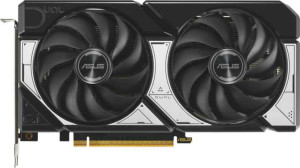
Asus Dual GeForce RTX 5060
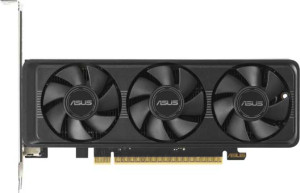
Asus GeForce RTX 5060 LP BRK OC Edition

Asus Dual GeForce RTX 5060 Asus GeForce RTX 5060 LP BRK OC Edition

Overview

When choosing between the Asus Dual GeForce RTX 5060 and the Asus GeForce RTX 5060 LP BRK OC Edition, two key battlegrounds immediately stand out: peak performance headroom and physical form factor. Both cards are built on the same Blackwell architecture and share identical memory hardware, yet they diverge in GPU turbo speeds, port configurations, and notably in their dimensions. This comparison breaks down every specification to help you determine which card is the right fit for your build and display setup.

Common Features

  • Both products share a base GPU clock speed of 2280 MHz.
  • Both products have a GPU memory speed of 1750 MHz.
  • Both products feature 3840 shading units.
  • Both products include 120 texture mapping units (TMUs).
  • Both products have 48 render output units (ROPs).
  • Double Precision Floating Point (DPFP) is supported on both products.
  • Both products use GDDR7 memory with an effective speed of 28000 MHz.
  • Both products offer 8GB of VRAM.
  • Both products have a maximum memory bandwidth of 448 GB/s.
  • Both products use a 128-bit memory bus width.
  • ECC memory is supported on both products.
  • Both products support DirectX 12 Ultimate.
  • Both products support OpenGL version 4.6.
  • Both products support OpenCL version 3.
  • Multi-display technology is supported on both products.
  • Ray tracing is supported on both products.
  • 3D support is available on both products.
  • DLSS is supported on both products.
  • XeSS (XMX) is not available on either product.
  • Both products have an HDMI output.
  • Neither product includes USB-C ports, DVI outputs, or mini DisplayPort outputs.
  • Both products are based on the Blackwell GPU architecture.
  • Both products have a Thermal Design Power (TDP) of 145W.
  • Both products use PCIe version 5.
  • Both products are built on a 5 nm semiconductor process.
  • Both products feature 21900 million transistors.
  • Air-water cooling is not available on either product.

Main Differences

  • GPU turbo clock speed is 2497 MHz on Asus Dual GeForce RTX 5060 and 2550 MHz on Asus GeForce RTX 5060 LP BRK OC Edition.
  • Pixel rate is 119.9 GPixel/s on Asus Dual GeForce RTX 5060 and 122.4 GPixel/s on Asus GeForce RTX 5060 LP BRK OC Edition.
  • Floating-point performance is 19.18 TFLOPS on Asus Dual GeForce RTX 5060 and 19.58 TFLOPS on Asus GeForce RTX 5060 LP BRK OC Edition.
  • Texture rate is 299.6 GTexels/s on Asus Dual GeForce RTX 5060 and 306 GTexels/s on Asus GeForce RTX 5060 LP BRK OC Edition.
  • HDMI port count is 1 on Asus Dual GeForce RTX 5060 and 2 on Asus GeForce RTX 5060 LP BRK OC Edition.
  • HDMI version is 2.1b on Asus Dual GeForce RTX 5060 and 2.1 on Asus GeForce RTX 5060 LP BRK OC Edition.
  • DisplayPort outputs number 3 on Asus Dual GeForce RTX 5060 and 1 on Asus GeForce RTX 5060 LP BRK OC Edition.
  • Card width is 228 mm on Asus Dual GeForce RTX 5060 and 175.8 mm on Asus GeForce RTX 5060 LP BRK OC Edition.
  • Card height is 123 mm on Asus Dual GeForce RTX 5060 and 69 mm on Asus GeForce RTX 5060 LP BRK OC Edition.
Specs Comparison
Asus Dual GeForce RTX 5060

Asus Dual GeForce RTX 5060

Asus GeForce RTX 5060 LP BRK OC Edition

Asus GeForce RTX 5060 LP BRK OC Edition

Performance:
GPU clock speed 2280 MHz 2280 MHz
GPU turbo 2497 MHz 2550 MHz
pixel rate 119.9 GPixel/s 122.4 GPixel/s
floating-point performance 19.18 TFLOPS 19.58 TFLOPS
texture rate 299.6 GTexels/s 306 GTexels/s
GPU memory speed 1750 MHz 1750 MHz
shading units 3840 3840
texture mapping units (TMUs) 120 120
render output units (ROPs) 48 48
Has Double Precision Floating Point (DPFP)

At their core, both the Asus Dual GeForce RTX 5060 and the Asus RTX 5060 LP BRK OC Edition share identical silicon foundations: the same 3,840 shading units, 120 TMUs, 48 ROPs, and a base GPU clock of 2,280 MHz. This means both cards are drawing from the same raw hardware pool and will behave identically under sustained, thermally-constrained workloads.

The meaningful separation appears at boost clock territory. The LP BRK OC Edition reaches a turbo of 2,550 MHz versus the Dual's 2,497 MHz — a 53 MHz advantage that directly lifts every derived metric. Its floating-point throughput of 19.58 TFLOPS edges out the Dual's 19.18 TFLOPS, and its texture rate of 306 GTexels/s versus 299.6 GTexels/s translates to marginally faster geometry and shading throughput in real workloads. In practice, this gap is roughly 2%, which is unlikely to be perceptible in most gaming scenarios but could show up consistently in synthetic benchmarks.

On balance, the LP BRK OC Edition holds a narrow but genuine performance edge in this group, driven entirely by its higher factory overclock on the boost clock. Both cards are otherwise identical in architecture and memory subsystem, so this advantage is consistent rather than situational. Buyers prioritizing peak clock headroom out of the box should lean toward the LP BRK OC Edition, though the real-world gains are modest.

Memory:
effective memory speed 28000 MHz 28000 MHz
maximum memory bandwidth 448 GB/s 448 GB/s
VRAM 8GB 8GB
GDDR version GDDR7 GDDR7
memory bus width 128-bit 128-bit
Supports ECC memory

Memory is where any differentiation between these two cards completely disappears. Both the Asus Dual RTX 5060 and the LP BRK OC Edition carry 8GB of GDDR7 across a 128-bit bus, running at an effective speed of 28,000 MHz for a peak bandwidth of 448 GB/s. Every single memory specification is a perfect match.

That said, the shared specs are worth contextualizing. GDDR7 at 28,000 MHz is a meaningful generational step up from the GDDR6X found on previous-generation mid-range cards, and 448 GB/s of bandwidth helps offset the narrowness of the 128-bit bus — a constraint that could otherwise bottleneck memory-hungry workloads at higher resolutions. ECC memory support on both cards is a minor bonus, adding a layer of data integrity useful in compute or professional workloads rather than gaming.

This group is a dead heat: neither card offers any memory advantage whatsoever. Buyers for whom VRAM capacity or memory bandwidth is the deciding factor will find no reason to prefer one over the other here — the choice must be made on other grounds.

Features:
DirectX version DirectX 12 Ultimate DirectX 12 Ultimate
OpenGL version 4.6 4.6
OpenCL version 3 3
Supports multi-display technology
supports ray tracing
Supports 3D
supports DLSS
has XeSS (XMX)
AMD SAM / Intel Resizable BAR Intel Resizable BAR Intel Resizable BAR
has LHR
has RGB lighting
supported displays 4 4

Feature parity is total between these two cards. Both support DirectX 12 Ultimate and ray tracing, meaning neither is left behind on the API or visual fidelity front — DX12 Ultimate in particular ensures compatibility with the full suite of modern rendering features including mesh shaders and variable-rate shading. DLSS support on both cards is equally significant, giving users access to AI-accelerated upscaling that can meaningfully boost frame rates without a proportional hit to image quality.

A few shared absences are worth noting. Neither card carries LHR restrictions, which is a non-issue for gamers but relevant to compute users. Both lack RGB lighting, which may matter to system builders chasing an aesthetic. On the connectivity side, support for up to 4 simultaneous displays and Intel Resizable BAR on both cards rounds out an identical feature profile.

There is no differentiator to call out in this group — the two cards are a complete tie across every feature. Any decision between them must rest on performance headroom, physical form factor, or pricing rather than software or API capability.

Ports:
has an HDMI output
HDMI ports 1 2
HDMI version HDMI 2.1b HDMI 2.1
DisplayPort outputs 3 1
USB-C ports 0 0
DVI outputs 0 0
mini DisplayPort outputs 0 0

Port configuration is where these two cards diverge most visibly, and the split reflects genuinely different use-case priorities. The Asus Dual RTX 5060 offers 3 DisplayPort outputs and a single HDMI, making it the stronger choice for multi-monitor gaming or productivity setups where DisplayPort is the dominant connection standard — particularly for high-refresh-rate displays. The LP BRK OC Edition flips this, offering 2 HDMI ports and only a single DisplayPort, a layout better suited to users connecting TVs or HDMI-native displays, such as in a living-room or compact build scenario.

The HDMI version difference adds another layer. The Dual carries HDMI 2.1b versus the LP BRK OC Edition's HDMI 2.1 — a subtle but real distinction, as 2.1b introduces incremental improvements over standard 2.1. For the vast majority of users this gap will be invisible in practice, but it does mean the Dual holds the marginally more future-proof single HDMI connection.

Declaring a winner here depends entirely on your setup. For DisplayPort-centric multi-monitor desks, the Dual has a clear structural advantage with its three outputs. For HDMI-heavy environments, the LP BRK OC Edition's dual HDMI layout is more practical. Neither card is objectively superior — they are optimized for different connectivity patterns.

General info:
GPU architecture Blackwell Blackwell
release date May 2025 August 2025
Thermal Design Power (TDP) 145W 145W
PCI Express (PCIe) version 5 5
semiconductor size 5 nm 5 nm
number of transistors 21900 million 21900 million
Has air-water cooling
width 228 mm 175.8 mm
height 123 mm 69 mm

Underneath the surface, these two cards are built from identical silicon: the same Blackwell architecture, a 5 nm manufacturing process, 21.9 billion transistors, and a 145W TDP with PCIe 5.0 support. Thermally and electrically, they make the same demands on a system, which means power supply and cooling infrastructure requirements are interchangeable between them.

The defining difference in this group is physical form factor. The Asus Dual RTX 5060 measures 228 × 123 mm, a standard dual-slot footprint that fits comfortably in most mid-tower and full-tower cases. The LP BRK OC Edition, true to its low-profile designation, comes in at a dramatically smaller 175.8 × 69 mm — roughly half the height. This is not a marginal size difference; it makes the LP BRK OC Edition physically compatible with small form factor and low-profile cases where the Dual simply cannot fit.

The LP BRK OC Edition holds a unique positional advantage here: it unlocks the RTX 5060 for builds where space is the primary constraint, without any change to TDP or architecture. For standard desktop builds, form factor is a non-issue and both cards are equivalent. But for SFF, HTPC, or low-profile workstation cases, the LP BRK OC Edition is the only viable option of the two.

Comparison Summary & Verdict

Both cards deliver the same core Blackwell RTX 5060 experience, sharing 8GB of GDDR7 memory, a 145W TDP, ray tracing, DLSS support, and an identical memory bandwidth of 448 GB/s. The Asus GeForce RTX 5060 LP BRK OC Edition edges ahead on raw output, boasting a higher GPU turbo of 2550 MHz, 19.58 TFLOPS of floating-point performance, and a compact low-profile footprint of just 175.8 x 69 mm, making it the natural choice for small form factor or HTPC builds. Its two HDMI ports also benefit multi-monitor or living-room setups. The Asus Dual GeForce RTX 5060, by contrast, offers three DisplayPort outputs and the newer HDMI 2.1b standard, making it a stronger pick for users with DisplayPort-heavy monitor configurations in a standard full-size chassis.

Asus Dual GeForce RTX 5060
Buy Asus Dual GeForce RTX 5060 if...

Buy the Asus Dual GeForce RTX 5060 if you need three DisplayPort outputs and the newer HDMI 2.1b port for a standard-sized PC build with multiple monitors.

Asus GeForce RTX 5060 LP BRK OC Edition
Buy Asus GeForce RTX 5060 LP BRK OC Edition if...

Buy the Asus GeForce RTX 5060 LP BRK OC Edition if you are building a compact or low-profile system and want a higher GPU turbo clock alongside dual HDMI outputs.