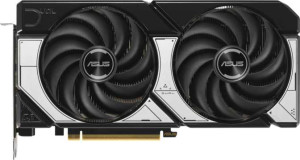
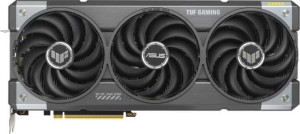
At their core, the Asus Dual RTX 5070 OC and the Asus TUF Gaming RTX 5070 are built on the same silicon foundation: identical base clocks of 2325 MHz, the same 6144 shading units, 192 TMUs, 80 ROPs, and matched memory speeds of 1750 MHz. This means both cards are fundamentally the same GPU, and any performance difference between them comes down to how aggressively each is factory-tuned rather than any architectural distinction.
The one area where the two diverge is the boost clock. The Dual OC Edition reaches a turbo of 2542 MHz versus 2512 MHz on the TUF — a gap of 30 MHz, or roughly 1.2%. This trickles directly into every computed throughput metric: the Dual OC edges ahead with 31.24 TFLOPS of floating-point performance versus 30.87 TFLOPS, a 488.1 GTexels/s texture rate versus 482.3 GTexels/s, and a pixel rate of 203.4 GPixel/s versus 201 GPixel/s. In practice, these differences translate to gains well under 2% across the board — a margin that will be invisible in real-world gaming benchmarks and only barely detectable in sustained compute workloads.
The Dual OC Edition holds a narrow but clear technical edge in this group, purely by virtue of its factory overclock. However, the advantage is marginal enough that it should not be a deciding factor on its own — buyers would need to weigh cooling solution, acoustics, and price to determine whether that small frequency headroom is worth a potential premium.