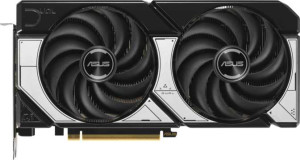
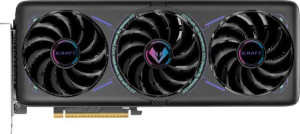
At first glance, the Maxsun RTX 5060 Ti iCraft OC appears competitive thanks to its higher base and boost clocks — 2407 MHz / 2662 MHz versus the Asus RTX 5070's 2325 MHz / 2512 MHz. Clock speed alone, however, is a poor proxy for raw throughput; what matters is how many execution units those clocks are driving. The RTX 5070 fields 6144 shading units, 192 TMUs, and 80 ROPs, compared to 4608 / 144 / 48 on the 5060 Ti — a lead of roughly 33% in every dimension of the rendering pipeline.
Those architectural advantages translate directly into real-world output numbers. The RTX 5070 delivers 30.87 TFLOPS of floating-point performance against the 5060 Ti's 24.53 TFLOPS — a ~26% gap that will be felt in compute-heavy workloads like ray tracing, AI-accelerated features, and shader-intensive scenes. The pixel rate advantage is even more pronounced: 201 GPixel/s versus 127.8 GPixel/s, a ~57% difference that directly affects how quickly the GPU can resolve and output final pixels at high resolutions. This makes the 5070 noticeably more capable at 4K, where fill-rate pressure is highest. Texture throughput tells a similar story — 482.3 GTexels/s on the 5070 versus 383.3 GTexels/s on the 5060 Ti.
Both cards share identical 1750 MHz memory bus speeds and both support Double Precision Floating Point, so neither holds an edge there. Overall, the Asus RTX 5070 holds a clear and substantial performance advantage across every meaningful throughput metric in this group. The 5060 Ti's higher clocks are a compensatory tuning choice that narrows but does not close the gap imposed by its smaller GPU silicon.