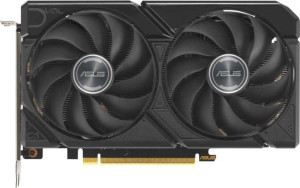
Asus Dual Radeon RX 9060 XT 16GB
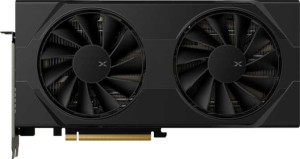
XFX Swift Radeon RX 9060 XT OC Gaming Edition 16GB

Asus Dual Radeon RX 9060 XT 16GB XFX Swift Radeon RX 9060 XT OC Gaming Edition 16GB

Overview

Welcome to our in-depth spec comparison between the Asus Dual Radeon RX 9060 XT 16GB and the XFX Swift Radeon RX 9060 XT OC Gaming Edition 16GB. Both cards share the same RDNA 4.0 foundation, 16GB of GDDR6 memory, and a full feature set including ray tracing and FSR4, yet they take noticeably different approaches to clock speeds and physical dimensions. Read on to see how these two RX 9060 XT variants stack up across performance, memory throughput, and form factor.

Common Features

  • Both cards share the same GPU memory speed of 2518 MHz.
  • Both cards feature 2048 shading units.
  • Both cards include 128 texture mapping units (TMUs).
  • Both cards have 64 render output units (ROPs).
  • Double Precision Floating Point (DPFP) is supported on both cards.
  • Both cards use an effective memory speed of 20000 MHz.
  • Both cards come with 16GB of VRAM.
  • Both cards use GDDR6 memory.
  • Both cards have a 128-bit memory bus width.
  • ECC memory is supported on both cards.
  • Both cards support DirectX 12 Ultimate.
  • Both cards support OpenGL version 4.6.
  • Both cards support OpenCL version 2.2.
  • Multi-display technology is supported on both cards.
  • Ray tracing is supported on both cards.
  • 3D support is available on both cards.
  • DLSS is not supported on either card.
  • FSR4 is available on both cards.
  • Both cards include one HDMI 2.1b port and two DisplayPort outputs, with no USB-C or DVI outputs.
  • Both cards are built on the RDNA 4.0 architecture with a 4 nm semiconductor process, a TDP of 160W, PCIe 5 interface, and 29700 million transistors.
  • Neither card uses air-water cooling.

Main Differences

  • GPU base clock speed is 1700 MHz on the Asus Dual Radeon RX 9060 XT 16GB and 1900 MHz on the XFX Swift Radeon RX 9060 XT OC Gaming Edition 16GB.
  • GPU turbo clock is 3230 MHz on the Asus Dual Radeon RX 9060 XT 16GB and 3320 MHz on the XFX Swift Radeon RX 9060 XT OC Gaming Edition 16GB.
  • Pixel rate is 206.7 GPixel/s on the Asus Dual Radeon RX 9060 XT 16GB and 212.5 GPixel/s on the XFX Swift Radeon RX 9060 XT OC Gaming Edition 16GB.
  • Floating-point performance is 26.46 TFLOPS on the Asus Dual Radeon RX 9060 XT 16GB and 27.2 TFLOPS on the XFX Swift Radeon RX 9060 XT OC Gaming Edition 16GB.
  • Texture rate is 413.4 GTexels/s on the Asus Dual Radeon RX 9060 XT 16GB and 425 GTexels/s on the XFX Swift Radeon RX 9060 XT OC Gaming Edition 16GB.
  • Maximum memory bandwidth is 322.3 GB/s on the Asus Dual Radeon RX 9060 XT 16GB and 340 GB/s on the XFX Swift Radeon RX 9060 XT OC Gaming Edition 16GB.
  • Card width is 202 mm on the Asus Dual Radeon RX 9060 XT 16GB and 270 mm on the XFX Swift Radeon RX 9060 XT OC Gaming Edition 16GB.
  • Card height is 120 mm on the Asus Dual Radeon RX 9060 XT 16GB and 124 mm on the XFX Swift Radeon RX 9060 XT OC Gaming Edition 16GB.
Specs Comparison
Asus Dual Radeon RX 9060 XT 16GB

Asus Dual Radeon RX 9060 XT 16GB

XFX Swift Radeon RX 9060 XT OC Gaming Edition 16GB

XFX Swift Radeon RX 9060 XT OC Gaming Edition 16GB

Performance:
GPU clock speed 1700 MHz 1900 MHz
GPU turbo 3230 MHz 3320 MHz
pixel rate 206.7 GPixel/s 212.5 GPixel/s
floating-point performance 26.46 TFLOPS 27.2 TFLOPS
texture rate 413.4 GTexels/s 425 GTexels/s
GPU memory speed 2518 MHz 2518 MHz
shading units 2048 2048
texture mapping units (TMUs) 128 128
render output units (ROPs) 64 64
Has Double Precision Floating Point (DPFP)

Both cards share the same core silicon architecture — identical 2048 shading units, 128 TMUs, and 64 ROPs — meaning any performance gap between them comes purely from clock speeds, not from hardware configuration differences. This is a factory overclock situation: the XFX Swift ships with a higher base clock of 1900 MHz versus the Asus Dual's 1700 MHz, and a higher boost ceiling of 3320 MHz versus 3230 MHz. In practice, base clock differences matter less in gaming since GPUs spend most of their time near boost, but a higher base does reduce the risk of clock dips during sustained workloads.

The clock advantage translates directly into every throughput metric. The XFX edges ahead with 27.2 TFLOPS of floating-point performance versus 26.46 TFLOPS, and a texture rate of 425 GTexels/s compared to 413.4 GTexels/s. These are roughly a 2.8–3% uplift across the board — real, but modest. In gaming, this margin typically translates to a few frames per second at most, an improvement that will be measurable in benchmarks but unlikely to be perceptible in everyday use. Memory throughput is a non-issue: both cards run identical 2518 MHz GDDR memory, so bandwidth is not a differentiating factor.

The XFX Swift holds a clear, if narrow, performance edge in this group strictly on the basis of its factory overclock. If raw peak throughput is the priority, it wins. That said, the Asus Dual operates on the same die with the same memory subsystem, and the gap is small enough that real-world gaming differences will be marginal — thermal behavior, power limits, and driver conditions could easily close it under sustained load.
Memory:
effective memory speed 20000 MHz 20000 MHz
maximum memory bandwidth 322.3 GB/s 340 GB/s
VRAM 16GB 16GB
GDDR version GDDR6 GDDR6
memory bus width 128-bit 128-bit
Supports ECC memory

At the foundation, these two cards share an identical memory configuration: 16GB of GDDR6 across a 128-bit bus at the same 20000 MHz effective speed. The 16GB allocation is a meaningful advantage for this GPU tier — it provides substantial headroom for high-resolution texture packs, VRAM-hungry titles at 1440p, and future-proofing against creeping memory requirements in modern games.

The one divergence surfaces in maximum memory bandwidth: the XFX Swift is rated at 340 GB/s versus 322.3 GB/s for the Asus Dual — a gap of roughly 5.5%. This is notable because both cards report the same effective memory speed, suggesting the bandwidth difference likely stems from how each manufacturer calculates or reports the figure rather than a physical hardware distinction. Given identical bus width and memory clock, the theoretical bandwidth ceiling should be the same for both; the discrepancy warrants some skepticism and should not be treated as a guaranteed real-world advantage.

On memory, these cards are effectively tied in practical terms. The shared GDDR6 spec, capacity, and bus width mean both will behave identically under memory-bound workloads. The bandwidth figure on paper favors the XFX Swift, but given the likely reporting inconsistency, it is not a reliable basis for a purchasing decision in this category.

Features:
DirectX version DirectX 12 Ultimate DirectX 12 Ultimate
OpenGL version 4.6 4.6
OpenCL version 2.2 2.2
Supports multi-display technology
supports ray tracing
Supports 3D
supports DLSS
has FSR4
has XeSS (XMX)
AMD SAM / Intel Resizable BAR AMD SAM AMD SAM
has LHR
has RGB lighting
supported displays 3 3

Feature parity is total here — every single spec in this group is identical across both cards. The highlights worth understanding: both support DirectX 12 Ultimate, which unlocks the full suite of modern rendering features including hardware-accelerated ray tracing, mesh shaders, and variable rate shading. These are not just checkbox features; ray tracing support in particular is increasingly relevant as more titles implement it for lighting and shadow realism.

On the upscaling front, both cards support FSR4 — AMD's latest spatial and machine-learning-based upscaling technology — while lacking DLSS (an Nvidia-exclusive) and XeSS XMX (Intel's matrix-accelerated variant). FSR4 is a meaningful generational step up from FSR 3, and its availability on both cards ensures competitive image quality scaling at 1440p and beyond. AMD SAM (Smart Access Memory) support is also shared, which can provide a meaningful performance uplift when paired with a compatible AMD Ryzen platform by allowing the CPU full access to the GPU's VRAM.

This group is an unambiguous tie. There is not a single feature advantage on either side — buyers choosing between these two cards can do so entirely on the basis of price, cooling, and clock speed, knowing the feature sets are completely interchangeable.

Ports:
has an HDMI output
HDMI ports 1 1
HDMI version HDMI 2.1b HDMI 2.1b
DisplayPort outputs 2 2
USB-C ports 0 0
DVI outputs 0 0
mini DisplayPort outputs 0 0

Port configurations are mirror images of each other: both cards offer 1 HDMI 2.1b and 2 DisplayPort outputs, totaling three display connections — which aligns with the three supported displays noted in the features group. The absence of USB-C, DVI, or mini DisplayPort outputs is consistent across both, keeping the I/O bracket clean and modern.

The HDMI 2.1b standard is worth highlighting — it supports up to 4K at 144Hz or 8K at 60Hz with DSC, and crucially includes full Variable Refresh Rate (VRR) support for living-room gaming setups where DisplayPort may not be an option. The dual DisplayPort outputs, meanwhile, are well-suited for high-refresh-rate 1440p or 4K PC monitor configurations, particularly for users running a multi-monitor productivity or gaming setup.

No differentiation exists in this category — it is a complete tie. Connectivity decisions will have no bearing on choosing between these two cards.

General info:
GPU architecture RDNA 4.0 RDNA 4.0
release date June 2025 June 2025
Thermal Design Power (TDP) 160W 160W
PCI Express (PCIe) version 5 5
semiconductor size 4 nm 4 nm
number of transistors 29700 million 29700 million
Has air-water cooling
width 202 mm 270 mm
height 120 mm 124 mm

Under the hood, these two cards are built from the same blueprint: identical RDNA 4.0 architecture, the same 4nm process node, the same transistor count, and a shared 160W TDP. The 160W power envelope is notably efficient for this performance tier, meaning both cards should run cool and quiet without demanding exotic case airflow or high-wattage power supplies.

The one meaningful divergence in this group is physical size. The Asus Dual measures 202mm long, while the XFX Swift stretches to 270mm — a 68mm difference that is far from trivial. For users with compact mid-tower or mini-ITX builds, that gap could determine whether a card physically fits. The Asus Dual's shorter length is a genuine practical advantage in space-constrained systems, while the XFX Swift's larger footprint likely accommodates a bigger cooler, which may contribute to better thermal headroom under sustained load — though thermal performance data is not part of this group's specs.

For most full-size ATX builds the size difference is a non-issue, but for anyone working with a smaller chassis, the Asus Dual holds a clear edge in this category on the basis of its significantly more compact form factor.

Comparison Summary & Verdict

Both cards deliver the same core experience: RDNA 4.0 architecture, 16GB of GDDR6 memory, ray tracing, FSR4, and identical display output configurations. However, the differences are meaningful for the right buyer. The XFX Swift OC Gaming Edition holds a consistent performance edge thanks to its higher base and turbo clocks (1900 MHz and 3320 MHz respectively), translating into a lead in floating-point performance (27.2 vs 26.46 TFLOPS) and memory bandwidth (340 vs 322.3 GB/s). The Asus Dual, on the other hand, is notably more compact at just 202 mm in length, making it a strong fit for smaller builds where clearance is limited. Choose the XFX for maximum out-of-the-box performance; choose the Asus for a compact, space-efficient build without sacrificing the full RX 9060 XT feature set.

Asus Dual Radeon RX 9060 XT 16GB
Buy Asus Dual Radeon RX 9060 XT 16GB if...

Buy the Asus Dual Radeon RX 9060 XT 16GB if you need a compact card that fits small or mid-tower builds, as its 202 mm length is significantly shorter than its rival while still delivering the full RX 9060 XT feature set.

XFX Swift Radeon RX 9060 XT OC Gaming Edition 16GB
Buy XFX Swift Radeon RX 9060 XT OC Gaming Edition 16GB if...

Buy the XFX Swift Radeon RX 9060 XT OC Gaming Edition 16GB if you want the best out-of-the-box performance, as its higher clock speeds, greater floating-point throughput, and wider memory bandwidth give it a measurable edge over the Asus Dual.