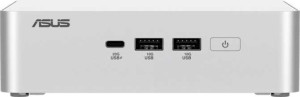
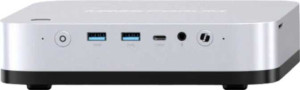
At the shader and rasterization level, these two integrated GPUs are virtually identical — both pack 1024 shading units, 64 TMUs, and 32 ROPs, and both cap out at four simultaneous displays with full DirectX 12 Ultimate and OpenGL 4.6 support. For typical iGPU workloads like light gaming, video playback, or driving a multi-monitor productivity setup, users will find the experience largely comparable on paper.
The differentiators emerge at the architecture level. The Minisforum AI X1 Pro holds a raw clock speed advantage with a GPU turbo of 2900 MHz versus 2300 MHz on the NUC 15 Pro Plus — a 26% gap that can translate to noticeably higher sustained frame rates in GPU-limited scenarios. However, the Asus NUC 15 Pro Plus counters with a 3nm fabrication process versus 4nm, meaning it achieves its performance more efficiently, with better transistor density and lower heat output per compute unit. It also features PCIe 5 connectivity versus PCIe 4 on the AI X1 Pro, offering double the theoretical bandwidth — relevant if future GPU or storage expansion is a consideration.
The NUC 15 Pro Plus further benefits from OpenCL 3.0 support compared to the AI X1 Pro's 2.1, which matters for GPU-accelerated compute tasks like image processing or AI workloads that leverage OpenCL. Weighing all factors, the AI X1 Pro has the edge in raw graphical throughput, but the NUC 15 Pro Plus holds a broader architectural advantage — newer process node, faster interconnect, and more capable compute API support make it the stronger choice for users who care about efficiency and compute versatility alongside graphics output.