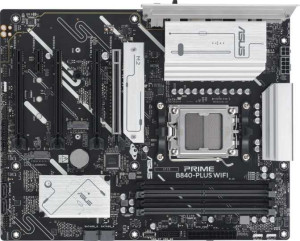
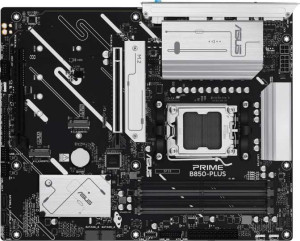
Both boards share the same AM5 socket, ATX form factor, and identical dimensions of 244 × 305 mm, meaning they are drop-in compatible with the same cases and support the same current-generation AMD processors. They also match on key convenience features — dual BIOS, easy BIOS reset, RGB lighting, overclocking support, and a 3-year warranty — so neither has an edge in terms of build confidence or platform fundamentals.
The most meaningful distinction lies in the chipset and connectivity. The Prime B840-Plus WiFi pairs its slightly lower-tier B840 chipset with built-in Wi-Fi and Bluetooth, while the Prime B850-Plus steps up to the B850 chipset — which generally offers more PCIe lanes, better USB bandwidth allocation, and broader overclocking headroom — but ships with no wireless connectivity whatsoever. This is a deliberate trade-off: the B850 board targets users who intend to use a wired network and may already have a dedicated wireless card, whereas the B840 board prioritizes out-of-the-box convenience for wireless users.
In terms of general-info edge, the right choice depends entirely on the user's setup. If wireless connectivity matters and the system will sit away from an ethernet port, the Prime B840-Plus WiFi wins outright — adding a Wi-Fi card later adds cost and consumes a PCIe slot. However, for users building a wired workstation or gaming rig who want the stronger chipset foundation, the Prime B850-Plus holds the platform advantage. Neither product has integrated graphics or an integrated CPU, so both strictly require a discrete GPU or a processor with a built-in iGPU.