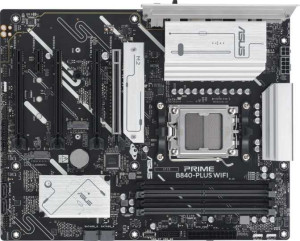
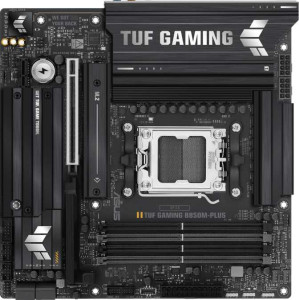
Both boards target the AMD AM5 platform, but they diverge in meaningful ways starting with their chipsets and physical footprint. The Prime B840-Plus WiFi uses the B840 chipset and comes in a full ATX form factor (305 × 244 mm), while the TUF Gaming B850M-Plus steps up to the B850 chipset and shrinks into a Micro-ATX footprint (244 × 244 mm). The B850 chipset generally offers more connectivity headroom — additional PCIe lanes and USB bandwidth — which matters if you plan to stack NVMe drives or high-speed peripherals. The ATX size of the Prime, on the other hand, typically translates to more expansion slots and better VRM airflow spacing, advantages that are independent of chipset tier.
The most practical day-to-day differentiator is wireless connectivity. The Prime B840-Plus WiFi includes both Wi-Fi and Bluetooth, while the TUF Gaming B850M-Plus has neither. For a desktop tucked near an Ethernet port this may be irrelevant, but for builds where running a cable is inconvenient — or where Bluetooth peripherals like headsets and controllers are part of the setup — the Prime's built-in wireless is a tangible convenience advantage that would otherwise require an add-in card on the TUF board. The Prime also supports easy BIOS reset, whereas the TUF does not, a small but welcome feature during troubleshooting or after a failed overclock. Both boards share dual BIOS, RGB lighting, HDMI 2.1 output, a 3-year warranty, and overclocking support, so those points are a wash.
In summary, the two boards suit different priorities. The TUF Gaming B850M-Plus holds a chipset advantage and a compact size suited for smaller cases, appealing to builders who want slightly more I/O ceiling in a tighter package and have no need for wireless. The Prime B840-Plus WiFi wins on convenience features — integrated Wi-Fi and Bluetooth, easier BIOS recovery, and a larger PCB with more room for components — making it the stronger all-rounder for typical desktop builds, especially where wireless connectivity matters.