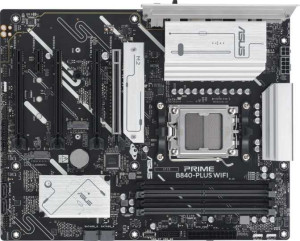
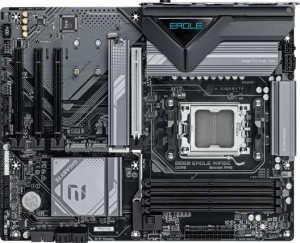
Both the Asus Prime B840-Plus WiFi and the Gigabyte B850 Eagle WiFi6E share the same AM5 socket, ATX form factor, and identical dimensions, making them direct platform competitors for AMD Ryzen builds. They also match on wireless connectivity — both support up to Wi-Fi 6E and Bluetooth 5.3 — and both offer HDMI 2.1 output, dual BIOS, and a 3-year warranty. For the everyday builder, these shared traits mean a very similar baseline experience in terms of physical fit, connectivity, and long-term support.
The most meaningful hardware difference lies in the chipset: the Gigabyte uses the newer B850, while the Asus runs on the B840. In AMD's lineup, B850 sits above B840, typically offering more PCIe lanes, broader overclocking support, and greater future-proofing for high-bandwidth peripherals. Both boards are listed as easy to overclock, but B850's architectural headroom gives the Gigabyte a structural edge for users pushing their platform harder. On the other hand, the Asus counters with two usability-focused advantages: RGB lighting and an easy BIOS reset mechanism — neither of which the Gigabyte offers. The BIOS reset feature in particular is underrated; it simplifies recovery from a bad overclock or failed update without needing extra hardware.
In this general info category, neither board is a clear overall winner — it depends on priorities. The Gigabyte B850 Eagle has the edge for users who want a more capable chipset and don't care about aesthetics or BIOS convenience. The Asus Prime B840-Plus WiFi is better suited to builders who value ease of use and system personalization via RGB, while accepting a slightly less capable chipset tier.