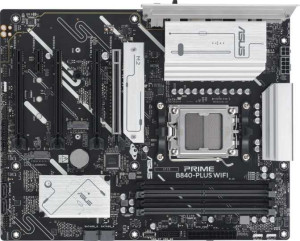
Asus Prime B840-Plus WiFi
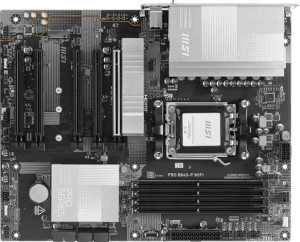
MSI Pro B840-P WiFi

Asus Prime B840-Plus WiFi MSI Pro B840-P WiFi

Overview

Welcome to our detailed spec comparison of the Asus Prime B840-Plus WiFi and the MSI Pro B840-P WiFi — two AM5 motherboards built on the B840 chipset that share a surprisingly strong common foundation. While both target the same ATX platform with DDR5 memory support, Wi-Fi, and Bluetooth, they diverge in meaningful ways across wireless standards, memory capacity, expansion flexibility, and storage connectivity. Read on to discover which board best matches your build goals.

Common Features

  • Both boards use the AM5 CPU socket.
  • Both boards feature the B840 chipset.
  • Both boards come in the ATX form factor.
  • Wi-Fi connectivity is available on both boards.
  • Bluetooth is available on both boards.
  • Both boards include an HDMI 2.1 output.
  • Both boards support overclocking.
  • RGB lighting is present on both boards.
  • Both boards have 4 memory slots.
  • Both boards use DDR5 memory.
  • Both boards operate on a dual-channel memory configuration.
  • ECC memory is not supported on either board.
  • Both boards provide 1 USB 3.2 Gen 2 port (USB-A), 2 USB 3.2 Gen 1 ports (USB-A), 1 USB 3.2 Gen 2 port (USB-C), and 4 USB 2.0 ports on the rear I/O.
  • Neither board includes USB 3.2 Gen 2x2, USB 4 40Gbps, or USB 4 20Gbps ports.
  • Both boards offer 4 SATA 3 connectors and 6 fan headers.
  • A TPM connector is present on both boards.
  • Neither board includes a U.2 socket or an mSATA connector.
  • Both boards include 1 PCIe 4.0 x16 slot and no PCIe 5.0 x16 slots.
  • Both boards deliver 7.1-channel audio with 3 audio connectors and no S/PDIF Out port.
  • Both boards support RAID 0, RAID 1, and RAID 10, but neither supports RAID 0+1.

Main Differences

  • Wi-Fi version reaches Wi-Fi 6E (802.11ax) on the Asus Prime B840-Plus WiFi, while the MSI Pro B840-P WiFi extends support up to Wi-Fi 7 (802.11be).
  • Bluetooth version is 5.3 on the Asus Prime B840-Plus WiFi and 5.4 on the MSI Pro B840-P WiFi.
  • The board height is 244 mm on the Asus Prime B840-Plus WiFi and 243.8 mm on the MSI Pro B840-P WiFi.
  • The board width is 305 mm on the Asus Prime B840-Plus WiFi and 304.8 mm on the MSI Pro B840-P WiFi.
  • Maximum supported memory is 192 GB on the Asus Prime B840-Plus WiFi and 256 GB on the MSI Pro B840-P WiFi.
  • Maximum overclocked RAM speed is 7600 MHz on the Asus Prime B840-Plus WiFi and 8000 MHz on the MSI Pro B840-P WiFi.
  • DisplayPort output is present on the Asus Prime B840-Plus WiFi but not available on the MSI Pro B840-P WiFi.
  • M.2 sockets number 3 on the Asus Prime B840-Plus WiFi and 2 on the MSI Pro B840-P WiFi.
  • PCIe 3.0 x16 slots total 3 on the Asus Prime B840-Plus WiFi and 1 on the MSI Pro B840-P WiFi.
  • PCIe x1 slots are absent on the Asus Prime B840-Plus WiFi, while the MSI Pro B840-P WiFi provides 3.
  • RAID 5 support is present on the Asus Prime B840-Plus WiFi but not available on the MSI Pro B840-P WiFi.
Specs Comparison
Asus Prime B840-Plus WiFi

Asus Prime B840-Plus WiFi

MSI Pro B840-P WiFi

MSI Pro B840-P WiFi

General info:
CPU socket AM5 AM5
chipset B840 B840
form factor ATX ATX
release date January 2025 January 2025
supports Wi-Fi
Wi-Fi version Wi-Fi 4 (802.11n), Wi-Fi 5 (802.11ac), Wi-Fi 6 (802.11ax), Wi-Fi 6E (802.11ax) Wi-Fi 4 (802.11n), Wi-Fi 5 (802.11ac), Wi-Fi 6 (802.11ax), Wi-Fi 6E (802.11ax), Wi-Fi 7 (802.11be)
Has Bluetooth
Bluetooth version 5.3 5.4
HDMI version HDMI 2.1 HDMI 2.1
Easy to overclock
has RGB lighting
Easy to reset BIOS
Has dual BIOS
has aptX
CPU sockets 1 1
Has integrated graphics
warranty period 3 years 3 years
height 244 mm 243.8 mm
width 305 mm 304.8 mm
Has integrated CPU

Both boards share the same foundational identity: AM5 socket, B840 chipset, standard ATX form factor, and near-identical dimensions — a difference of just 0.2 mm in each direction. They also match on every major feature checkbox: Wi-Fi, Bluetooth, HDMI 2.1, RGB lighting, dual BIOS, easy BIOS reset, and overclocking support. For most buyers, this common ground covers everything that matters at a glance.

The real differentiation sits in wireless connectivity. The MSI Pro B840-P WiFi supports Wi-Fi 7 (802.11be), while the Asus Prime B840-Plus WiFi tops out at Wi-Fi 6E. In practice, Wi-Fi 7 delivers significantly higher theoretical throughput and lower latency — relevant if you own a Wi-Fi 7 router today or plan to upgrade soon. Similarly, the MSI edges ahead with Bluetooth 5.4 versus 5.3 on the Asus; the newer version brings modest improvements in connection stability and power efficiency, though the real-world impact is subtle for most users.

On general specs alone, the MSI Pro B840-P WiFi holds a clear edge thanks to its newer wireless stack. Both boards carry a 3-year warranty and are otherwise functionally equivalent in this category, so if future-proofing your wireless connectivity matters — particularly Wi-Fi 7 readiness — the MSI is the stronger pick here.

Memory:
maximum memory amount 192GB 256GB
overclocked RAM speed 7600 MHz 8000 MHz
memory slots 4 4
DDR memory version 5 5
memory channels 2 2
Supports ECC memory

The Asus Prime B840-Plus WiFi and MSI Pro B840-P WiFi both support DDR5 memory with 4 memory slots and 2 memory channels, making them suitable for modern memory configurations. The maximum supported memory differs, with the Asus board supporting up to 192GB, while the MSI board allows for a higher maximum of 256GB.

In terms of overclocked RAM speeds, the Asus Prime B840-Plus WiFi supports a maximum of 7600 MHz, whereas the MSI Pro B840-P WiFi offers a slightly higher maximum of 8000 MHz. Both motherboards do not support ECC memory, ensuring they are aimed at general use and gaming setups rather than specialized workloads requiring error-correcting memory.

While both motherboards are quite similar in their base memory features, the key difference lies in their maximum memory capacity and overclocked RAM speed, with the MSI board offering higher performance potential in these areas.

Ports:
USB 3.2 Gen 2 ports (USB-A) 1 1
USB 3.2 Gen 1 ports (USB-A) 2 2
USB 3.2 Gen 2 ports (USB-C) 1 1
USB 3.2 Gen 1 ports (USB-C) 0 0
USB 2.0 ports 4 4
USB 3.2 Gen 2x2 ports 0 0
USB 4 40Gbps ports 0 0
USB 4 20Gbps ports 0 0
Thunderbolt 4 ports 0 0
Thunderbolt 3 ports 0 0
has an HDMI output
DisplayPort outputs 1 0
RJ45 ports 1 1
Has USB Type-C
eSATA ports 0 0
DVI outputs 0 0
has a VGA connector
PS/2 ports 0 0

The Asus Prime B840-Plus WiFi and MSI Pro B840-P WiFi have similar port configurations, with both offering a mix of USB 3.2 Gen 2 and Gen 1 ports, including one USB 3.2 Gen 2 USB-A port and one USB 3.2 Gen 2 USB-C port. Both motherboards also feature two USB 3.2 Gen 1 USB-A ports and four USB 2.0 ports, ensuring flexibility for a variety of devices. Neither of these boards includes USB 3.2 Gen 2x2, USB 4, or Thunderbolt ports.

Both boards are equipped with an HDMI output, though the Asus model provides a DisplayPort output, while the MSI version does not. They both include one RJ45 port for network connectivity. In terms of video output, neither motherboard has a VGA connector, and neither features PS/2 or eSATA ports.

Overall, the port offerings are quite similar between the two models, with the key distinction being the DisplayPort output on the Asus board, which the MSI board lacks. Both also support USB Type-C, with no significant differences in the USB configuration.

Connectors:
USB 3.2 Gen 1 ports (through expansion) 2 2
USB 2.0 ports (through expansion) 4 4
SATA 3 connectors 4 4
fan headers 6 6
USB 3.0 ports (through expansion) 2 2
M.2 sockets 3 2
Has TPM connector
U.2 sockets 0 0
Has mSATA connector
SATA 2 connectors 0 0

The Asus Prime B840-Plus WiFi and MSI Pro B840-P WiFi share several similar features in their connectors. Both motherboards offer two USB 3.2 Gen 1 ports and four USB 2.0 ports through expansion, as well as two USB 3.0 ports through expansion. They also come with four SATA 3 connectors and six fan headers, providing good support for additional storage and cooling options.

The Asus board includes three M.2 sockets, whereas the MSI board has two M.2 sockets. Both motherboards feature a TPM connector, while neither includes mSATA connectors or U.2 sockets. Additionally, both motherboards do not support SATA 2 connectors.

Overall, the main difference between the two products in this group is the number of M.2 sockets, with the Asus board offering one more M.2 socket than the MSI board. All other connector features are identical across both models.

Expansion slots:
PCIe 4.0 x16 slots 1 1
PCIe 5.0 x16 slots 0 0
PCIe 3.0 x16 slots 3 1
PCIe x1 slots 0 3
PCI slots 0 0
PCIe 2.0 x16 slots 0 0
PCIe x4 slots 0 0
PCIe x8 slots 0 0

The Asus Prime B840-Plus WiFi and MSI Pro B840-P WiFi have some similarities and differences in their expansion slot configurations. Both motherboards feature one PCIe 4.0 x16 slot, but the Asus model includes three PCIe 3.0 x16 slots, while the MSI board only has one. The MSI board, however, provides three PCIe x1 slots, whereas the Asus board does not have any PCIe x1 slots.

Neither of the boards includes PCIe x4, PCIe x8, or PCI slots. Both motherboards also do not have PCIe 2.0 x16 slots. Neither motherboard features a PCIe 5.0 x16 slot.

Overall, the Asus board offers more PCIe 3.0 x16 slots, while the MSI board compensates with more PCIe x1 slots, providing different options depending on your expansion needs.

Audio:
audio channels 7.1 7.1
Has S/PDIF Out port
audio connectors 3 3

Both the Asus Prime B840-Plus WiFi and MSI Pro B840-P WiFi offer similar audio features, with both supporting 7.1 audio channels. Neither motherboard includes an S/PDIF Out port. Both boards also feature three audio connectors, providing the same connectivity options for audio devices.

There are no differences between the two products in terms of their audio capabilities, as both offer the same number of audio channels, connectors, and lack of S/PDIF Out support.

Overall, the audio specifications for these two motherboards are identical, offering equivalent functionality for users seeking standard audio performance.

Storage:
Supports RAID 1
Supports RAID 10 (1+0)
Supports RAID 5
Supports RAID 0
Supports RAID 0+1

The Asus Prime B840-Plus WiFi and MSI Pro B840-P WiFi both support RAID 1, RAID 10 (1+0), and RAID 0 configurations, providing flexibility for various storage setups. However, the Asus board also supports RAID 5, while the MSI board does not. Neither of the boards supports RAID 0+1, meaning users won’t be able to use this particular RAID configuration on either motherboard.

In terms of RAID support, the primary difference between the two models is the inclusion of RAID 5 on the Asus Prime B840-Plus WiFi, which offers an additional level of data redundancy compared to the MSI Pro B840-P WiFi.

Overall, while both boards offer the most common RAID configurations, the Asus board provides slightly more storage options due to its support for RAID 5.

Comparison Summary & Verdict

Both the Asus Prime B840-Plus WiFi and the MSI Pro B840-P WiFi are capable B840-platform boards with a shared core feature set, but their differences point them toward distinct audiences. The Asus Prime B840-Plus WiFi stands out for builders who need more storage flexibility, offering 3 M.2 sockets, a DisplayPort output, RAID 5 support, and 3 PCIe 3.0 x16 slots for multi-card configurations. The MSI Pro B840-P WiFi, on the other hand, appeals to users who want cutting-edge wireless with Wi-Fi 7 and Bluetooth 5.4, a higher maximum RAM capacity of 256 GB, and faster overclocked memory speeds of up to 8000 MHz — making it the stronger choice for memory-intensive and future-focused workloads.

Asus Prime B840-Plus WiFi
Buy Asus Prime B840-Plus WiFi if...

Buy the Asus Prime B840-Plus WiFi if you need more storage options with 3 M.2 sockets, a DisplayPort output on the rear I/O, or RAID 5 support for your build.

MSI Pro B840-P WiFi
Buy MSI Pro B840-P WiFi if...

Buy the MSI Pro B840-P WiFi if you want the latest Wi-Fi 7 connectivity, Bluetooth 5.4, support for up to 256 GB of RAM, and faster overclocked memory speeds of up to 8000 MHz.