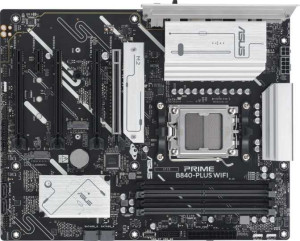
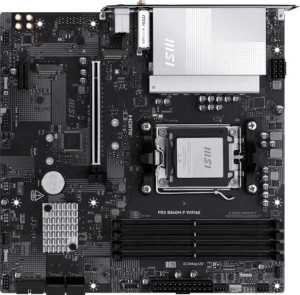
Both boards share the same AM5 socket and B840 chipset, meaning they target the same generation of AMD processors with identical platform-level capabilities. Connectivity is also a wash: both include Wi-Fi 6E (covering 802.11n/ac/ax across 2.4, 5, and 6 GHz bands), Bluetooth 5.3, and HDMI 2.1, so neither board holds an edge in wireless or display output. The 3-year warranty and shared features like RGB lighting, easy BIOS reset, and overclock support further level the playing field at a platform level.
The clearest split between these two boards is form factor. The Asus Prime B840-Plus WiFi is a full ATX board at 305 × 244 mm, while the MSI Pro B840M-P Wi-Fi6E is a Micro-ATX at 243.8 × 243.8 mm. In practical terms, ATX opens up more room for expansion slots, better airflow routing, and greater headroom for large cooling solutions, whereas Micro-ATX trades that flexibility for a smaller chassis footprint — useful in compact or space-constrained builds.
The other meaningful differentiator is dual BIOS: the Asus board includes it, the MSI does not. Dual BIOS acts as a hardware-level safety net — if a firmware update goes wrong or the BIOS becomes corrupted, the board can recover automatically from a backup chip without user intervention. For builders who plan to update firmware or experiment with settings, this is a tangible reliability advantage. Overall, the Asus Prime B840-Plus WiFi holds a clear edge in this group: it offers a more expandable form factor and the added resilience of dual BIOS, with no trade-offs in connectivity or platform features compared to the MSI.