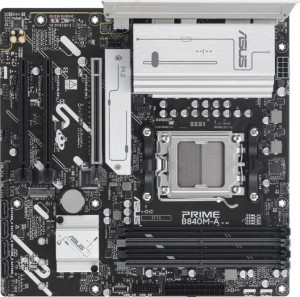
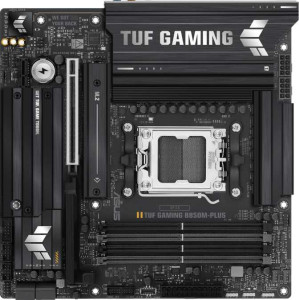
At the foundational level, the Asus Prime B840M-A and the Asus TUF Gaming B850M-Plus share a nearly identical general profile. Both are Micro-ATX boards built around the AM5 socket, making them compatible with the same generation of AMD processors. Their physical footprint is identical at 244 × 244 mm, they both output video via HDMI 2.1, support overclocking, feature RGB lighting, include a dual BIOS chip for firmware redundancy, and come backed by a 3-year warranty. Neither board integrates Wi-Fi, Bluetooth, or a built-in CPU, so users on both platforms will need to factor in discrete networking and a separate processor purchase.
The only meaningful differentiator within this spec group is easy BIOS reset: the Prime B840M-A supports it, while the TUF Gaming B850M-Plus does not. In practice, a dedicated BIOS reset mechanism — typically a physical button or a clear-CMOS header accessible without fully disassembling the system — is genuinely useful when an overclock goes wrong or a firmware update leaves the board unbootable. Without it, recovering a bricked BIOS on the TUF board may require removing the CMOS battery or using jumper pins, which is a more involved process, especially in compact Micro-ATX builds where access can be tight.
For this spec group, the Prime B840M-A holds a narrow but practical edge thanks to its easier BIOS reset capability. Both boards are otherwise evenly matched on all general specifications, so this advantage is most relevant to builders who plan to push overclocking limits or experiment with BIOS settings frequently. Casual users who set and forget their BIOS will find the two boards effectively tied here.