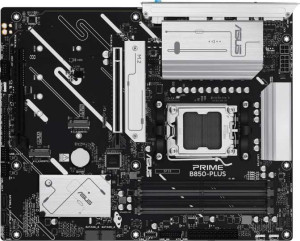
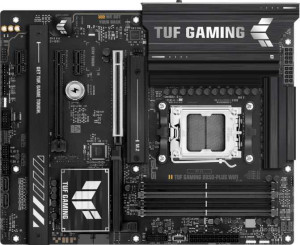
Both boards share a strong memory foundation: four DDR5 slots arranged in a dual-channel configuration, with overclocked support reaching up to 8000 MHz. That ceiling is relevant for AMD's EXPO profiles and enthusiast kits, meaning neither board artificially limits high-speed memory performance. For the vast majority of desktop workloads — gaming, content creation, everyday productivity — these shared specs make the two platforms effectively equivalent.
The one concrete split is maximum supported capacity: the Prime B850-Plus supports up to 256 GB, while the TUF Gaming caps at 192 GB. In practical terms, most users running 32 GB or even 64 GB will never approach either limit. However, the gap becomes meaningful for power users running memory-intensive workloads such as large virtual machines, professional video editing with heavy cache usage, or RAM-heavy data processing pipelines — scenarios where headroom matters and future-proofing justifies the consideration.
On memory, the Prime B850-Plus holds a clear, if narrow, advantage. The higher 256 GB ceiling gives it more long-term flexibility for demanding use cases, while both boards are otherwise identically matched on speed, slot count, and channel configuration. If maximum memory capacity is irrelevant to your workload, this group is essentially a tie — but for users who might eventually push beyond 192 GB, the Prime is the safer long-term investment.