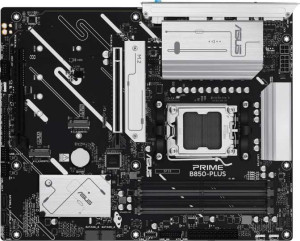
Asus Prime B850-Plus
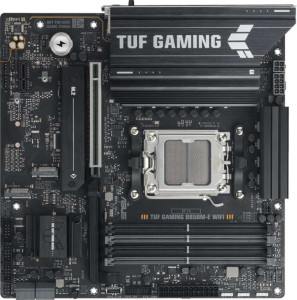
Asus TUF Gaming B850M-E Wi-Fi

Asus Prime B850-Plus Asus TUF Gaming B850M-E Wi-Fi

Common Features

  • Both products have an AM5 CPU socket.
  • Both products use a B850 chipset.
  • Both products support HDMI 2.1.
  • Both products are easy to overclock.
  • Both products feature RGB lighting.
  • Both products have dual BIOS.
  • Both products have one CPU socket.
  • Both products do not have integrated graphics.
  • Both products support up to 256GB of memory.
  • Both products support DDR5 memory.
  • Both products have 4 memory slots.
  • Both products support 2 memory channels.
  • Both products support up to 8000 MHz of overclocked RAM.
  • Both products have 2 USB 3.2 Gen 1 USB-A ports.
  • Both products have 1 USB 3.2 Gen 2 USB-C port.
  • Both products have 2 USB 3.2 Gen 1 USB-C ports.
  • Both products support RAID 1.
  • Both products support RAID 10 (1+0).
  • Both products support RAID 5.

Main Differences

  • Asus Prime B850-Plus has an ATX form factor while Asus TUF Gaming B850M-E Wi-Fi has a Micro-ATX form factor.
  • Asus Prime B850-Plus does not support Wi-Fi, whereas Asus TUF Gaming B850M-E Wi-Fi includes Wi-Fi support.
  • Asus Prime B850-Plus does not have Bluetooth, while Asus TUF Gaming B850M-E Wi-Fi supports Bluetooth.
  • Asus Prime B850-Plus is easy to reset BIOS, but Asus TUF Gaming B850M-E Wi-Fi is not.
  • Asus Prime B850-Plus has a width of 305 mm, while Asus TUF Gaming B850M-E Wi-Fi is 244 mm wide.
  • Asus Prime B850-Plus has 3 USB 3.2 Gen 2 USB-A ports, whereas Asus TUF Gaming B850M-E Wi-Fi has 1 USB 3.2 Gen 2 USB-A port.
  • Asus Prime B850-Plus includes 2 USB 2.0 ports, but Asus TUF Gaming B850M-E Wi-Fi does not.
  • Asus Prime B850-Plus has 1 DisplayPort output, while Asus TUF Gaming B850M-E Wi-Fi has 2 DisplayPort outputs.
  • Asus Prime B850-Plus does not have a PS/2 port, but Asus TUF Gaming B850M-E Wi-Fi includes a PS/2 port.
  • Asus Prime B850-Plus has 6 fan headers, whereas Asus TUF Gaming B850M-E Wi-Fi has 4 fan headers.
  • Asus Prime B850-Plus has a TPM connector, but Asus TUF Gaming B850M-E Wi-Fi does not.
  • Asus Prime B850-Plus does not have PCIe x1 slots, while Asus TUF Gaming B850M-E Wi-Fi includes 1 PCIe x1 slot.
Specs Comparison
Asus Prime B850-Plus

Asus Prime B850-Plus

Asus TUF Gaming B850M-E Wi-Fi

Asus TUF Gaming B850M-E Wi-Fi

General info:
CPU socket AM5 AM5
chipset B850 B850
form factor ATX Micro-ATX
release date April 2025 September 2025
supports Wi-Fi
Has Bluetooth
HDMI version HDMI 2.1 HDMI 2.1
Easy to overclock
has RGB lighting
Easy to reset BIOS
Has dual BIOS
CPU sockets 1 1
Has integrated graphics
warranty period 3 years 3 years
height 244 mm 244 mm
width 305 mm 244 mm
Has integrated CPU

The Asus Prime B850-Plus and the Asus TUF Gaming B850M-E Wi-Fi share many core similarities, but there are notable differences in features. Both motherboards use the AM5 CPU socket and the B850 chipset, and they support one CPU socket. The form factor differs, however, with the Prime B850-Plus being ATX and the TUF Gaming B850M-E Wi-Fi using a more compact Micro-ATX design. Both motherboards come with HDMI 2.1, support overclocking, have RGB lighting, and feature dual BIOS for extra stability. However, the Prime B850-Plus offers easy BIOS resetting, while the TUF Gaming B850M-E Wi-Fi does not.

In terms of connectivity, the TUF Gaming B850M-E Wi-Fi has a significant advantage with built-in Wi-Fi and Bluetooth support, which the Prime B850-Plus lacks entirely. Both motherboards do not have integrated graphics or an integrated CPU, and they have the same 3-year warranty period. The dimensions are another point of differentiation, with the Prime B850-Plus measuring 305 mm x 244 mm and the TUF Gaming B850M-E Wi-Fi being smaller at 244 mm x 244 mm.

Overall, while both motherboards share a solid feature set, the TUF Gaming B850M-E Wi-Fi stands out for its Wi-Fi and Bluetooth capabilities, while the Prime B850-Plus offers a slightly larger form factor and easier BIOS management.

Memory:
maximum memory amount 256GB 256GB
overclocked RAM speed 8000 MHz 8000 MHz
memory slots 4 4
DDR memory version 5 5
memory channels 2 2
Supports ECC memory

The Asus Prime B850-Plus and the Asus TUF Gaming B850M-E Wi-Fi are nearly identical in terms of memory specifications. Both motherboards support a maximum memory capacity of 256GB and offer four memory slots, providing ample room for expansion. They both feature DDR5 memory and support dual memory channels, which allows for better performance when paired with compatible memory modules. Additionally, both products support overclocked RAM speeds of up to 8000 MHz.

Neither motherboard supports ECC memory, so they are more suited for general consumer use rather than specialized workloads requiring error-correcting capabilities.

In summary, the memory features of the Asus Prime B850-Plus and the Asus TUF Gaming B850M-E Wi-Fi are identical across the board, offering the same performance potential and configuration options.

Ports:
USB 3.2 Gen 2 ports (USB-A) 3 1
USB 3.2 Gen 1 ports (USB-A) 2 2
USB 3.2 Gen 2 ports (USB-C) 1 1
USB 3.2 Gen 1 ports (USB-C) 0 0
USB 2.0 ports 2 0
USB 3.2 Gen 2x2 ports 0 0
USB 4 40Gbps ports 0 0
USB 4 20Gbps ports 0 0
Thunderbolt 4 ports 0 0
Thunderbolt 3 ports 0 0
has an HDMI output
DisplayPort outputs 1 2
RJ45 ports 1 1
Has USB Type-C
eSATA ports 0 0
DVI outputs 0 0
has a VGA connector
PS/2 ports 0 1

The Asus Prime B850-Plus and the Asus TUF Gaming B850M-E Wi-Fi have a few key differences in their port configurations. The Prime B850-Plus offers more USB 3.2 Gen 2 USB-A ports, with three available, compared to just one on the TUF Gaming B850M-E Wi-Fi. Both motherboards feature a single USB 3.2 Gen 2 USB-C port, with no USB 3.2 Gen 1 USB-C ports available on either. The Prime B850-Plus has two USB 2.0 ports, whereas the TUF Gaming B850M-E Wi-Fi does not provide any. Neither motherboard includes USB 3.2 Gen 2x2, USB 4, or Thunderbolt ports.

In terms of video outputs, both motherboards include an HDMI output, but the Prime B850-Plus has a single DisplayPort output, while the TUF Gaming B850M-E Wi-Fi offers two DisplayPort outputs. Additionally, the TUF Gaming B850M-E Wi-Fi has a PS/2 port, which the Prime B850-Plus lacks.

Both motherboards are equipped with a single RJ45 port for Ethernet connectivity. Both also feature USB Type-C ports, but the Prime B850-Plus has more overall USB-A options, making it a better fit for users who need multiple high-speed USB ports. The lack of USB 2.0 ports and PS/2 support on the TUF Gaming B850M-E Wi-Fi may be a consideration for users who rely on these features.

Connectors:
USB 3.2 Gen 1 ports (through expansion) 2 2
USB 2.0 ports (through expansion) 4 4
SATA 3 connectors 4 4
fan headers 6 4
USB 3.0 ports (through expansion) 2 2
M.2 sockets 3 3
Has TPM connector
U.2 sockets 0 0
Has mSATA connector
SATA 2 connectors 0 0

The Asus Prime B850-Plus and the Asus TUF Gaming B850M-E Wi-Fi share several connectors, but there are some differences in the configuration. Both motherboards feature the same number of USB 3.2 Gen 1, USB 2.0, and USB 3.0 ports through expansion, offering two USB 3.2 Gen 1 ports, four USB 2.0 ports, and two USB 3.0 ports. Both also provide four SATA 3 connectors and three M.2 sockets for high-speed storage options. However, the Prime B850-Plus includes six fan headers, while the TUF Gaming B850M-E Wi-Fi has only four fan headers.

One notable difference is that the Prime B850-Plus supports a TPM (Trusted Platform Module) connector, while the TUF Gaming B850M-E Wi-Fi does not. Both motherboards do not include U.2 or mSATA connectors and feature no SATA 2 connectors.

Overall, the key differences in the connectors come down to the number of fan headers and the inclusion of the TPM connector on the Prime B850-Plus, while both motherboards have similar storage options and USB expansion capabilities.

Expansion slots:
PCIe 5.0 x16 slots 1 1
PCIe 3.0 x16 slots 0 0
PCIe x1 slots 0 1
PCI slots 0 0
PCIe 2.0 x16 slots 0 0
PCIe x4 slots 0 0
PCIe x8 slots 0 0

The Asus Prime B850-Plus and the Asus TUF Gaming B850M-E Wi-Fi share some commonalities in their expansion slots but also have a few key differences. Both motherboards feature a PCIe 5.0 x16 slot, but neither has PCIe 3.0 x16, PCIe 2.0 x16, PCIe x4, or PCIe x8 slots. The most notable difference comes in the PCIe x1 slots, where the TUF Gaming B850M-E Wi-Fi includes one PCIe x1 slot, while the Prime B850-Plus does not have any PCIe x1 slots.

Both motherboards also lack PCI slots, which means they are focused on modern, high-speed PCIe expansion cards rather than legacy options.

In summary, the main distinction between these two motherboards in terms of expansion slots is the presence of a single PCIe x1 slot on the TUF Gaming B850M-E Wi-Fi, while the Prime B850-Plus does not include one.

Audio:
audio channels 7.1 7.1
Has S/PDIF Out port
audio connectors 3 3

The Asus Prime B850-Plus and the Asus TUF Gaming B850M-E Wi-Fi have identical audio specifications. Both motherboards support 7.1 audio channels, ensuring a rich audio experience for users. Neither motherboard includes an S/PDIF Out port. Additionally, both motherboards offer three audio connectors, providing basic audio output options for users who need them.

In summary, the audio features of the Asus Prime B850-Plus and the Asus TUF Gaming B850M-E Wi-Fi are exactly the same, with both providing 7.1 audio, three audio connectors, and lacking S/PDIF Out ports.

Storage:
Supports RAID 1
Supports RAID 10 (1+0)
Supports RAID 5
Supports RAID 0
Supports RAID 0+1

The Asus Prime B850-Plus and the Asus TUF Gaming B850M-E Wi-Fi share identical storage capabilities when it comes to RAID support. Both motherboards support RAID 1, RAID 10 (1+0), RAID 5, and RAID 0, offering flexibility for users looking to configure their storage for redundancy or performance. Neither motherboard supports RAID 0+1, which is a less commonly used RAID configuration.

In summary, there are no differences between the two motherboards in terms of RAID support, with both providing the same set of options for storage management.

Comparison Summary

This is a specification comparison between Asus Prime B850-Plus and Asus TUF Gaming B850M-E Wi-Fi. Both motherboards share features like an AM5 CPU socket, 256GB maximum memory support, and the ability to overclock RAM. However, there are key differences: the Asus Prime B850-Plus has an ATX form factor and lacks Wi-Fi support, while the Asus TUF Gaming B850M-E Wi-Fi comes with Wi-Fi and Bluetooth. The Asus Prime B850-Plus includes 2 USB 2.0 ports, while the Asus TUF Gaming B850M-E Wi-Fi does not. Additionally, the Asus Prime B850-Plus offers 6 fan headers, compared to just 4 on the Asus TUF Gaming B850M-E Wi-Fi.