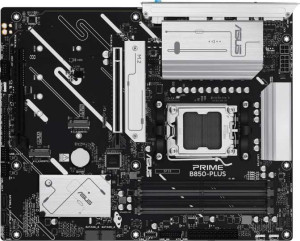
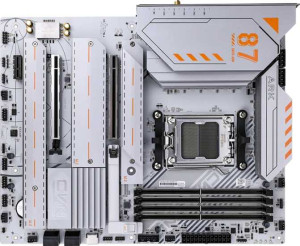
Both boards share the same AM5 socket, ATX form factor, and near-identical dimensions, making them physically interchangeable in most cases. The most meaningful platform-level difference is the chipset: the Colorful CVN runs on X870, AMD's flagship consumer chipset, while the Asus Prime uses B850. In practice, X870 typically unlocks more PCIe lanes, greater overclocking headroom, and broader feature support — though the real-world gap depends heavily on how those lanes are implemented by each vendor.
On connectivity, the split is stark. The CVN includes Wi-Fi and Bluetooth, making it ready for wireless builds out of the box. The Asus Prime omits both entirely, so wireless connectivity requires a separate adapter — a meaningful added cost and complexity for users who need it. Counterintuitively, however, the Prime strikes back with HDMI 2.1 versus the CVN's HDMI 2.0, supporting higher refresh rates and resolutions over HDMI — relevant for users routing display output directly through the board. The Prime also offers dual BIOS and an easy BIOS reset mechanism, which are genuine reliability and usability advantages; a corrupted firmware on the CVN has no hardware fallback.
For most users, neither board holds a clean sweep. The CVN X870 edges ahead on raw platform capability and wireless convenience, but the Asus Prime B850-Plus punches back with a stronger HDMI spec and notably better firmware resilience through dual BIOS. Buyers who prioritize a cleaner, more recoverable system and don't need wireless will find the Prime compelling, while those wanting a higher-tier chipset with integrated connectivity should lean toward the CVN.