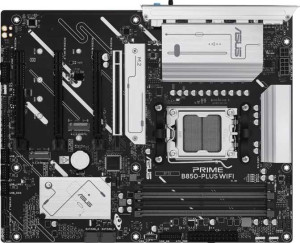
Asus Prime B850-Plus Wi-Fi
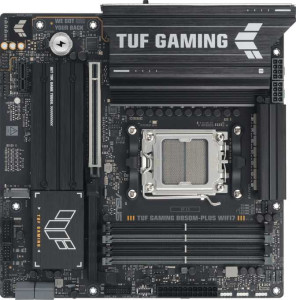
Asus TUF Gaming B850M-Plus Wi-Fi7

Asus Prime B850-Plus Wi-Fi Asus TUF Gaming B850M-Plus Wi-Fi7

Overview

Welcome to our in-depth specification comparison between the Asus Prime B850-Plus Wi-Fi and the Asus TUF Gaming B850M-Plus Wi-Fi7. Both boards share the AM5 socket and B850 chipset, but they diverge in meaningful ways across form factor, wireless capabilities, and expansion options. Whether you are planning a full-tower build or a compact workstation, understanding these distinctions is key to choosing the right foundation for your system.

Common Features

  • Both boards use the AM5 CPU socket.
  • Both boards feature the B850 chipset.
  • Wi-Fi connectivity is available on both products.
  • Bluetooth is available on both products.
  • Both boards output via HDMI 2.1.
  • Overclocking is supported on both products.
  • RGB lighting is present on both products.
  • Easy BIOS reset functionality is available on both products.
  • Both boards support a maximum memory amount of 256GB.
  • Both boards support an overclocked RAM speed of up to 8000 MHz.
  • Both boards have 4 memory slots across 2 memory channels.
  • Both boards use DDR5 memory.
  • ECC memory is not supported on either product.
  • Both boards have 3 USB 3.2 Gen 2 ports (USB-A).
  • Neither board has USB 3.2 Gen 1 ports (USB-C), USB 4 ports, or Thunderbolt ports.
  • Both boards have an HDMI output and 1 DisplayPort output.
  • Both boards have 2 USB 3.2 Gen 1 ports available through expansion and 2 USB 3.0 ports through expansion.
  • Both boards have 4 SATA 3 connectors, 3 M.2 sockets, and no U.2 or mSATA connectors.
  • Both boards have 1 PCIe 5.0 x16 slot and no PCIe 3.0 x16, PCIe 2.0 x16, PCI, PCIe x4, or PCIe x8 slots.
  • Both boards offer 7.1 audio channels with 3 audio connectors and no S/PDIF Out port.
  • Both boards support RAID 0, RAID 1, RAID 5, and RAID 10, but neither supports RAID 0+1.

Main Differences

  • The form factor is ATX on Asus Prime B850-Plus Wi-Fi and Micro-ATX on Asus TUF Gaming B850M-Plus Wi-Fi7.
  • The width is 305 mm on Asus Prime B850-Plus Wi-Fi and 244 mm on Asus TUF Gaming B850M-Plus Wi-Fi7.
  • Wi-Fi 7 (802.11be) support is present on Asus TUF Gaming B850M-Plus Wi-Fi7 but not available on Asus Prime B850-Plus Wi-Fi.
  • The Bluetooth version is 5.3 on Asus Prime B850-Plus Wi-Fi and 5.4 on Asus TUF Gaming B850M-Plus Wi-Fi7.
  • USB 3.2 Gen 1 ports (USB-A) total 2 on Asus Prime B850-Plus Wi-Fi and 4 on Asus TUF Gaming B850M-Plus Wi-Fi7.
  • USB 3.2 Gen 2 ports (USB-C) total 1 on Asus Prime B850-Plus Wi-Fi and 0 on Asus TUF Gaming B850M-Plus Wi-Fi7.
  • USB 2.0 ports total 2 on Asus Prime B850-Plus Wi-Fi and 4 on Asus TUF Gaming B850M-Plus Wi-Fi7.
  • USB 3.2 Gen 2x2 ports total 0 on Asus Prime B850-Plus Wi-Fi and 1 on Asus TUF Gaming B850M-Plus Wi-Fi7.
  • USB 2.0 ports through expansion total 4 on Asus Prime B850-Plus Wi-Fi and 3 on Asus TUF Gaming B850M-Plus Wi-Fi7.
  • Fan headers total 6 on Asus Prime B850-Plus Wi-Fi and 5 on Asus TUF Gaming B850M-Plus Wi-Fi7.
  • A TPM connector is present on Asus Prime B850-Plus Wi-Fi but not available on Asus TUF Gaming B850M-Plus Wi-Fi7.
  • A PCIe 4.0 x16 slot is present on Asus Prime B850-Plus Wi-Fi but not available on Asus TUF Gaming B850M-Plus Wi-Fi7.
  • PCIe x1 slots total 0 on Asus Prime B850-Plus Wi-Fi and 1 on Asus TUF Gaming B850M-Plus Wi-Fi7.
Specs Comparison
Asus Prime B850-Plus Wi-Fi

Asus Prime B850-Plus Wi-Fi

Asus TUF Gaming B850M-Plus Wi-Fi7

Asus TUF Gaming B850M-Plus Wi-Fi7

General info:
CPU socket AM5 AM5
chipset B850 B850
form factor ATX Micro-ATX
release date April 2025 July 2025
supports Wi-Fi
Wi-Fi version Wi-Fi 4 (802.11n), Wi-Fi 5 (802.11ac), Wi-Fi 6 (802.11ax), Wi-Fi 6E (802.11ax) Wi-Fi 4 (802.11n), Wi-Fi 5 (802.11ac), Wi-Fi 6 (802.11ax), Wi-Fi 6E (802.11ax), Wi-Fi 7 (802.11be)
Has Bluetooth
Bluetooth version 5.3 5.4
HDMI version HDMI 2.1 HDMI 2.1
Easy to overclock
has RGB lighting
Easy to reset BIOS
Has dual BIOS
has aptX
CPU sockets 1 1
Has integrated graphics
warranty period 3 years 3 years
height 244 mm 244 mm
width 305 mm 244 mm
Has integrated CPU

Both boards share the same AM5 socket and B850 chipset, meaning they support the same generation of AMD processors and offer identical overclocking headroom. They also match on HDMI 2.1, dual BIOS, easy BIOS reset, RGB lighting, and a 3-year warranty — so neither board has a platform-level or support advantage over the other. The most immediately practical difference is form factor: the Asus Prime B850-Plus Wi-Fi is a full ATX board (305 × 244 mm), while the TUF Gaming B850M-Plus Wi-Fi 7 is Micro-ATX (244 × 244 mm). This affects case compatibility and, to a lesser extent, the number of expansion slots available — ATX typically offers more PCIe real estate, while Micro-ATX suits smaller, more compact builds.

The more meaningful differentiator in this group is wireless connectivity. The TUF Gaming supports Wi-Fi 7 (802.11be), whereas the Prime tops out at Wi-Fi 6E. In practical terms, Wi-Fi 7 delivers significantly higher theoretical throughput, lower latency, and introduces multi-link operation — benefits that matter most if you have a Wi-Fi 7 router and a bandwidth-intensive use case. The TUF Gaming also edges ahead on Bluetooth, offering version 5.4 versus 5.3 on the Prime; the difference is minor in day-to-day use, but 5.4 brings marginally improved connection stability and energy efficiency.

For this spec group, the TUF Gaming B850M-Plus Wi-Fi 7 holds a clear advantage on wireless: Wi-Fi 7 and Bluetooth 5.4 are objectively newer standards. However, if your build requires a full-ATX board for case compatibility or expansion slot density, the Prime's larger form factor is the deciding factor regardless of wireless. Choose the TUF Gaming if wireless performance and compact sizing are priorities; choose the Prime if you need ATX and can live without Wi-Fi 7.
Memory:
maximum memory amount 256GB 256GB
overclocked RAM speed 8000 MHz 8000 MHz
memory slots 4 4
DDR memory version 5 5
memory channels 2 2
Supports ECC memory

Across every memory specification provided, these two boards are identical. Both support DDR5 with four slots, dual-channel architecture, a maximum capacity of 256GB, and overclocked speeds up to 8000 MHz — and neither supports ECC memory. There is simply no differentiator to weigh here.

That said, the shared specs are worth contextualizing. DDR5 with dual-channel and 8000 MHz headroom is a strong foundation for high-performance workloads — video editing, 3D rendering, and gaming all benefit from the bandwidth that DDR5's higher frequencies enable over DDR4. The 256GB ceiling is far beyond what most consumers will ever use, but it future-proofs both boards for memory-intensive professional tasks. The absence of ECC support is standard for B850-class consumer boards and is only relevant if you are building a workstation requiring error-correcting memory.

This group is a complete tie. Memory capabilities should not factor into a decision between these two boards — any choice made here will be driven entirely by the differentiators found in other spec groups.

Ports:
USB 3.2 Gen 2 ports (USB-A) 3 3
USB 3.2 Gen 1 ports (USB-A) 2 4
USB 3.2 Gen 2 ports (USB-C) 1 0
USB 3.2 Gen 1 ports (USB-C) 0 0
USB 2.0 ports 2 4
USB 3.2 Gen 2x2 ports 0 1
USB 4 40Gbps ports 0 0
USB 4 20Gbps ports 0 0
Thunderbolt 4 ports 0 0
Thunderbolt 3 ports 0 0
has an HDMI output
DisplayPort outputs 1 1
RJ45 ports 1 1
Has USB Type-C
eSATA ports 0 0
DVI outputs 0 0
has a VGA connector
PS/2 ports 0 0

The rear I/O layouts diverge in two meaningful ways. The TUF Gaming B850M-Plus Wi-Fi 7 counters with a USB 3.2 Gen 2x2 port — running at 20Gbps, double the speed of a standard Gen 2 port — making it the faster option for connecting a high-speed external NVMe enclosure or other bandwidth-hungry peripherals. The Prime B850-Plus Wi-Fi, meanwhile, offers a USB 3.2 Gen 2 Type-C port at 10Gbps, which is broadly useful for modern devices but does not reach the TUF's peak throughput. Both boards confirm USB Type-C presence, but the nature of that connectivity is what sets them apart.

On raw port count, the TUF Gaming also pulls ahead. It provides four USB 3.2 Gen 1 Type-A ports and four USB 2.0 ports alongside three Gen 2 Type-A, totalling eleven rear USB ports. The Prime delivers two Gen 1 Type-A and two USB 2.0 alongside its three Gen 2 Type-A and one Gen 2 Type-C — eight in total. For users with many peripherals, keyboards, mice, audio interfaces, or dongles, the TUF's additional ports reduce dependence on hubs. Display outputs (HDMI 2.1 and one DisplayPort) and the single RJ45 Ethernet port are identical across both boards.

The TUF Gaming has the edge here on two fronts: sheer port quantity and the inclusion of a Gen 2x2 20Gbps connection for peak transfer speeds. The Prime's Gen 2 Type-C is a practical advantage for USB-C device compatibility, but it does not offset the TUF's overall I/O superiority in this group.

Connectors:
USB 3.2 Gen 1 ports (through expansion) 2 2
USB 2.0 ports (through expansion) 4 3
SATA 3 connectors 4 4
fan headers 6 5
USB 3.0 ports (through expansion) 2 2
M.2 sockets 3 3
Has TPM connector
U.2 sockets 0 0
Has mSATA connector
SATA 2 connectors 0 0

Internal connectivity is closely matched between these two boards, but a few distinctions are worth unpacking. Storage options are identical — both offer three M.2 sockets and four SATA 3 connectors, which is a well-rounded setup for builds combining fast NVMe drives with traditional HDDs or SSDs. Neither offers U.2 or mSATA, but those are niche omissions that will not affect the vast majority of users.

Where the Prime B850-Plus Wi-Fi pulls ahead is in system management and cooling flexibility. It includes a TPM connector, which the TUF Gaming B850M-Plus Wi-Fi 7 lacks — relevant for users building systems that require hardware-based security modules for enterprise environments or BitLocker workflows. The Prime also provides six fan headers versus the TUF's five, a small but real advantage for builders running larger cooling arrays, particularly in full-ATX cases with multiple case fans and a CPU cooler. The TUF gives back one internal USB 2.0 expansion port (three versus four on the Prime), though this is a minor tradeoff that matters only if you are populating every internal USB header simultaneously.

The Prime B850-Plus Wi-Fi takes a narrow edge in this group. The TPM connector is a meaningful functional addition for security-conscious builds, and the extra fan header offers slightly more thermal management headroom — two practical advantages the TUF Gaming does not match here.

Expansion slots:
PCIe 4.0 x16 slots 1 0
PCIe 5.0 x16 slots 1 1
PCIe 3.0 x16 slots 0 0
PCIe x1 slots 0 1
PCI slots 0 0
PCIe 2.0 x16 slots 0 0
PCIe x4 slots 0 0
PCIe x8 slots 0 0

Both boards feature a single PCIe 5.0 x16 slot as their primary GPU interface, meaning neither has an advantage for graphics card bandwidth — the latest discrete GPUs will run at full speed on either board. The divergence comes in what each board offers beyond that primary slot. The Prime B850-Plus Wi-Fi adds a second PCIe 4.0 x16 slot, while the TUF Gaming B850M-Plus Wi-Fi 7 instead provides a single PCIe x1 slot.

These are meaningfully different expansion philosophies. The Prime's second x16 physical slot — even if it operates at fewer electrical lanes in practice — is ideal for adding a high-bandwidth card such as a dedicated NVMe controller, a 10GbE network card, or a capture card that benefits from wider lane access. The TUF's x1 slot is more limited in bandwidth but still covers a broad range of add-in cards like sound cards, basic network adapters, or USB expansion cards. However, fitting even a x1 card inside a Micro-ATX build with a large GPU installed can be physically constrained — a real-world consideration the compact form factor introduces.

The Prime B850-Plus Wi-Fi has a clear advantage here. The second x16 physical slot offers substantially more expansion flexibility than a x1 slot, particularly for users who anticipate adding high-bandwidth PCIe devices alongside their GPU. For a single-GPU build with minimal add-in card needs, the TUF's x1 slot is sufficient, but the Prime simply provides more room to grow.

Audio:
audio channels 7.1 7.1
Has S/PDIF Out port
audio connectors 3 3

Audio is another category where these two boards land in exactly the same place. Both deliver 7.1-channel surround sound support with three analog audio connectors on the rear panel, and neither includes an S/PDIF optical output. There is nothing to separate them here.

The 7.1-channel capability is worth noting for users building home theater or immersive gaming setups, as it supports full surround configurations without an external audio card. The absence of S/PDIF out is a limitation for anyone wanting to connect a digital audio receiver or AV amplifier via optical — both boards share this constraint equally, so it is a consideration for the platform rather than a differentiator between the two products.

This group is a complete tie. Audio hardware should play no role in choosing between these boards — anyone with more demanding audio requirements, such as optical output or higher-fidelity DAC performance, would need to look at a dedicated sound card regardless of which board they choose.

Storage:
Supports RAID 1
Supports RAID 10 (1+0)
Supports RAID 5
Supports RAID 0
Supports RAID 0+1

RAID support is identical across both boards. Each covers the four most practically relevant configurations — RAID 0 for striped performance, RAID 1 for mirrored redundancy, RAID 5 for distributed parity across three or more drives, and RAID 10 for the combined speed and redundancy of striped mirror pairs. Neither supports RAID 0+1, though this is a minor omission given that RAID 10 is generally preferred over 0+1 for its superior fault tolerance anyway.

For most consumer builds, RAID support is background noise — the majority of users run drives independently. Where it does matter, such as small NAS-adjacent desktop builds, home media servers, or workstations requiring data redundancy, both boards offer the same capable foundation. The inclusion of RAID 5 is particularly noteworthy for users with four SATA drives who want an efficient balance of capacity and protection without dedicating half their storage to mirroring.

This group is a complete tie. Storage redundancy configuration offers no basis for differentiation between these two boards, and the decision should rest entirely on the distinctions identified in other spec categories.

Comparison Summary & Verdict

After examining all the data, both boards deliver a strong shared foundation: DDR5 support, four memory slots, 256GB max RAM, three M.2 sockets, and multi-RAID compatibility. The Asus Prime B850-Plus Wi-Fi stands out with its ATX form factor, an extra PCIe 4.0 x16 slot, a TPM connector, a USB 3.2 Gen 2 Type-C rear port, and six fan headers, making it the stronger pick for enthusiasts building a spacious, expansion-ready desktop. The Asus TUF Gaming B850M-Plus Wi-Fi7, on the other hand, wins on wireless performance thanks to Wi-Fi 7 and Bluetooth 5.4, and also offers a USB 3.2 Gen 2x2 port and more USB-A connectivity, all in a compact Micro-ATX footprint. Choose the Prime if you value expandability and a richer connector set; choose the TUF if you need cutting-edge wireless and a smaller chassis.

Asus Prime B850-Plus Wi-Fi
Buy Asus Prime B850-Plus Wi-Fi if...

Buy the Asus Prime B850-Plus Wi-Fi if you need an ATX board with a PCIe 4.0 x16 slot, a TPM connector, more fan headers, and a rear USB 3.2 Gen 2 Type-C port for a fully expandable desktop build.

Asus TUF Gaming B850M-Plus Wi-Fi7
Buy Asus TUF Gaming B850M-Plus Wi-Fi7 if...

Buy the Asus TUF Gaming B850M-Plus Wi-Fi7 if you want the latest Wi-Fi 7 connectivity, Bluetooth 5.4, a USB 3.2 Gen 2x2 port, and a compact Micro-ATX form factor for a smaller, wireless-focused system.