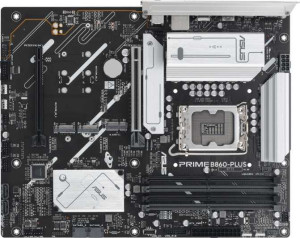
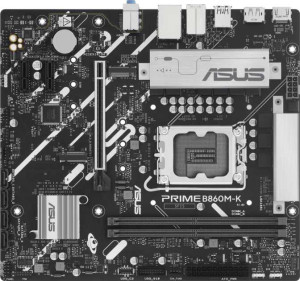
Both the Asus Prime B860-Plus and the Asus Prime B860M-K share the same fundamental platform: the LGA 1851 socket paired with Intel's B860 chipset, meaning they target the same generation of processors with identical compatibility. They also match on several quality-of-life features — both support easy overclocking, include dual BIOS and easy BIOS reset, offer RGB lighting, and carry a 3-year warranty. Neither board includes integrated graphics, Wi-Fi, or Bluetooth, so users will need to factor in a discrete GPU and, if wireless connectivity is needed, a separate adapter or card.
The single defining differentiator in this group is form factor. The B860-Plus is a full ATX board (305 × 244 mm), while the B860M-K is a Micro-ATX board (244 × 222 mm), making it noticeably smaller in both dimensions. In practice, this means the B860M-K fits into more compact cases and is the natural choice for space-constrained or smaller desktop builds. The B860-Plus, by contrast, demands a standard mid-tower or full-tower enclosure but in return typically offers more physical room for expansion slots, VRM cooling, and cable management — advantages that become relevant when you examine the feature-specific spec groups.
For this general-info group alone, neither board has a clear overall edge on capability — the specs that matter most here are identical. The choice comes down entirely to build size: pick the B860-Plus if you are building in a standard ATX case and may want the headroom that a larger PCB affords, or the B860M-K if a smaller footprint is a priority and your case does not accommodate full ATX.