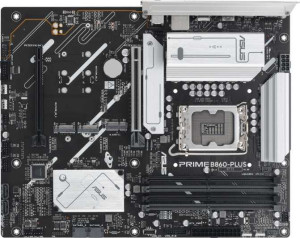
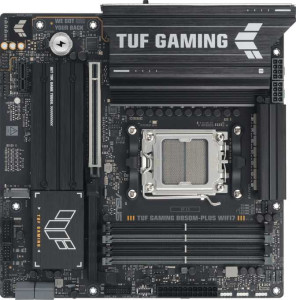
The most fundamental difference here is platform: the Asus Prime B860-Plus is built around Intel's LGA 1851 socket with a B860 chipset, while the Asus TUF Gaming B850M-Plus Wi-Fi7 targets AMD's AM5 ecosystem with a B850 chipset. These two boards are not interchangeable — your CPU choice locks you into one or the other. Neither platform is inherently superior from these specs alone, but the socket decision is the single most consequential choice a builder will make, as it determines upgrade paths for years ahead.
Form factor is the next major split. The Prime B860-Plus is a full ATX board (305 mm wide), offering more PCIe slots, RAM slots, and general expansion room inside a standard mid-tower or larger case. The TUF Gaming B850M-Plus is Micro-ATX (244 mm wide), making it the better fit for compact builds or smaller cases where space is at a premium — though at the cost of some expandability. Connectivity also diverges sharply: the TUF includes integrated Wi-Fi and Bluetooth, while the Prime B860-Plus ships with neither, meaning wireless on that board requires a separate PCIe or USB adapter.
Where the two boards converge is notable: both share HDMI 2.1, dual BIOS, easy BIOS reset, RGB lighting, overclocking support, and a 3-year warranty — so neither has a quality or feature-parity edge on those fronts. Overall, the TUF Gaming B850M-Plus holds a practical advantage for builders who want a compact, wireless-ready system out of the box, while the Prime B860-Plus suits those committed to the Intel platform who need a full-ATX footprint and don't require onboard wireless.