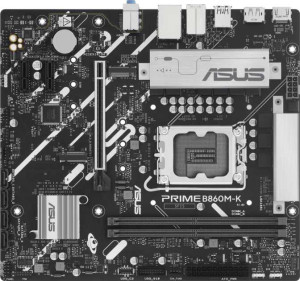
Asus Prime B860M-K
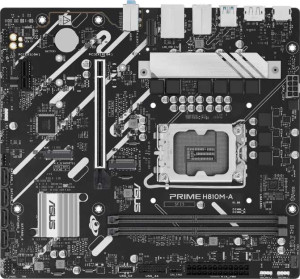
Asus Prime H810M-A

Asus Prime B860M-K Asus Prime H810M-A

Overview

Welcome to our detailed spec comparison between the Asus Prime B860M-K and the Asus Prime H810M-A, two Micro-ATX motherboards built on the LGA 1851 platform with DDR5 support. While they share a strong foundation of common features, key battlegrounds emerge around overclocking capability, USB port configurations, and BIOS resilience options. Read on to discover which board best suits your specific build requirements.

Common Features

  • Both motherboards use the LGA 1851 CPU socket.
  • Both boards share the Micro-ATX form factor.
  • Neither board supports Wi-Fi.
  • Neither board has Bluetooth.
  • Both feature HDMI 2.1 output.
  • RGB lighting is available on both products.
  • Easy BIOS reset is supported on both boards.
  • Both boards have a single CPU socket.
  • Both support a maximum memory amount of 128GB.
  • Both boards have 2 memory slots.
  • Both use DDR5 memory.
  • Both boards support 2 memory channels.
  • ECC memory is not supported on either board.
  • Neither board has USB 3.2 Gen 2 ports in USB-C format.
  • Neither board has USB 3.2 Gen 1 ports in USB-C format.
  • Neither board has USB 4 or Thunderbolt ports.
  • An HDMI output is present on both boards.
  • Both boards have 2 USB 3.2 Gen 1 ports available through expansion, 4 SATA 3 connectors, 3 fan headers, 2 M.2 sockets, and a TPM connector.
  • Neither board has an mSATA connector.
  • Both boards have 1 PCIe 4.0 x16 slot and no PCIe 5.0 x16 slots.
  • Both boards offer 7.1 audio channels with 3 audio connectors, and neither has an S/PDIF Out port.
  • Neither board supports RAID 0+1.

Main Differences

  • Overclocking support is available on Asus Prime B860M-K but not on Asus Prime H810M-A.
  • Dual BIOS is present on Asus Prime B860M-K but not available on Asus Prime H810M-A.
  • USB 3.2 Gen 2 ports (USB-A) count is 1 on Asus Prime B860M-K and 2 on Asus Prime H810M-A.
  • USB 3.2 Gen 1 ports (USB-A) count is 2 on Asus Prime B860M-K and 0 on Asus Prime H810M-A.
  • USB 2.0 ports count is 3 on Asus Prime B860M-K and 4 on Asus Prime H810M-A.
  • USB Type-C connectivity is present on Asus Prime B860M-K but not available on Asus Prime H810M-A.
  • USB 2.0 ports through expansion number 4 on Asus Prime B860M-K and 2 on Asus Prime H810M-A.
  • PCIe x1 slots count is 2 on Asus Prime B860M-K and 1 on Asus Prime H810M-A.
Specs Comparison
Asus Prime B860M-K

Asus Prime B860M-K

Asus Prime H810M-A

Asus Prime H810M-A

General info:
CPU socket LGA 1851 LGA 1851
form factor Micro-ATX Micro-ATX
release date January 2025 January 2025
supports Wi-Fi
Has Bluetooth
HDMI version HDMI 2.1 HDMI 2.1
Easy to overclock
has RGB lighting
Easy to reset BIOS
Has dual BIOS
CPU sockets 1 1
Has integrated graphics
warranty period 3 years 3 years
height 222 mm 222 mm
width 244 mm 244 mm
Has integrated CPU

Both the Asus Prime B860M-K and the Asus Prime H810M-A share the same foundational identity: Micro-ATX form factor with identical 222 × 244 mm dimensions, the same LGA 1851 CPU socket, HDMI 2.1 output, RGB lighting, easy BIOS reset, a 3-year warranty, and no Wi-Fi, Bluetooth, integrated graphics, or integrated CPU. For users comparing these two purely on platform compatibility or physical fit, they are effectively interchangeable.

The meaningful separation comes down to two features. First, the B860M-K supports overclocking, while the H810M-A does not — a significant distinction for users who intend to push CPU or memory performance beyond stock settings. Second, the B860M-K includes dual BIOS, which provides a hardware-level safety net: if a firmware update goes wrong or the primary BIOS becomes corrupted, the board can automatically recover using the backup chip. The H810M-A lacks this, making it more vulnerable to unrecoverable BIOS failures.

The Asus Prime B860M-K holds a clear advantage in this group. Its overclocking support opens the door to performance tuning, and its dual BIOS adds a layer of long-term reliability that the H810M-A simply cannot match. For builders who want headroom to grow or simply value resilience in their platform, the B860M-K is the stronger choice based on the general specs alone.

Memory:
maximum memory amount 128GB 128GB
memory slots 2 2
DDR memory version 5 5
memory channels 2 2
Supports ECC memory

On memory, the Asus Prime B860M-K and Asus Prime H810M-A are perfectly matched across every provided specification. Both offer 2 DIMM slots, a 128GB ceiling, DDR5 support, dual-channel operation, and no ECC capability.

The shared DDR5 platform is worth noting: compared to DDR4, DDR5 brings higher bandwidth and lower operating voltage, which translates to better performance in memory-intensive workloads like video editing, large application multitasking, and modern gaming. The dual-channel configuration means that populating both slots — rather than just one — effectively doubles the memory bus bandwidth, a meaningful real-world gain that users should not overlook. The 128GB maximum is generous for a Micro-ATX board in this class, comfortably accommodating power users and content creators, though it is worth noting that reaching that ceiling requires two high-density 64GB modules. The absence of ECC support is standard for consumer-grade motherboards and is only a concern for workstation or server use cases.

This group is a complete tie. There is no memory-related reason to choose one board over the other — any decision here should rest entirely on differentiators found in other specification groups.

Ports:
USB 3.2 Gen 2 ports (USB-A) 1 2
USB 3.2 Gen 1 ports (USB-A) 2 0
USB 3.2 Gen 2 ports (USB-C) 0 0
USB 3.2 Gen 1 ports (USB-C) 0 0
USB 2.0 ports 3 4
USB 3.2 Gen 2x2 ports 0 0
USB 4 40Gbps ports 0 0
USB 4 20Gbps ports 0 0
Thunderbolt 4 ports 0 0
Thunderbolt 3 ports 0 0
has an HDMI output
DisplayPort outputs 1 1
RJ45 ports 1 1
Has USB Type-C
eSATA ports 0 0
DVI outputs 0 0
has a VGA connector
PS/2 ports 1 1

The rear I/O layout of these two boards is largely similar — both offer HDMI, a DisplayPort output, a single RJ45 ethernet port, a legacy PS/2 port, and no VGA or eSATA. The divergence appears in the USB configuration. The H810M-A delivers 2× USB 3.2 Gen 2 (10Gbps) Type-A ports, while the B860M-K provides only 1× Gen 2 alongside 2× Gen 1 (5Gbps) ports. For users regularly transferring large files to fast external SSDs or high-speed peripherals, the H810M-A's extra Gen 2 port is a tangible advantage.

However, the B860M-K counters with a USB Type-C port — absent entirely on the H810M-A. As modern peripherals, displays, and storage devices increasingly standardize on USB-C, having that connector on the rear I/O adds meaningful day-to-day flexibility without requiring an adapter. The H810M-A's omission of USB-C is a forward-compatibility gap that will only become more noticeable over time.

This group comes down to a trade-off: the H810M-A offers a marginally stronger high-speed USB-A configuration, but the B860M-K's inclusion of USB-C addresses a growing real-world need. For most users building a system today with longevity in mind, the B860M-K holds the modest edge here.

Connectors:
USB 3.2 Gen 1 ports (through expansion) 2 2
USB 2.0 ports (through expansion) 4 2
SATA 3 connectors 4 4
fan headers 3 3
USB 3.0 ports (through expansion) 2 2
M.2 sockets 2 2
Has TPM connector
U.2 sockets 0 0
Has mSATA connector
SATA 2 connectors 0 0

Internal connectivity is nearly identical across these two boards. Both the Asus Prime B860M-K and Asus Prime H810M-A provide 4× SATA 3 connectors, 2× M.2 sockets, 3 fan headers, 2 USB 3.2 Gen 1 internal headers, and a TPM connector — a solid and well-rounded set of internals for a Micro-ATX build.

The single differentiator in this group is the internal USB 2.0 expansion headers: the B860M-K offers 4 compared to the H810M-A's 2. In practice, these headers feed front-panel USB ports, all-in-one cooler controllers, RGB hubs, and other internal accessories. With only 2 headers, the H810M-A can become a bottleneck in builds with multiple USB 2.0-dependent devices competing for internal connections, whereas the B860M-K's extra capacity gives builders more flexibility without resorting to header splitters.

The B860M-K takes a narrow but practical edge here. The expanded internal USB 2.0 header count is a minor advantage in simple builds, but it becomes genuinely useful in more accessory-rich configurations. Everything else in this group is evenly matched.

Expansion slots:
PCIe 4.0 x16 slots 1 1
PCIe 5.0 x16 slots 0 0
PCIe 3.0 x16 slots 0 0
PCIe x1 slots 2 1
PCI slots 0 0
PCIe 2.0 x16 slots 0 0
PCIe x4 slots 0 0
PCIe x8 slots 0 0

Expansion slot layouts are straightforward on both boards, as expected from Micro-ATX designs. The Asus Prime B860M-K and Asus Prime H810M-A each carry a single PCIe 4.0 x16 slot — the primary home for a discrete GPU. PCIe 4.0 delivers ample bandwidth for current-generation graphics cards, and a single x16 slot is entirely standard for this form factor.

The only divergence is in smaller expansion: the B860M-K includes 2× PCIe x1 slots versus the H810M-A's . These compact slots are used for add-in cards such as dedicated sound cards, additional NIC adapters, capture cards, or USB expansion cards. Having two rather than one means the B860M-K can accommodate a more accessory-rich build without forcing the user to choose between add-in cards.

The B860M-K holds a modest edge here. For most users running a single GPU with no additional cards, the difference is irrelevant — both boards serve that use case equally well. But for builders who plan to add even one PCIe x1 accessory alongside a GPU, the B860M-K's extra slot provides headroom the H810M-A simply does not offer.

Audio:
audio channels 7.1 7.1
Has S/PDIF Out port
audio connectors 3 3

Audio is one area where no distinction can be drawn between these two boards. The Asus Prime B860M-K and Asus Prime H810M-A are identical across every provided spec: both support 7.1-channel surround audio, offer 3 analog audio connectors, and lack an S/PDIF optical output.

The 7.1-channel capability is a meaningful feature for users with surround sound speaker setups, providing full positional audio support without an add-in card. The 3-connector arrangement is typical for this level of onboard audio — covering line-in, line-out, and microphone at the rear I/O. The absence of S/PDIF out means neither board can feed a digital optical signal to an external DAC or AV receiver through that interface, which is a consideration for home theater-oriented builds.

This group is a complete tie. Neither board offers any audio advantage over the other, and users with more demanding audio requirements — such as S/PDIF connectivity or higher-channel discrete setups — would need to factor in a dedicated sound card on either platform equally.

Storage:
Supports RAID 0+1

Both the Asus Prime B860M-K and Asus Prime H810M-A do not support RAID 0+1. The specification is identical for both products in this category, with neither offering RAID 0+1 support.

As a result, there are no differences between the two motherboards in terms of RAID capabilities in this group.

Comparison Summary & Verdict

Both the Asus Prime B860M-K and Asus Prime H810M-A share a solid LGA 1851 foundation, DDR5 dual-channel memory support up to 128GB, HDMI 2.1, dual M.2 sockets, and 7.1 audio. However, their differences point clearly to distinct audiences. The Asus Prime B860M-K is the stronger choice for enthusiasts who want overclocking support, the safety net of a dual BIOS, USB Type-C connectivity, and greater PCIe x1 expansion. The Asus Prime H810M-A, on the other hand, appeals to users who prioritize more USB 3.2 Gen 2 ports and a higher USB 2.0 count for legacy peripherals, without the need for advanced tuning features. Choose accordingly based on your workflow and peripheral needs.

Asus Prime B860M-K
Buy Asus Prime B860M-K if...

Buy the Asus Prime B860M-K if you want overclocking support, the added reliability of dual BIOS, USB Type-C connectivity, and more PCIe x1 expansion slots for your build.

Asus Prime H810M-A
Buy Asus Prime H810M-A if...

Buy the Asus Prime H810M-A if you need more USB 3.2 Gen 2 Type-A ports and a higher USB 2.0 port count for legacy devices, and have no need for overclocking or dual BIOS.