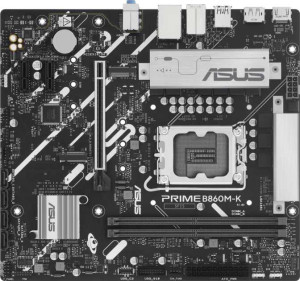
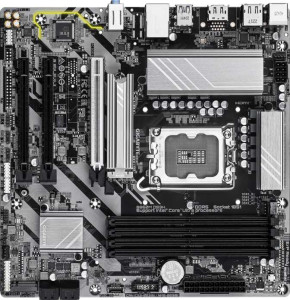
Asus Prime B860M-K
Gigabyte B860M DS3H

Asus Prime B860M-K Gigabyte B860M DS3H

Overview

When comparing the Asus Prime B860M-K and the Gigabyte B860M DS3H, you are looking at two Micro-ATX motherboards that share the same B860 chipset and LGA 1851 socket, yet diverge in meaningful ways across memory capacity, expansion slot generations, and practical usability features. This head-to-head breakdown examines every key specification to help you identify which board is the right foundation for your next build.

Common Features

  • Both motherboards use the LGA 1851 CPU socket.
  • Both motherboards feature the B860 chipset.
  • Both boards come in a Micro-ATX form factor.
  • Neither board supports Wi-Fi.
  • Neither board has Bluetooth.
  • Both boards include an HDMI 2.1 port.
  • Both boards support easy overclocking.
  • Both boards have a dual BIOS feature.
  • Both boards use DDR5 memory.
  • Both boards have 2 memory channels.
  • Neither board supports ECC memory.
  • Both boards have 1 USB 3.2 Gen 2 port (USB-A).
  • Both boards have 2 USB 3.2 Gen 1 ports (USB-A).
  • Neither board has any USB 3.2 Gen 2 ports (USB-C).
  • Neither board has any USB 3.2 Gen 1 ports (USB-C).
  • Both boards have 3 USB 2.0 ports.
  • Both boards provide 2 USB 3.2 Gen 1 ports through expansion.
  • Both boards provide 4 USB 2.0 ports through expansion.
  • Both boards have 4 SATA 3 connectors.
  • Both boards have 2 M.2 sockets.
  • Both boards include a TPM connector.
  • Neither board has an mSATA connector.
  • Both boards have 2 PCIe x1 slots.
  • Both boards offer 7.1 audio channels.
  • Both boards have 3 audio connectors.
  • Neither board has an S/PDIF Out port.
  • Both boards support RAID 0, RAID 1, RAID 5, and RAID 10.
  • Neither board supports RAID 0+1.

Main Differences

  • RGB lighting is present on Asus Prime B860M-K but not available on Gigabyte B860M DS3H.
  • Easy BIOS reset is supported on Asus Prime B860M-K but not available on Gigabyte B860M DS3H.
  • The height is 222 mm on Asus Prime B860M-K and 244 mm on Gigabyte B860M DS3H.
  • Maximum memory capacity is 128GB on Asus Prime B860M-K and 256GB on Gigabyte B860M DS3H.
  • Overclocked RAM speed reaches 8800 MHz on Asus Prime B860M-K and 9066 MHz on Gigabyte B860M DS3H.
  • Memory slots total 2 on Asus Prime B860M-K and 4 on Gigabyte B860M DS3H.
  • A USB Type-C port is present on Asus Prime B860M-K but not available on Gigabyte B860M DS3H.
  • Fan headers number 3 on Asus Prime B860M-K and 4 on Gigabyte B860M DS3H.
  • Asus Prime B860M-K has 1 PCIe 4.0 x16 slot while Gigabyte B860M DS3H has none.
  • Gigabyte B860M DS3H has 1 PCIe 5.0 x16 slot while Asus Prime B860M-K has none.
Specs Comparison
Asus Prime B860M-K

Asus Prime B860M-K

Gigabyte B860M DS3H

Gigabyte B860M DS3H

General info:
CPU socket LGA 1851 LGA 1851
chipset B860 B860
form factor Micro-ATX Micro-ATX
release date January 2025 January 2025
supports Wi-Fi
Has Bluetooth
HDMI version HDMI 2.1 HDMI 2.1
Easy to overclock
has RGB lighting
Easy to reset BIOS
Has dual BIOS
CPU sockets 1 1
Has integrated graphics
warranty period 3 years 3 years
height 222 mm 244 mm
width 244 mm 244 mm
Has integrated CPU

Both boards share an identical foundation: the LGA 1851 socket paired with the B860 chipset, housed in a Micro-ATX form factor, with no Wi-Fi or Bluetooth, and a 3-year warranty. For users building a wired, budget-conscious Intel system, either board slots into the same ecosystem without compromise on core platform support.

The real divergence lies in usability and aesthetics. The Asus Prime B860M-K includes RGB lighting and — more importantly from a practical standpoint — supports easy BIOS reset, which is a meaningful convenience during troubleshooting or recovery scenarios. The Gigabyte B860M DS3H offers neither, making it a more utilitarian option. Both boards carry dual BIOS, which provides a hardware-level safety net against firmware corruption, but without an easy reset mechanism on the DS3H, recovering from a bad flash is a less straightforward process. There is also a physical difference: the Prime measures 222 × 244 mm versus the DS3H's 244 × 244 mm, meaning the Asus board is slightly shorter and may fit more easily in tighter Micro-ATX cases.

For this spec group, the Asus Prime B860M-K holds a clear edge. It matches the DS3H on every shared feature while adding RGB aesthetics, a simpler BIOS recovery experience, and a slightly more compact footprint — without giving anything up in return.

Memory:
maximum memory amount 128GB 256GB
overclocked RAM speed 8800 MHz 9066 MHz
memory slots 2 4
DDR memory version 5 5
memory channels 2 2
Supports ECC memory

The Asus Prime B860M-K supports a maximum memory amount of 128GB, while the Gigabyte B860M DS3H can handle up to 256GB, offering a significant difference in total capacity. Both motherboards use DDR5 memory, with 2 memory channels for efficient data transfer.

When it comes to overclocking, the Asus Prime B860M-K supports speeds up to 8800 MHz, while the Gigabyte B860M DS3H can push up to 9066 MHz. This means the Gigabyte motherboard supports slightly higher RAM speeds in an overclocked state.

The Asus board is equipped with 2 memory slots, while the Gigabyte board offers 4 slots, providing more flexibility for expanding memory in the future.

Ports:
USB 3.2 Gen 2 ports (USB-A) 1 1
USB 3.2 Gen 1 ports (USB-A) 2 2
USB 3.2 Gen 2 ports (USB-C) 0 0
USB 3.2 Gen 1 ports (USB-C) 0 0
USB 2.0 ports 3 3
USB 3.2 Gen 2x2 ports 0 0
USB 4 40Gbps ports 0 0
USB 4 20Gbps ports 0 0
Thunderbolt 4 ports 0 0
Thunderbolt 3 ports 0 0
has an HDMI output
DisplayPort outputs 1 1
RJ45 ports 1 1
Has USB Type-C
eSATA ports 0 0
DVI outputs 0 0
has a VGA connector
PS/2 ports 1 1

The Asus Prime B860M-K and the Gigabyte B860M DS3H both provide similar USB port configurations. Each motherboard includes 1 USB 3.2 Gen 2 (USB-A) port, 2 USB 3.2 Gen 1 (USB-A) ports, and 3 USB 2.0 ports. Neither board offers USB 3.2 Gen 2 or USB 4 ports, and both lack USB Type-C Gen 1 or 2 ports.

Both motherboards feature HDMI output and DisplayPort output, allowing for versatile video connectivity. They also have 1 RJ45 Ethernet port for network connectivity. One key difference is that the Asus Prime B860M-K includes a USB Type-C port, while the Gigabyte B860M DS3H does not.

Additionally, both boards feature 1 PS/2 port and lack VGA connectors, eSATA ports, DVI outputs, Thunderbolt ports, and other advanced connectivity options. Overall, their port offerings are quite similar, with the main distinction being the presence of USB Type-C on the Asus board.

Connectors:
USB 3.2 Gen 1 ports (through expansion) 2 2
USB 2.0 ports (through expansion) 4 4
SATA 3 connectors 4 4
fan headers 3 4
USB 3.0 ports (through expansion) 2 2
M.2 sockets 2 2
Has TPM connector
U.2 sockets 0 0
Has mSATA connector
SATA 2 connectors 0 0

The Asus Prime B860M-K and the Gigabyte B860M DS3H have similar connector configurations. Both boards provide 2 USB 3.2 Gen 1 ports and 4 USB 2.0 ports through expansion. They also each feature 4 SATA 3 connectors for storage drives and 2 M.2 sockets for high-speed storage options.

One difference between the two motherboards is the number of fan headers. The Asus Prime B860M-K has 3 fan headers, while the Gigabyte B860M DS3H offers 4, giving the Gigabyte board a slight edge in cooling expansion.

Both motherboards include a TPM connector for security purposes and lack mSATA connectors. Additionally, neither product features U.2 sockets or SATA 2 connectors, ensuring their focus is on modern interfaces like SATA 3 and M.2.

Expansion slots:
PCIe 4.0 x16 slots 1 0
PCIe 5.0 x16 slots 0 1
PCIe 3.0 x16 slots 0 0
PCIe x1 slots 2 2
PCI slots 0 0
PCIe 2.0 x16 slots 0 0
PCIe x4 slots 0 0
PCIe x8 slots 0 0

The Asus Prime B860M-K and the Gigabyte B860M DS3H differ in their expansion slot configurations. The Asus board features 1 PCIe 4.0 x16 slot, while the Gigabyte board has a PCIe 5.0 x16 slot. This means that the Gigabyte board supports the newer PCIe 5.0 standard, while the Asus board is limited to PCIe 4.0 for its primary graphics slot.

Both motherboards include 2 PCIe x1 slots, but neither board offers any PCI slots, PCIe 2.0 x16 slots, PCIe x4 slots, or PCIe x8 slots. This makes their expansion options for lower-speed cards like network adapters and sound cards similar.

In summary, the key difference lies in the type of PCIe x16 slot, with the Gigabyte board offering PCIe 5.0 and the Asus board offering PCIe 4.0. Both boards provide the same number of PCIe x1 slots for additional expansion cards.

Audio:
audio channels 7.1 7.1
Has S/PDIF Out port
audio connectors 3 3

Both the Asus Prime B860M-K and the Gigabyte B860M DS3H feature 7.1 audio channels, providing full surround sound support. Neither motherboard includes an S/PDIF Out port, so they don't offer digital audio output for home theater systems or similar devices.

Both motherboards also provide 3 audio connectors, ensuring that users can connect multiple audio devices like speakers or microphones.

Overall, the audio specifications of both motherboards are identical, with the same audio channels, absence of S/PDIF Out, and the same number of audio connectors.

Storage:
Supports RAID 1
Supports RAID 10 (1+0)
Supports RAID 5
Supports RAID 0
Supports RAID 0+1

Both the Asus Prime B860M-K and the Gigabyte B860M DS3H offer support for RAID 1, RAID 10 (1+0), and RAID 5, providing users with flexibility for data redundancy and performance. Neither motherboard supports RAID 0+1, a combination of RAID 0 and RAID 1.

In terms of RAID support, the specifications for both motherboards are identical, offering the same set of RAID levels for users who require advanced storage configurations.

Overall, both boards offer robust RAID support, with no differences in their ability to handle common RAID configurations like 1, 10 (1+0), and 5, while both exclude support for RAID 0+1.

Comparison Summary & Verdict

Both boards are competent B860 Micro-ATX options, but they serve different builder profiles. The Asus Prime B860M-K is the stronger choice for those who want a polished, feature-rich experience in a smaller footprint, thanks to its RGB lighting, easy BIOS reset, and USB Type-C connectivity — practical touches that simplify day-to-day use. The Gigabyte B860M DS3H, meanwhile, is built for builders who prioritize raw headroom: its four memory slots support up to 256GB of DDR5 at 9066 MHz, and its PCIe 5.0 x16 slot ensures compatibility with the latest GPUs, while the extra fan header adds flexibility for more demanding thermal setups. If future-proofing and expandability matter most, the Gigabyte wins; if convenience and compactness are your priorities, the Asus is the more refined pick.

Asus Prime B860M-K
Buy Asus Prime B860M-K if...

Buy the Asus Prime B860M-K if you want RGB lighting, an easy BIOS reset, and a USB Type-C port in a compact and user-friendly Micro-ATX build.

Gigabyte B860M DS3H
Buy Gigabyte B860M DS3H if...

Choose the Gigabyte B860M DS3H if you need up to 256GB of DDR5 across four memory slots, a PCIe 5.0 x16 slot for next-gen GPUs, and higher overclocked RAM speeds for a more future-proof system.