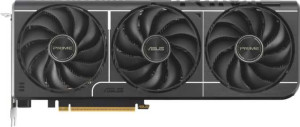
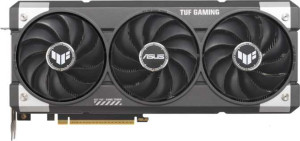
At their core, the Asus Prime RTX 5060 Ti OC and the Asus TUF Gaming RTX 5060 Ti are built on identical silicon: the same 4608 shading units, 144 TMUs, 48 ROPs, and 1750 MHz memory speed. This means their fundamental compute architecture and memory bandwidth are indistinguishable, and both support Double Precision Floating Point — a feature relevant for compute workloads beyond gaming.
The real differentiator here is the factory overclock applied to the Prime OC Edition. While both cards share the same base clock of 2407 MHz, the Prime OC boosts to 2617 MHz versus the TUF's 2572 MHz — a gap of 45 MHz, or roughly 1.75%. This directly cascades into every derived throughput metric: the Prime OC edges ahead with 24.12 TFLOPS of floating-point performance versus 23.7 TFLOPS, and leads in both pixel fill rate (125.6 vs 123.5 GPixel/s) and texture throughput (376.8 vs 370.4 GTexels/s). In practice, a sub-2% clock advantage rarely translates to a perceptible framerate difference in gaming, but it does give the Prime OC a consistent, measurable lead across all compute-bound scenarios.
The Prime OC Edition holds a clear but narrow performance edge in this group, driven entirely by its higher turbo clock. Users prioritizing peak throughput will find it the stronger card on paper, while those who view the TUF's slightly lower clocks as acceptable in exchange for other factors — such as cooling design or price — lose very little raw performance in the trade-off.