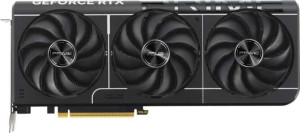
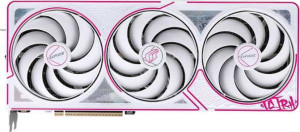
When comparing the Asus Prime RTX 5070 Ti OC and the Colorful iGame RTX 5070 Ti Ultra W OC on pure performance metrics, the data tells a straightforward story: these two cards are built on an identical performance foundation. Both share a base GPU clock of 2295 MHz and a turbo clock of 2497 MHz, and every downstream metric — 44.75 TFLOPS of floating-point performance, a pixel rate of 239.7 GPixel/s, and a texture rate of 699.2 GTexels/s — is a direct reflection of that shared clock profile. Neither card has been tuned to squeeze out additional headroom at the factory level.
At the hardware unit level, both GPUs expose the same 8960 shading units, 280 TMUs, and 96 ROPs. These counts directly govern how much geometry, texture, and pixel workload the GPU can process per clock cycle. With ROPs and TMUs aligned, neither card will pull ahead in rasterization-heavy titles or texture-bound scenarios. Memory speed is equally matched at 1750 MHz, meaning bandwidth characteristics — and thus performance in memory-sensitive workloads like high-resolution rendering or large asset streaming — will be indistinguishable between the two. Both also support Double Precision Floating Point, which matters for compute and professional workloads beyond gaming.
The verdict for this group is an absolute tie. Every measurable performance parameter is identical across both cards. Any real-world performance difference between them will come down to factors outside this group — cooling efficiency, sustained boost behavior under thermal load, or memory configuration — not the core GPU engine itself. Buyers choosing between these two should look to other categories to find a differentiator.