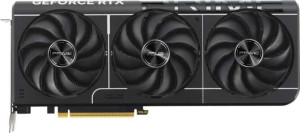
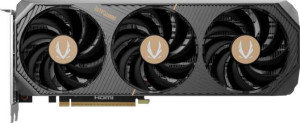
At their core, the Asus Prime RTX 5070 Ti OC and the Zotac Gaming RTX 5070 Ti Solid SFF OC are built on virtually identical hardware foundations. Both cards share the same 2295 MHz base clock, 8960 shading units, 280 TMUs, 96 ROPs, and 1750 MHz memory speed — meaning the underlying GPU silicon and memory subsystem are, for all practical purposes, the same. Both also support Double Precision Floating Point, which is relevant for compute and professional workloads beyond standard gaming.
The only meaningful differentiator within this group is the boost clock: the Asus reaches a turbo of 2497 MHz versus the Zotac's 2482 MHz — a gap of just 15 MHz, or roughly 0.6%. This marginal advantage cascades into the derived metrics: the Asus posts a pixel rate of 239.7 GPixel/s versus 238.3 GPixel/s, a texture rate of 699.2 GTexels/s versus 695 GTexels/s, and floating-point performance of 44.75 TFLOPS versus 44.48 TFLOPS. These are not independent advantages — they all flow directly from that single clock speed delta.
In real-world terms, a sub-1% boost clock difference will produce no perceptible performance gap in gaming or general GPU workloads; benchmark variance alone would likely dwarf this delta. The Asus Prime holds a technical edge on paper, but buyers should treat these two cards as performance equals and weigh other factors — such as cooling design, form factor, and price — far more heavily than these negligible figures.