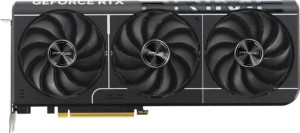
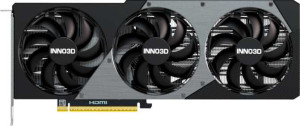
Both the Asus Prime RTX 5070 Ti and the Inno3D RTX 5070 Ti X3 OC share identical silicon foundations: the same 8960 shading units, 280 TMUs, 96 ROPs, and 1750 MHz memory speed. Their base GPU clock is also locked at 2295 MHz, which means any performance divergence between the two comes entirely from how aggressively each card boosts under load.
Under boost conditions, the Inno3D X3 OC pulls ahead in raw compute metrics. Its 2482 MHz turbo clock outpaces the Asus Prime's 2452 MHz by 30 MHz, translating into a marginally higher 44.48 TFLOPS of floating-point throughput versus 43.94 TFLOPS, and a slightly superior texture fill rate of 695 GTexels/s compared to 686.6 GTexels/s. These differences are modest — under 2% — but they consistently favor the Inno3D in shader-heavy and compute-intensive workloads. Conversely, the Asus Prime reports a notably higher pixel rate of 313.9 GPixel/s against the Inno3D's 238.3 GPixel/s, which on paper would suggest an advantage in rasterization-heavy scenes. Both cards support Double Precision Floating Point, relevant for professional compute tasks.
In practical terms, the performance gap between these two cards is razor-thin for gaming. The Inno3D X3 OC holds a slight edge in shader and compute throughput thanks to its higher factory overclock, making it the marginally stronger choice for users who prioritize compute tasks or want every last frame in GPU-limited scenarios. The Asus Prime's higher reported pixel rate is an outlier worth noting, but the real-world advantage of the Inno3D's across-the-board compute metrics gives it a narrow but consistent lead in this group.