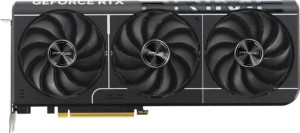
Asus Prime GeForce RTX 5070 Ti
MSI GeForce RTX 5070 Ti Inspire 3X OC Plus

Asus Prime GeForce RTX 5070 Ti MSI GeForce RTX 5070 Ti Inspire 3X OC Plus

Overview

Choosing between the Asus Prime GeForce RTX 5070 Ti and the MSI GeForce RTX 5070 Ti Inspire 3X OC Plus means evaluating two Blackwell-architecture cards that share a remarkably similar foundation in memory, features, and thermal design. Both pack 16GB of GDDR7 VRAM and a 300W TDP, yet they differ in key areas such as GPU turbo clock speed, pixel rate, texture throughput, and physical dimensions. This head-to-head breaks down every specification to help you decide which card is the right fit.

Common Features

  • Both cards share a base GPU clock speed of 2295 MHz.
  • Both cards have a GPU memory speed of 1750 MHz.
  • Both cards feature 8960 shading units.
  • Both cards include 280 texture mapping units (TMUs).
  • Both cards have 96 render output units (ROPs).
  • Double Precision Floating Point (DPFP) support is available on both cards.
  • Both cards have an effective memory speed of 28000 MHz.
  • Both cards offer a maximum memory bandwidth of 896 GB/s.
  • Both cards come equipped with 16GB of VRAM.
  • Both cards use GDDR7 memory.
  • Both cards have a 256-bit memory bus width.
  • ECC memory support is available on both cards.
  • Both cards support DirectX 12 Ultimate.
  • Both cards support OpenGL version 4.6.
  • Both cards support OpenCL version 3.
  • Multi-display technology is supported on both cards.
  • Ray tracing is supported on both cards.
  • 3D support is available on both cards.
  • DLSS support is available on both cards.
  • XeSS (XMX) support is not available on either card.
  • Both cards include one HDMI 2.1b output.
  • Both cards provide three DisplayPort outputs.
  • Neither card includes USB-C, DVI, or mini DisplayPort outputs.
  • Both cards are built on the Blackwell GPU architecture.
  • Both cards have a Thermal Design Power (TDP) of 300W.
  • Both cards use PCI Express version 5.
  • Both cards are manufactured on a 5 nm semiconductor process.
  • Both cards contain 45600 million transistors.
  • Air-water cooling is not available on either card.

Main Differences

  • GPU turbo clock speed is 2452 MHz on the Asus Prime GeForce RTX 5070 Ti and 2482 MHz on the MSI GeForce RTX 5070 Ti Inspire 3X OC Plus.
  • Pixel rate is 313.9 GPixel/s on the Asus Prime GeForce RTX 5070 Ti and 238.3 GPixel/s on the MSI GeForce RTX 5070 Ti Inspire 3X OC Plus.
  • Floating-point performance is 43.94 TFLOPS on the Asus Prime GeForce RTX 5070 Ti and 44.48 TFLOPS on the MSI GeForce RTX 5070 Ti Inspire 3X OC Plus.
  • Texture rate is 686.6 GTexels/s on the Asus Prime GeForce RTX 5070 Ti and 695 GTexels/s on the MSI GeForce RTX 5070 Ti Inspire 3X OC Plus.
  • Card width is 304 mm on the Asus Prime GeForce RTX 5070 Ti and 288 mm on the MSI GeForce RTX 5070 Ti Inspire 3X OC Plus.
  • Card height is 126 mm on the Asus Prime GeForce RTX 5070 Ti and 112 mm on the MSI GeForce RTX 5070 Ti Inspire 3X OC Plus.
Specs Comparison
Asus Prime GeForce RTX 5070 Ti

Asus Prime GeForce RTX 5070 Ti

MSI GeForce RTX 5070 Ti Inspire 3X OC Plus

MSI GeForce RTX 5070 Ti Inspire 3X OC Plus

Performance:
GPU clock speed 2295 MHz 2295 MHz
GPU turbo 2452 MHz 2482 MHz
pixel rate 313.9 GPixel/s 238.3 GPixel/s
floating-point performance 43.94 TFLOPS 44.48 TFLOPS
texture rate 686.6 GTexels/s 695 GTexels/s
GPU memory speed 1750 MHz 1750 MHz
shading units 8960 8960
texture mapping units (TMUs) 280 280
render output units (ROPs) 96 96
Has Double Precision Floating Point (DPFP)

At their foundation, both cards are nearly identical: the same 2295 MHz base clock, 8960 shading units, 280 TMUs, 96 ROPs, and 1750 MHz memory speed. This means the core GPU silicon and memory subsystem are essentially the same, and any performance differences will come down to how each manufacturer pushes the chip in boosted states.

Looking at those boosted states, the picture diverges in an interesting way. The MSI Inspire 3X OC Plus pulls ahead on raw compute metrics: its 2482 MHz GPU turbo (versus 2452 MHz on the Asus Prime) translates into marginally higher floating-point throughput at 44.48 TFLOPS and a texture rate of 695 GTexels/s — edges of roughly 1.2% and 1.2% respectively. In shader-heavy or compute-intensive workloads such as ray tracing, AI-accelerated rendering, or general GPU compute, this small headroom in favor of the MSI is real but unlikely to be perceptible in practice. On the other side, the Asus Prime reports a substantially higher pixel rate of 313.9 GPixel/s versus 238.3 GPixel/s for the MSI — a difference that, if accurate, would suggest an advantage in traditional rasterization throughput, particularly at high resolutions where fill rate becomes a bottleneck.

In summary, both cards share the same hardware DNA and neither dominates the other comprehensively. The MSI holds a slim but consistent edge in floating-point and texture performance — metrics that matter most for compute and texture-bound scenes. The Asus counters with a notably higher declared pixel fill rate, which is relevant for rasterization-heavy gaming scenarios. For most users, these differences are marginal enough that real-world frame rates will be virtually indistinguishable; the decision between the two should rest on factors like cooling design, noise levels, and price rather than raw performance figures.
Memory:
effective memory speed 28000 MHz 28000 MHz
maximum memory bandwidth 896 GB/s 896 GB/s
VRAM 16GB 16GB
GDDR version GDDR7 GDDR7
memory bus width 256-bit 256-bit
Supports ECC memory

The memory specifications for the Asus Prime GeForce RTX 5070 Ti and the MSI GeForce RTX 5070 Ti Inspire 3X OC Plus are identical. Both cards feature an effective memory speed of 28000 MHz and a maximum memory bandwidth of 896 GB/s. They both come with 16GB of VRAM, utilize GDDR7 memory, and have a 256-bit memory bus width.

Additionally, both cards support ECC (Error-Correcting Code) memory, ensuring stability and reliability during demanding tasks.

In summary, the memory configurations on these two products are exactly the same, with no differences in any of the key memory specifications provided.

Features:
DirectX version DirectX 12 Ultimate DirectX 12 Ultimate
OpenGL version 4.6 4.6
OpenCL version 3 3
Supports multi-display technology
supports ray tracing
Supports 3D
supports DLSS
has XeSS (XMX)
AMD SAM / Intel Resizable BAR Intel Resizable BAR Intel Resizable BAR
has LHR
has RGB lighting
supported displays 4 4

The features of the Asus Prime GeForce RTX 5070 Ti and the MSI GeForce RTX 5070 Ti Inspire 3X OC Plus are virtually identical. Both cards support DirectX 12 Ultimate, OpenGL 4.6, and OpenCL 3, ensuring compatibility with a wide range of modern applications. They also support multi-display technology, ray tracing, and 3D, which are key features for immersive gaming and high-end visualization tasks. Additionally, both cards support DLSS for improved performance in supported games.

Neither product supports XeSS (XMX), and both have Intel Resizable BAR enabled, while lacking LHR (Lite Hash Rate) functionality. RGB lighting is also absent in both models, maintaining a more subdued aesthetic.

Finally, both the Asus and MSI cards can support up to 4 displays, offering plenty of room for multitasking or multi-monitor setups. Overall, these two products share the same feature set, with no differences in the listed specifications.

Ports:
has an HDMI output
HDMI ports 1 1
HDMI version HDMI 2.1b HDMI 2.1b
DisplayPort outputs 3 3
USB-C ports 0 0
DVI outputs 0 0
mini DisplayPort outputs 0 0

The port configurations of the Asus Prime GeForce RTX 5070 Ti and the MSI GeForce RTX 5070 Ti Inspire 3X OC Plus are identical. Both cards include one HDMI output with HDMI 2.1b support and three DisplayPort outputs. Neither card includes USB-C ports, DVI outputs, or mini DisplayPort outputs.

Thus, the two products offer the same port options for connecting displays, with no differences in the number or type of available outputs.

General info:
GPU architecture Blackwell Blackwell
release date January 2025 February 2025
Thermal Design Power (TDP) 300W 300W
PCI Express (PCIe) version 5 5
semiconductor size 5 nm 5 nm
number of transistors 45600 million 45600 million
Has air-water cooling
width 304 mm 288 mm
height 126 mm 112 mm

The general specifications of the Asus Prime GeForce RTX 5070 Ti and the MSI GeForce RTX 5070 Ti Inspire 3X OC Plus are nearly identical. Both cards use the Blackwell GPU architecture, have a Thermal Design Power (TDP) of 300W, and feature a 5 nm semiconductor size with 45.6 billion transistors. Additionally, both products utilize PCIe version 5 and lack air-water cooling systems.

However, there are slight differences in size: the Asus card has a width of 304 mm and a height of 126 mm, while the MSI card is smaller with a width of 288 mm and a height of 112 mm.

In summary, both products share the same core technical features, with the only notable difference being the size, with the Asus card being slightly larger than the MSI model.

Comparison Summary & Verdict

Both the Asus Prime GeForce RTX 5070 Ti and the MSI GeForce RTX 5070 Ti Inspire 3X OC Plus are built on the same Blackwell architecture and share identical VRAM, memory bandwidth, port selection, and feature support, making them evenly matched at their core. The MSI pulls ahead with a higher GPU turbo clock of 2482 MHz, slightly better floating-point performance at 44.48 TFLOPS, and a superior texture rate of 695 GTexels/s, suiting users who prioritize compute and shading throughput. The Asus counters with a significantly higher pixel rate of 313.9 GPixel/s, which benefits rasterization-heavy scenarios. The MSI is also the more compact option at 288 x 112 mm versus the Asus at 304 x 126 mm, an advantage in tighter builds. Choose the Asus for pixel-fill workloads and the MSI for a blend of higher clock speeds, compute performance, and a smaller footprint.

Asus Prime GeForce RTX 5070 Ti
Buy Asus Prime GeForce RTX 5070 Ti if...

Buy the Asus Prime GeForce RTX 5070 Ti if you prioritize a higher pixel rate of 313.9 GPixel/s for rasterization-heavy workloads and do not have strict size constraints.

MSI GeForce RTX 5070 Ti Inspire 3X OC Plus
Buy MSI GeForce RTX 5070 Ti Inspire 3X OC Plus if...

Buy the MSI GeForce RTX 5070 Ti Inspire 3X OC Plus if you want a higher GPU turbo clock, better floating-point and texture performance, and a more compact card that fits tighter PC builds.