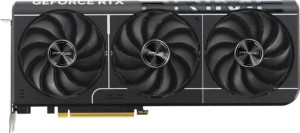
The most decisive differentiator in this group is raw compute throughput. The Asus Prime RTX 5070 Ti fields significantly more hardware resources — 8960 shading units, 280 TMUs, and 96 ROPs versus the Zotac Gaming RTX 5070 Solid OC's 6144 shading units, 192 TMUs, and 80 ROPs. This translates directly into a ~41% advantage in floating-point performance (43.94 TFLOPS vs 31.24 TFLOPS), a ~39% lead in texture throughput, and a ~54% edge in pixel fill rate. In practice, this means the 5070 Ti can push meaningfully higher framerates at demanding resolutions and handle more complex shading workloads without bottlenecking.
Interestingly, the Zotac 5070 Solid OC does clock higher — its base sits at 2325 MHz with a boost of 2542 MHz, compared to the 5070 Ti's 2295 MHz base and 2452 MHz boost. However, clock speed alone cannot compensate for the gap in shader and execution unit count; higher clocks on a smaller chip still yield lower absolute throughput, as the TFLOPS figures confirm. Both cards share identical GPU memory speed at 1750 MHz and both support Double Precision Floating Point, making them equivalent on those narrower points.
The Asus Prime RTX 5070 Ti holds a clear and substantial performance advantage in this group across every major compute metric. The Zotac 5070 Solid OC's clock speed lead is real but cosmetic in impact — the 5070 Ti's broader execution architecture overwhelms it. Users prioritizing raw rendering power, high-resolution gaming, or GPU-accelerated workloads should favor the 5070 Ti; the 5070 Solid OC is a lower-tier part that competes on efficiency and price, not peak throughput.