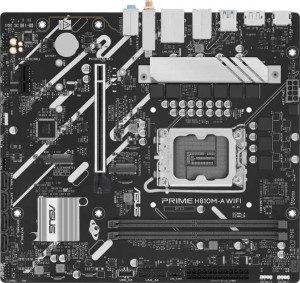
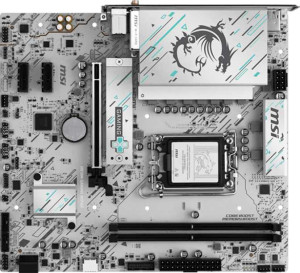
Both the Asus Prime H810M-A WiFi and the MSI H810M Gaming Wi-Fi6E share the same LGA 1851 socket, Micro-ATX form factor, Bluetooth 5.3, and HDMI 2.1 output, making them broadly comparable as platforms. Their physical dimensions are virtually identical, and both carry a 3-year warranty — so neither stands out on fundamentals alone.
The most meaningful general-info differentiator is wireless connectivity. The MSI extends its Wi-Fi support to Wi-Fi 6E (802.11ax), which unlocks the 6 GHz band — delivering less congestion and lower latency in dense wireless environments — while the Asus tops out at Wi-Fi 6. For users with a Wi-Fi 6E router, the MSI will tangibly benefit from that investment; for everyone else, the difference is moot today but relevant for future-proofing. The second notable split is in BIOS resilience: the Asus offers an easy BIOS reset mechanism (handy for quick recovery after a failed update or misconfiguration), whereas the MSI counters with a dual BIOS — a backup chip that automatically restores firmware if the primary becomes corrupted, which is arguably a more robust long-term safeguard.
Overall, the MSI H810M Gaming Wi-Fi6E holds a narrow edge in this group: its Wi-Fi 6E support and dual BIOS offer more forward-looking connectivity and stronger firmware redundancy. The Asus's easy BIOS reset is a convenience feature, but it is a lesser safety net compared to having a full backup BIOS chip. Users who already own or plan to buy a Wi-Fi 6E router, or who prioritize firmware resilience, will find the MSI the more capable choice on these general specifications.