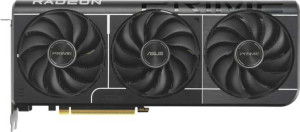
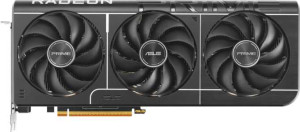
At first glance, the Asus Prime RX 9060 XT OC appears competitive on the clock front, with a base clock of 1700 MHz and a turbo of 3130 MHz — both slightly ahead of the RX 9070 XT OC's 1660 / 3010 MHz. However, raw clock speed is only one piece of the performance puzzle, and in this case it is largely overshadowed by a far more consequential gap in silicon resources.
The RX 9070 XT OC fields exactly twice the execution hardware: 4096 shading units, 256 TMUs, and 128 ROPs versus the 9060 XT's 2048 / 128 / 64. That doubling translates almost linearly into the throughput figures — the 9070 XT delivers 49.32 TFLOPS of floating-point performance and a texture rate of 770.6 GTexels/s, compared to 25.64 TFLOPS and 400.6 GTexels/s on the 9060 XT. In practice, this means the 9070 XT can push significantly more geometry and shading work per frame, which directly benefits complex scenes, higher resolutions, and GPU-compute workloads. The pixel fill rate of 385.3 GPixel/s versus 200.3 GPixel/s also favors the 9070 XT, meaning it can resolve nearly twice as many pixels per second — a tangible advantage at 4K. Memory speed is identical at 2518 MHz on both cards, and both support Double Precision Floating Point, so neither holds an edge there.
The RX 9070 XT OC Edition holds a clear and decisive performance advantage in this group. The 9060 XT's marginally higher clocks are a minor footnote against the 9070 XT's approximately ~92% lead across every major throughput metric, driven entirely by its larger shader array. Users prioritizing raw rendering horsepower — especially at 1440p or 4K — will find the 9070 XT the significantly more capable card.