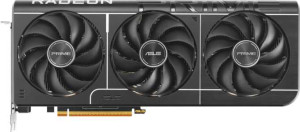
Asus Prime Radeon RX 9070 XT OC Edition
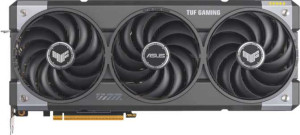
Asus TUF Gaming Radeon RX 9070 XT OC Edition

Asus Prime Radeon RX 9070 XT OC Edition Asus TUF Gaming Radeon RX 9070 XT OC Edition

Overview

Welcome to our detailed spec comparison between the Asus Prime Radeon RX 9070 XT OC Edition and the Asus TUF Gaming Radeon RX 9070 XT OC Edition — two factory-overclocked AMD RDNA 4.0 cards targeting enthusiast PC builders. While both share the same 16GB GDDR6 memory configuration and 304W TDP, the battle lines are drawn around peak GPU boost clocks, raw throughput figures, physical dimensions, and aesthetics. Read on to find out which card earns its place in your build.

Common Features

  • Both cards share a base GPU clock speed of 1660 MHz.
  • Both cards have a GPU memory speed of 2518 MHz.
  • Both cards feature 4096 shading units.
  • Both cards include 256 texture mapping units (TMUs).
  • Both cards have 128 render output units (ROPs).
  • Double Precision Floating Point (DPFP) is supported on both cards.
  • Both cards have an effective memory speed of 20000 MHz.
  • Both cards offer a maximum memory bandwidth of 644.6 GB/s.
  • Both cards come equipped with 16GB of VRAM.
  • Both cards use GDDR6 memory.
  • Both cards feature a 256-bit memory bus width.
  • ECC memory support is available on both cards.
  • Both cards support DirectX 12 Ultimate.
  • Both cards support OpenGL version 4.6.
  • Both cards support OpenCL version 2.2.
  • Multi-display technology is supported on both cards.
  • Ray tracing support is available on both cards.
  • 3D support is available on both cards.
  • DLSS is not supported on either card.
  • FSR4 support is available on both cards.
  • Both cards include one HDMI 2.1b output and three DisplayPort outputs.
  • Neither card includes USB-C, DVI, or mini DisplayPort outputs.
  • Both cards are built on the RDNA 4.0 GPU architecture.
  • Both cards have a Thermal Design Power (TDP) of 304W.
  • Both cards use PCIe version 5.
  • Both cards are manufactured on a 4 nm semiconductor process.
  • Both cards contain 53900 million transistors.
  • Neither card features air-water cooling.

Main Differences

  • GPU turbo clock speed is 3010 MHz on Asus Prime Radeon RX 9070 XT OC Edition and 3060 MHz on Asus TUF Gaming Radeon RX 9070 XT OC Edition.
  • Pixel rate is 385.3 GPixel/s on Asus Prime Radeon RX 9070 XT OC Edition and 391.7 GPixel/s on Asus TUF Gaming Radeon RX 9070 XT OC Edition.
  • Floating-point performance is 49.32 TFLOPS on Asus Prime Radeon RX 9070 XT OC Edition and 50.14 TFLOPS on Asus TUF Gaming Radeon RX 9070 XT OC Edition.
  • Texture rate is 770.6 GTexels/s on Asus Prime Radeon RX 9070 XT OC Edition and 783.4 GTexels/s on Asus TUF Gaming Radeon RX 9070 XT OC Edition.
  • RGB lighting is present on Asus TUF Gaming Radeon RX 9070 XT OC Edition but not available on Asus Prime Radeon RX 9070 XT OC Edition.
  • Card width is 312 mm on Asus Prime Radeon RX 9070 XT OC Edition and 330 mm on Asus TUF Gaming Radeon RX 9070 XT OC Edition.
  • Card height is 130 mm on Asus Prime Radeon RX 9070 XT OC Edition and 140 mm on Asus TUF Gaming Radeon RX 9070 XT OC Edition.
Specs Comparison
Asus Prime Radeon RX 9070 XT OC Edition

Asus Prime Radeon RX 9070 XT OC Edition

Asus TUF Gaming Radeon RX 9070 XT OC Edition

Asus TUF Gaming Radeon RX 9070 XT OC Edition

Performance:
GPU clock speed 1660 MHz 1660 MHz
GPU turbo 3010 MHz 3060 MHz
pixel rate 385.3 GPixel/s 391.7 GPixel/s
floating-point performance 49.32 TFLOPS 50.14 TFLOPS
texture rate 770.6 GTexels/s 783.4 GTexels/s
GPU memory speed 2518 MHz 2518 MHz
shading units 4096 4096
texture mapping units (TMUs) 256 256
render output units (ROPs) 128 128
Has Double Precision Floating Point (DPFP)

At their core, both the Asus Prime RX 9070 XT OC and the Asus TUF Gaming RX 9070 XT OC share identical silicon foundations: the same 4096 shading units, 256 TMUs, 128 ROPs, a base clock of 1660 MHz, and memory running at 2518 MHz. This means both cards draw from the same pool of raw compute resources and memory bandwidth, giving them near-identical performance floors in typical workloads.

The only meaningful differentiator in this group is the GPU boost clock. The TUF Gaming edition reaches 3060 MHz versus the Prime's 3010 MHz — a 50 MHz advantage that directly lifts its derived metrics: floating-point performance edges to 50.14 TFLOPS vs 49.32 TFLOPS, texture throughput to 783.4 GTexels/s vs 770.6 GTexels/s, and pixel fill rate to 391.7 GPixel/s vs 385.3 GPixel/s. In practice, a ~1.7% boost clock difference translates to a performance gap that is real but marginal — likely imperceptible in most gaming scenarios, though it could surface as a consistent single-digit frame rate lead under sustained heavy loads like 4K rasterization or compute-intensive tasks.

Based strictly on the provided specs, the TUF Gaming RX 9070 XT OC holds a narrow but measurable performance edge, solely due to its higher turbo clock. The Prime edition is not disadvantaged in any fundamental way — its architecture is identical — but if peak throughput is the priority, the TUF Gaming variant is the stronger performer of the two.
Memory:
effective memory speed 20000 MHz 20000 MHz
maximum memory bandwidth 644.6 GB/s 644.6 GB/s
VRAM 16GB 16GB
GDDR version GDDR6 GDDR6
memory bus width 256-bit 256-bit
Supports ECC memory

When it comes to memory, the Asus Prime RX 9070 XT OC and the Asus TUF Gaming RX 9070 XT OC are carbon copies of each other. Both carry 16GB of GDDR6 across a 256-bit bus, delivering an effective memory speed of 20000 MHz and a peak bandwidth of 644.6 GB/s. There is no differentiator to be found here — every single memory specification is shared between the two cards.

The specs themselves are well-suited for the cards' target tier. 16GB of VRAM provides comfortable headroom for high-resolution gaming, including texture-heavy titles at 4K, and leaves room for AI-assisted rendering workloads. The 256-bit bus paired with GDDR6 at this speed yields bandwidth that keeps the GPU's shader array fed without becoming a bottleneck under typical gaming loads. The added support for ECC memory is a noteworthy inclusion — it enables error-correcting memory operation, which is more relevant for professional or compute workloads than gaming, but signals the memory subsystem's robustness.

This group is a clear and complete tie. Neither the Prime nor the TUF Gaming edition holds any memory advantage whatsoever, so this category should carry no weight in a purchasing decision between the two.

Features:
DirectX version DirectX 12 Ultimate DirectX 12 Ultimate
OpenGL version 4.6 4.6
OpenCL version 2.2 2.2
Supports multi-display technology
supports ray tracing
Supports 3D
supports DLSS
has FSR4
has XeSS (XMX)
AMD SAM / Intel Resizable BAR AMD SAM AMD SAM
has LHR
has RGB lighting
supported displays 4 4

Functionally, the Asus Prime RX 9070 XT OC and the Asus TUF Gaming RX 9070 XT OC are feature-identical in every meaningful way. Both support DirectX 12 Ultimate and ray tracing, ensuring compatibility with the full spectrum of modern rendering techniques. Both include FSR4 — AMD's latest upscaling technology — which is a significant asset for boosting frame rates at higher resolutions with minimal image quality trade-offs. Neither card supports DLSS, which is expected given these are AMD products, and XeSS (XMX) is also absent on both.

The sole differentiator in this group is RGB lighting: the TUF Gaming edition has it, the Prime does not. This is purely an aesthetic distinction with no bearing on gaming performance or software capability. For users building a visually coordinated system — particularly those using Asus Aura Sync ecosystems — the TUF Gaming's lighting integration adds genuine value. For those indifferent to aesthetics or preferring a cleaner look, the Prime's lack of RGB is equally valid.

On features, these two cards are essentially tied where it matters. The TUF Gaming RX 9070 XT OC earns a marginal edge solely due to RGB lighting, but this advantage is entirely subjective and lifestyle-driven rather than technical. Buyers should weight this difference only according to their own preference for system aesthetics.

Ports:
has an HDMI output
HDMI ports 1 1
HDMI version HDMI 2.1b HDMI 2.1b
DisplayPort outputs 3 3
USB-C ports 0 0
DVI outputs 0 0
mini DisplayPort outputs 0 0

Port configuration is identical across both cards. The Asus Prime RX 9070 XT OC and the Asus TUF Gaming RX 9070 XT OC each offer three DisplayPort outputs and one HDMI 2.1b port, totaling four simultaneous display connections — which aligns with the four supported displays noted in their feature specs. There are no USB-C, DVI, or mini DisplayPort outputs on either card.

The output selection is well-chosen for a card at this tier. HDMI 2.1b supports 4K at high refresh rates and 8K output, making it a solid single-cable solution for modern TVs and high-end monitors alike. The three DisplayPort outputs cater to multi-monitor desktop setups or high-refresh-rate gaming displays, where DisplayPort remains the preferred standard for its bandwidth headroom. The absence of USB-C is worth noting for users who rely on USB-C monitors or need DisplayPort Alt Mode, though it is not an unusual omission at this product tier.

This category is an unambiguous tie — port layout, versions, and counts are perfectly matched. Connectivity should play no role in choosing between these two cards.

General info:
GPU architecture RDNA 4.0 RDNA 4.0
release date March 2025 March 2025
Thermal Design Power (TDP) 304W 304W
PCI Express (PCIe) version 5 5
semiconductor size 4 nm 4 nm
number of transistors 53900 million 53900 million
Has air-water cooling
width 312 mm 330 mm
height 130 mm 140 mm

Both the Asus Prime RX 9070 XT OC and the Asus TUF Gaming RX 9070 XT OC are built on the same RDNA 4.0 architecture, fabbed at 4nm with an identical transistor count of 53.9 billion. They share the same 304W TDP and PCIe 5.0 interface, meaning power delivery requirements and motherboard compatibility are exactly the same for both. At the silicon level, these two cards are indistinguishable.

The only differentiator in this group is physical size. The TUF Gaming edition measures 330 × 140 mm, while the Prime comes in at a more compact 312 × 130 mm — roughly 18mm shorter in length and 10mm slimmer in height. This distinction is genuinely practical: in smaller mid-tower or mini-ITX-adjacent cases where clearance is tight, the Prime's reduced footprint could be the deciding factor for fitment. The TUF Gaming's larger dimensions are typically a byproduct of a more expansive cooling shroud, though thermal performance itself is not captured in this spec group.

For users with spacious cases, this group is functionally a tie — the shared architecture, TDP, and interface specs mean neither card demands anything different from the system around it. However, if case space is a constraint, the Prime RX 9070 XT OC holds a clear advantage with its more compact form factor.

Comparison Summary & Verdict

Both cards are built on the same RDNA 4.0 architecture with identical memory subsystems, port layouts, and power envelopes, making them closely matched at their core. The Asus TUF Gaming Radeon RX 9070 XT OC Edition edges ahead with a higher GPU turbo of 3060 MHz, a superior floating-point performance of 50.14 TFLOPS, and the added flair of RGB lighting — making it the stronger choice for enthusiasts who want every last drop of performance and a visually striking rig. The Asus Prime Radeon RX 9070 XT OC Edition, meanwhile, offers a more compact footprint at 312×130 mm, making it the smarter pick for tighter cases or builders who prefer a cleaner, no-RGB aesthetic without sacrificing the fundamentals.

Asus Prime Radeon RX 9070 XT OC Edition
Buy Asus Prime Radeon RX 9070 XT OC Edition if...

Buy the Asus Prime Radeon RX 9070 XT OC Edition if you have a compact case or prefer a smaller, no-RGB card that still delivers strong overclocked RDNA 4.0 performance.

Asus TUF Gaming Radeon RX 9070 XT OC Edition
Buy Asus TUF Gaming Radeon RX 9070 XT OC Edition if...

Buy the Asus TUF Gaming Radeon RX 9070 XT OC Edition if you want the highest boost clock, better raw throughput figures, and RGB lighting for a more visually dynamic build.