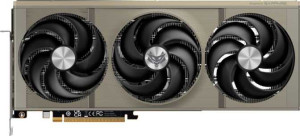
At the foundation, both the Asus Prime RX 9070 XT OC and the Sapphire Nitro+ RX 9070 XT share identical GPU architectures in terms of shader and rasterization hardware: 4096 shading units, 256 TMUs, and 128 ROPs. Their base clocks are also locked in at the same 1660 MHz, and both run their GDDR6 memory at 2518 MHz. This means the underlying silicon and memory bandwidth are equivalent — any performance difference between them comes purely from boost clock headroom.
That headroom is where the Sapphire Nitro+ pulls ahead. Its GPU turbo reaches 3060 MHz versus the Asus Prime's 3010 MHz — a 50 MHz advantage that directly cascades into every derived throughput metric. The Nitro+ delivers 50.14 TFLOPS of floating-point performance against the Prime's 49.32 TFLOPS, a 783.4 GTexels/s texture rate versus 770.6 GTexels/s, and a pixel fill rate of 391.7 GPixel/s compared to 385.3 GPixel/s. In practical terms, this translates to marginally faster geometry throughput, slightly snappier texture sampling in complex scenes, and a modest edge in raw compute workloads.
The performance gap is real but narrow — roughly 1.6% across all throughput metrics. In gaming, this difference is unlikely to be perceptible in frame rates under typical conditions, and both cards support Double Precision Floating Point for compute tasks. That said, the Sapphire Nitro+ RX 9070 XT holds a clear, if slim, performance edge in this group strictly by virtue of its higher sustained boost clock. If maximizing peak GPU throughput is the priority, the Nitro+ is the stronger choice on paper.