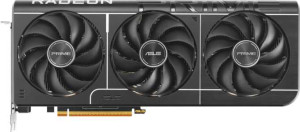
Asus Prime Radeon RX 9070 XT OC Edition
Sapphire Pure Radeon RX 9070 XT

Asus Prime Radeon RX 9070 XT OC Edition Sapphire Pure Radeon RX 9070 XT

Overview

Welcome to our in-depth specification comparison between the Asus Prime Radeon RX 9070 XT OC Edition and the Sapphire Pure Radeon RX 9070 XT. Both cards are built on the same RDNA 4.0 architecture and share identical core performance figures, making the choice between them a matter of finer details. In this comparison, we examine the key battlegrounds: port configurations, power consumption, physical dimensions, and feature extras like RGB lighting to help you decide which card suits your setup best.

Common Features

  • Both cards have a base GPU clock speed of 1660 MHz.
  • Both cards have a GPU turbo clock of 3010 MHz.
  • Both cards deliver a pixel rate of 385.3 GPixel/s.
  • Both cards offer 49.32 TFLOPS of floating-point performance.
  • Both cards have a texture rate of 770.6 GTexels/s.
  • Both cards have a GPU memory speed of 2518 MHz.
  • Both cards feature 4096 shading units.
  • Both cards have 256 texture mapping units (TMUs).
  • Both cards come with 16GB of GDDR6 VRAM.
  • Both cards have an effective memory speed of 20000 MHz.
  • Both cards provide a maximum memory bandwidth of 644.6 GB/s.
  • Both cards use a 256-bit memory bus width.
  • ECC memory support is available on both cards.
  • Both cards support DirectX 12 Ultimate.
  • Both cards support OpenGL version 4.6.
  • Both cards support OpenCL version 2.2.
  • Multi-display technology is supported on both cards.
  • Ray tracing support is available on both cards.
  • 3D support is available on both cards.
  • DLSS is not supported on either card.
  • FSR4 support is available on both cards.
  • Both cards have an HDMI 2.1b output.
  • Neither card has USB-C ports, DVI outputs, or mini DisplayPort outputs.
  • Both cards are built on the RDNA 4.0 GPU architecture.
  • Both cards use PCIe version 5.
  • Both cards are manufactured on a 4 nm semiconductor process.
  • Both cards feature 53900 million transistors.
  • Neither card supports air-water cooling.

Main Differences

  • RGB lighting is present on Sapphire Pure Radeon RX 9070 XT but not available on Asus Prime Radeon RX 9070 XT OC Edition.
  • HDMI port count is 1 on Asus Prime Radeon RX 9070 XT OC Edition and 2 on Sapphire Pure Radeon RX 9070 XT.
  • DisplayPort outputs number 3 on Asus Prime Radeon RX 9070 XT OC Edition and 2 on Sapphire Pure Radeon RX 9070 XT.
  • Thermal Design Power (TDP) is 304W on Asus Prime Radeon RX 9070 XT OC Edition and 317W on Sapphire Pure Radeon RX 9070 XT.
  • Card width is 312 mm on Asus Prime Radeon RX 9070 XT OC Edition and 320 mm on Sapphire Pure Radeon RX 9070 XT.
  • Card height is 130 mm on Asus Prime Radeon RX 9070 XT OC Edition and 120.3 mm on Sapphire Pure Radeon RX 9070 XT.
Specs Comparison
Asus Prime Radeon RX 9070 XT OC Edition

Asus Prime Radeon RX 9070 XT OC Edition

Sapphire Pure Radeon RX 9070 XT

Sapphire Pure Radeon RX 9070 XT

Performance:
GPU clock speed 1660 MHz 1660 MHz
GPU turbo 3010 MHz 3010 MHz
pixel rate 385.3 GPixel/s 385.3 GPixel/s
floating-point performance 49.32 TFLOPS 49.32 TFLOPS
texture rate 770.6 GTexels/s 770.6 GTexels/s
GPU memory speed 2518 MHz 2518 MHz
shading units 4096 4096
texture mapping units (TMUs) 256 256
render output units (ROPs) 128 128
Has Double Precision Floating Point (DPFP)

When comparing the Asus Prime RX 9070 XT OC and the Sapphire Pure RX 9070 XT on pure performance metrics, the data tells a remarkably clear story: these two cards are identical across every measurable specification in this group. Both share a base GPU clock of 1660 MHz, a turbo clock of 3010 MHz, 4096 shading units, 256 TMUs, and 128 ROPs, while delivering the same 49.32 TFLOPS of floating-point throughput and a memory speed of 2518 MHz.

What do these numbers mean in practice? A 3010 MHz turbo clock is an aggressive target for the RDNA 4 architecture, directly enabling the high pixel fill rate of 385.3 GPixel/s and the texture throughput of 770.6 GTexels/s — both figures that translate to smooth, high-resolution rendering and strong performance in texture-heavy scenes. The 49.32 TFLOPS figure is also relevant beyond gaming: it underpins compute workloads, AI inference, and creative applications. The inclusion of Double Precision Floating Point (DPFP) on both cards further extends their utility to scientific or professional compute tasks, a capability not always present at this market tier.

In terms of a winner for this group, there is no performance edge for either card — they are in a complete tie. Both boards are built around the same GPU configuration with no factory overclock differentiation visible in these specs. Any real-world performance difference between the two would come down to cooling efficiency and power delivery stability under sustained load, which fall outside this spec group.

Memory:
effective memory speed 20000 MHz 20000 MHz
maximum memory bandwidth 644.6 GB/s 644.6 GB/s
VRAM 16GB 16GB
GDDR version GDDR6 GDDR6
memory bus width 256-bit 256-bit
Supports ECC memory

The memory subsystems of the Asus Prime RX 9070 XT OC and the Sapphire Pure RX 9070 XT are, once again, a perfect mirror of each other. Both cards deploy 16GB of GDDR6 across a 256-bit bus, achieving an effective memory speed of 20000 MHz and a peak bandwidth of 644.6 GB/s.

These figures carry real weight. A 256-bit bus paired with fast GDDR6 at 20 Gbps yields bandwidth that comfortably supports high-resolution textures, large frame buffers, and demanding rasterization workloads at 4K. The 16GB VRAM allocation is generous for this tier, meaning neither card is likely to run into memory pressure in current games or content creation tasks — a meaningful advantage over competing products with smaller frame buffers. Both cards also support ECC memory, which enables error-correcting operation useful in compute and professional workflows where data integrity matters, a feature not commonly highlighted at the consumer GPU level.

As with the performance group, this category is a complete tie. Every memory specification — capacity, speed, bus width, and ECC support — is identical between the two. Buyers comparing these cards solely on memory credentials will find no reason to favor one over the other; the decision will need to rest on other factors such as cooling design, price, or software bundle.

Features:
DirectX version DirectX 12 Ultimate DirectX 12 Ultimate
OpenGL version 4.6 4.6
OpenCL version 2.2 2.2
Supports multi-display technology
supports ray tracing
Supports 3D
supports DLSS
has FSR4
has XeSS (XMX)
AMD SAM / Intel Resizable BAR AMD SAM AMD SAM
has LHR
has RGB lighting
supported displays 4 4

Across the software and API feature set, the Asus Prime RX 9070 XT OC and the Sapphire Pure RX 9070 XT are functionally identical. Both support DirectX 12 Ultimate and ray tracing, which together ensure compatibility with the full range of modern rendering techniques — including hardware-accelerated shadows, reflections, and global illumination in current titles. FSR4 support on both cards is also significant: AMD's latest upscaling generation uses machine-learning-based reconstruction to deliver sharper results at lower render resolutions, meaningfully extending performance headroom at 4K. Notably, neither card supports DLSS, which is expected given their AMD architecture.

Both cards also carry AMD SAM (Smart Access Memory), enabling a compatible AMD CPU to access the full VRAM pool directly — a feature that can yield measurable frame rate gains in SAM-optimized titles. Support for up to 4 simultaneous displays rounds out a practical multi-monitor feature set shared equally between the two.

The sole differentiator in this group is RGB lighting: the Sapphire Pure includes it, while the Asus Prime does not. This is purely an aesthetic distinction with no bearing on performance or compatibility. For buyers who value a clean, understated build, the Asus Prime's lack of RGB may actually be a draw — but for those who want lighting integration with their system, the Sapphire Pure holds a narrow cosmetic edge. On any functionally meaningful feature, the two cards are tied.

Ports:
has an HDMI output
HDMI ports 1 2
HDMI version HDMI 2.1b HDMI 2.1b
DisplayPort outputs 3 2
USB-C ports 0 0
DVI outputs 0 0
mini DisplayPort outputs 0 0

Port configuration is where this comparison finally produces a meaningful split. Both the Asus Prime RX 9070 XT OC and the Sapphire Pure RX 9070 XT offer four total display outputs and share the same HDMI 2.1b standard — capable of driving 4K at high refresh rates or 8K output — but they divide those four ports differently.

The Asus Prime opts for 1 HDMI and 3 DisplayPort outputs, while the Sapphire Pure flips the balance to 2 HDMI and 2 DisplayPort. In practice, this distinction matters depending on your display setup. Users running multiple monitors that rely on HDMI — such as televisions, older screens, or certain ultrawide panels — will find the Sapphire Pure's dual-HDMI layout more accommodating without needing adapters. Conversely, the Asus Prime's three DisplayPort outputs better serve workstation-style setups where DisplayPort daisy-chaining or high-refresh-rate gaming monitors are the norm, as DisplayPort generally offers broader feature support in professional and enthusiast display ecosystems.

Neither layout is objectively superior — it comes down entirely to what your monitors require. However, the Sapphire Pure holds a slight practical edge for the broader consumer audience, since HDMI remains the most common connector on living-room displays and many everyday monitors. Users with predominantly DisplayPort-based setups will prefer the Asus Prime. There is no difference in maximum connected display count or output quality between the two.

General info:
GPU architecture RDNA 4.0 RDNA 4.0
release date March 2025 March 2025
Thermal Design Power (TDP) 304W 317W
PCI Express (PCIe) version 5 5
semiconductor size 4 nm 4 nm
number of transistors 53900 million 53900 million
Has air-water cooling
width 312 mm 320 mm
height 130 mm 120.3 mm

Sharing the same RDNA 4.0 architecture, 4nm process node, and 53.9 billion transistors, the Asus Prime RX 9070 XT OC and the Sapphire Pure RX 9070 XT are built from identical silicon — so any differences here are purely the result of board design choices made by each manufacturer.

The most consequential divergence is thermal design power: the Asus Prime is rated at 304W while the Sapphire Pure draws up to 317W — a 13W gap. Since both cards deliver the same GPU clocks and performance figures, the Asus Prime's lower TDP means it achieves the same output while placing a lighter load on your power supply and, potentially, generating marginally less heat under sustained workloads. For systems running near their PSU ceiling or with constrained airflow, this difference is worth noting. The physical dimensions tell a complementary story: the Asus Prime measures 312 × 130mm against the Sapphire Pure's 320 × 120.3mm. The Pure is slightly longer and notably slimmer in height, while the Prime is shorter but taller — meaning case compatibility checks should be done carefully for both, as neither profile is universally easier to fit.

On balance, the Asus Prime RX 9070 XT OC holds a tangible edge in this group. Its lower 304W TDP is a meaningful practical advantage — same performance, less power demand — and its more compact length may suit a wider range of mid-tower cases. The Sapphire Pure's slimmer height could benefit builds with tighter vertical clearance, but its higher draw and greater length make it the less flexible option here.

Comparison Summary & Verdict

After examining all the evidence, it is clear that the Asus Prime Radeon RX 9070 XT OC Edition and the Sapphire Pure Radeon RX 9070 XT are closely matched at their core, sharing the same GPU performance, memory configuration, and feature set. The distinctions lie in the details. The Asus card edges ahead with a lower 304W TDP versus 317W, and offers three DisplayPort outputs compared to two on the Sapphire, making it a stronger pick for multi-monitor productivity builds. The Sapphire Pure, on the other hand, brings RGB lighting, two HDMI 2.1b ports instead of one, and a slightly more compact height of 120.3 mm, appealing to users who value aesthetics and flexible display connectivity. Neither card is objectively superior; your ideal choice depends entirely on your specific needs.

Asus Prime Radeon RX 9070 XT OC Edition
Buy Asus Prime Radeon RX 9070 XT OC Edition if...

Buy the Asus Prime Radeon RX 9070 XT OC Edition if you want lower power consumption and three DisplayPort outputs for a multi-monitor setup.

Sapphire Pure Radeon RX 9070 XT
Buy Sapphire Pure Radeon RX 9070 XT if...

Buy the Sapphire Pure Radeon RX 9070 XT if you want RGB lighting and dual HDMI 2.1b ports for a more flexible and visually expressive build.