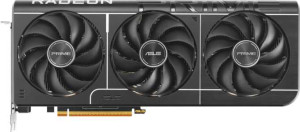
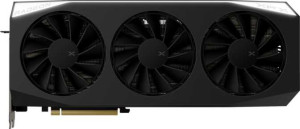
Underneath the heatsink, these two cards are built on identical foundations: the same RDNA 4.0 architecture, the same 4nm process node, and the same 53,900 million transistors. They share a 304W TDP and a PCIe 5.0 interface, meaning power requirements, slot compatibility, and the underlying silicon are indistinguishable. PCIe 5.0 doubles the available bandwidth versus PCIe 4.0, though at current GPU data rates this headroom remains largely theoretical — both cards will perform identically regardless of whether they are seated in a PCIe 4.0 or 5.0 slot.
Where the cards genuinely diverge is physical size. The Asus Prime OC Edition measures 312 × 130 mm, while the XFX Mercury is noticeably larger at 360 × 155 mm — that is a 48mm difference in length and 25mm in height. For builders working with compact mid-tower or small-form-factor cases, this gap is potentially decisive. The Asus fits into tighter chassis that the XFX simply cannot accommodate, and the shorter height may also ease clearance concerns near motherboard heatsinks or memory slots.
Given that both cards draw the same 304W and use air cooling exclusively, the XFX Mercury's larger footprint likely reflects a more expansive cooler designed to manage that thermal load across a bigger heatsink surface. However, since no thermal or noise data is provided in these specs, no conclusion can be drawn about cooling effectiveness. On pure physical footprint alone, the Asus Prime OC Edition holds a clear advantage for space-constrained builds, while the XFX Mercury demands more case real estate.