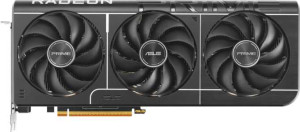
Asus Prime Radeon RX 9070 XT OC Edition
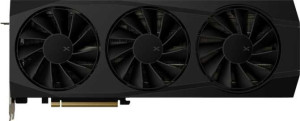
XFX Quicksilver Radeon RX 9070 XT Gaming Edition

Asus Prime Radeon RX 9070 XT OC Edition XFX Quicksilver Radeon RX 9070 XT Gaming Edition

Overview

Welcome to our in-depth spec comparison between the Asus Prime Radeon RX 9070 XT OC Edition and the XFX Quicksilver Radeon RX 9070 XT Gaming Edition. Both cards are built on AMD's RDNA 4.0 architecture with identical core configurations, yet they diverge in meaningful ways across peak clock speeds, real-world throughput figures, physical dimensions, and aesthetic features like RGB lighting. Read on to find out which card best suits your specific needs.

Common Features

  • Both cards share a base GPU clock speed of 1660 MHz.
  • Both cards have a GPU memory speed of 2518 MHz.
  • Both cards feature 4096 shading units.
  • Both cards include 256 texture mapping units (TMUs).
  • Both cards have 128 render output units (ROPs).
  • Double Precision Floating Point (DPFP) support is available on both cards.
  • Both cards have an effective memory speed of 20000 MHz.
  • Both cards come with 16GB of VRAM.
  • Both cards use GDDR6 memory.
  • Both cards feature a 256-bit memory bus width.
  • ECC memory support is available on both cards.
  • Both cards support DirectX 12 Ultimate.
  • Both cards support OpenGL version 4.6.
  • Both cards support OpenCL version 2.2.
  • Multi-display technology support is available on both cards.
  • Ray tracing support is available on both cards.
  • 3D support is available on both cards.
  • DLSS support is not available on either card.
  • FSR4 support is available on both cards.
  • Both cards feature 1 HDMI port using HDMI 2.1b and 3 DisplayPort outputs, with no USB-C, DVI, or mini DisplayPort outputs.
  • Both cards are built on the RDNA 4.0 GPU architecture.
  • Both cards have a Thermal Design Power (TDP) of 304W.
  • Both cards use PCIe version 5.
  • Both cards are manufactured on a 4 nm semiconductor process.
  • Both cards contain 53900 million transistors.
  • Neither card uses air-water cooling.

Main Differences

  • GPU turbo clock speed is 3010 MHz on the Asus Prime Radeon RX 9070 XT OC Edition and 2970 MHz on the XFX Quicksilver Radeon RX 9070 XT Gaming Edition.
  • Pixel rate is 385.3 GPixel/s on the Asus Prime Radeon RX 9070 XT OC Edition and 380.2 GPixel/s on the XFX Quicksilver Radeon RX 9070 XT Gaming Edition.
  • Floating-point performance is 49.32 TFLOPS on the Asus Prime Radeon RX 9070 XT OC Edition and 48.66 TFLOPS on the XFX Quicksilver Radeon RX 9070 XT Gaming Edition.
  • Texture rate is 770.6 GTexels/s on the Asus Prime Radeon RX 9070 XT OC Edition and 760.3 GTexels/s on the XFX Quicksilver Radeon RX 9070 XT Gaming Edition.
  • Maximum memory bandwidth is 644.6 GB/s on the Asus Prime Radeon RX 9070 XT OC Edition and 640 GB/s on the XFX Quicksilver Radeon RX 9070 XT Gaming Edition.
  • RGB lighting is present on the XFX Quicksilver Radeon RX 9070 XT Gaming Edition but not available on the Asus Prime Radeon RX 9070 XT OC Edition.
  • Card width is 312 mm on the Asus Prime Radeon RX 9070 XT OC Edition and 350 mm on the XFX Quicksilver Radeon RX 9070 XT Gaming Edition.
  • Card height is 130 mm on the Asus Prime Radeon RX 9070 XT OC Edition and 140 mm on the XFX Quicksilver Radeon RX 9070 XT Gaming Edition.
Specs Comparison
Asus Prime Radeon RX 9070 XT OC Edition

Asus Prime Radeon RX 9070 XT OC Edition

XFX Quicksilver Radeon RX 9070 XT Gaming Edition

XFX Quicksilver Radeon RX 9070 XT Gaming Edition

Performance:
GPU clock speed 1660 MHz 1660 MHz
GPU turbo 3010 MHz 2970 MHz
pixel rate 385.3 GPixel/s 380.2 GPixel/s
floating-point performance 49.32 TFLOPS 48.66 TFLOPS
texture rate 770.6 GTexels/s 760.3 GTexels/s
GPU memory speed 2518 MHz 2518 MHz
shading units 4096 4096
texture mapping units (TMUs) 256 256
render output units (ROPs) 128 128
Has Double Precision Floating Point (DPFP)

Both the Asus Prime RX 9070 XT OC and the XFX Quicksilver RX 9070 XT share the same fundamental GPU architecture: identical base clocks of 1660 MHz, the same 4096 shading units, 256 TMUs, 128 ROPs, and matching memory speeds of 2518 MHz. This means the two cards are built on exactly the same silicon foundation, and any performance gap between them comes down purely to how aggressively each manufacturer has tuned the boost behavior.

The meaningful differentiator here is the GPU turbo clock: the Asus reaches 3010 MHz versus 2970 MHz on the XFX — a 40 MHz advantage. That delta flows directly into every derived throughput metric: the Asus delivers 49.32 TFLOPS of floating-point performance against 48.66 TFLOPS, a 770.6 GTexels/s texture rate versus 760.3 GTexels/s, and a pixel fill rate of 385.3 GPixel/s compared to 380.2 GPixel/s. In absolute terms, these are roughly 1.3–1.4% differences — real, but modest.

In practice, this gap will be imperceptible in most gaming workloads, where frame-to-frame variance easily exceeds 1–2%. The Asus Prime OC Edition holds a narrow but consistent edge on paper thanks to its higher factory overclock, making it the slightly stronger performer by the numbers. However, buyers should weigh this marginal gain against pricing and cooling differences, as both cards are functionally near-identical in real-world use.

Memory:
effective memory speed 20000 MHz 20000 MHz
maximum memory bandwidth 644.6 GB/s 640 GB/s
VRAM 16GB 16GB
GDDR version GDDR6 GDDR6
memory bus width 256-bit 256-bit
Supports ECC memory

From a memory configuration standpoint, these two cards are nearly carbon copies of each other. Both feature 16GB of GDDR6 across a 256-bit bus at an effective speed of 20000 MHz, and both support ECC memory — a feature more relevant to professional and compute workloads than gaming, but indicative of the platform's versatility.

The only numerical divergence is in maximum memory bandwidth: the Asus Prime OC edges ahead at 644.6 GB/s versus 640 GB/s on the XFX Quicksilver — a gap of under 1%. This slight difference likely stems from the same factory overclock advantage seen in the GPU clocks, as bandwidth is directly tied to effective memory frequency. In practice, neither card will bottleneck in memory-intensive scenarios like high-resolution textures, ray tracing, or large frame buffers — 16GB at 256-bit is a well-balanced configuration for this performance tier.

For this specification group, the two cards are effectively tied. The 4.6 GB/s bandwidth advantage on the Asus is too marginal to produce any measurable real-world difference, and every other memory attribute is identical. Buyers should not let memory specs alone sway their decision between these two.

Features:
DirectX version DirectX 12 Ultimate DirectX 12 Ultimate
OpenGL version 4.6 4.6
OpenCL version 2.2 2.2
Supports multi-display technology
supports ray tracing
Supports 3D
supports DLSS
has FSR4
has XeSS (XMX)
AMD SAM / Intel Resizable BAR AMD SAM AMD SAM
has LHR
has RGB lighting
supported displays 4 4

On the software and API front, these two cards are indistinguishable. Both support DirectX 12 Ultimate, ray tracing, FSR 4, and AMD SAM, while neither supports DLSS or XeSS — expected behavior for AMD hardware. FSR 4 is worth highlighting as AMD's most advanced upscaling solution, offering meaningful performance-to-image-quality tradeoffs at higher resolutions, and its presence on both cards is a genuine asset. The shared support for up to 4 simultaneous displays also makes either card a capable choice for multi-monitor productivity setups.

The only differentiator in this group is aesthetic: the XFX Quicksilver includes RGB lighting, while the Asus Prime OC does not. For system builders who invest in a themed or illuminated build, this is a tangible distinction. For those indifferent to aesthetics, it carries no functional weight whatsoever.

Feature-for-feature, these cards are essentially tied on anything that affects actual rendering, compatibility, or display capability. The XFX holds a minor edge for RGB-focused builders, but if lighting is not a priority, neither card offers a meaningful feature advantage over the other in this category.

Ports:
has an HDMI output
HDMI ports 1 1
HDMI version HDMI 2.1b HDMI 2.1b
DisplayPort outputs 3 3
USB-C ports 0 0
DVI outputs 0 0
mini DisplayPort outputs 0 0

Port selection is identical across both cards: each offers 1 HDMI 2.1b output and 3 DisplayPort outputs, totaling four display connections — consistent with the four-display limit noted in the features group. The absence of USB-C, DVI, and mini DisplayPort outputs is the same on both, so neither card has an edge in connectivity flexibility.

The quality of those ports matters as much as the quantity. HDMI 2.1b supports up to 4K at high refresh rates and 8K output, making it well-suited for modern TVs and high-end monitors alike. Three DisplayPort outputs further enable dense multi-monitor configurations without the need for adapters, which is a practical advantage for productivity users and sim-racers running triple-screen setups.

This group is a complete tie — every port type, count, and version is identical. Connectivity should play no role in choosing between these two cards.

General info:
GPU architecture RDNA 4.0 RDNA 4.0
release date March 2025 March 2025
Thermal Design Power (TDP) 304W 304W
PCI Express (PCIe) version 5 5
semiconductor size 4 nm 4 nm
number of transistors 53900 million 53900 million
Has air-water cooling
width 312 mm 350 mm
height 130 mm 140 mm

At their core, these two cards are built on identical foundations: the same RDNA 4.0 architecture, fabbed on a 4nm process with 53.9 billion transistors, running over PCIe 5.0, and rated at exactly 304W TDP. The shared power envelope means neither card will demand more from a PSU or produce meaningfully more heat than the other — system builders can treat them as equivalent in terms of power planning.

Where they diverge is physical size. The Asus Prime OC measures 312 × 130 mm, while the XFX Quicksilver is notably larger at 350 × 140 mm — that is a 38mm length difference and 10mm more in height. In practical terms, the XFX may not fit in smaller mid-tower or compact ATX cases, and could potentially conflict with PSU clearance or front intake fans depending on the chassis. The Asus, being the more compact of the two, is the more case-friendly option.

Given that TDP, architecture, node, and transistor count are all identical, physical footprint is the only meaningful differentiator here. The Asus Prime OC has a clear advantage for builders working with space-constrained cases, while the XFX Quicksilver's larger cooler may be a non-issue — or a genuine obstacle — depending entirely on the enclosure.

Comparison Summary & Verdict

Both the Asus Prime Radeon RX 9070 XT OC Edition and the XFX Quicksilver Radeon RX 9070 XT Gaming Edition share a rock-solid foundation: the same RDNA 4.0 architecture, 16GB GDDR6 VRAM on a 256-bit bus, a 304W TDP, and identical port configurations. Where they diverge is in the details. The Asus card pulls ahead with a higher GPU turbo clock of 3010 MHz, superior floating-point performance at 49.32 TFLOPS, a faster texture rate of 770.6 GTexels/s, and a slightly higher memory bandwidth of 644.6 GB/s, making it the stronger performer on paper. It is also the more compact option at 312 x 130 mm. The XFX Quicksilver, meanwhile, trades a small performance margin for RGB lighting and a larger physical footprint at 350 x 140 mm, appealing to builders who prioritize aesthetics and case visibility. Choose accordingly based on whether raw performance headroom or visual flair matters most to you.

Asus Prime Radeon RX 9070 XT OC Edition
Buy Asus Prime Radeon RX 9070 XT OC Edition if...

Buy the Asus Prime Radeon RX 9070 XT OC Edition if you want the highest possible clock speeds and throughput figures in a more compact card, and have no need for RGB lighting.

XFX Quicksilver Radeon RX 9070 XT Gaming Edition
Buy XFX Quicksilver Radeon RX 9070 XT Gaming Edition if...

Buy the XFX Quicksilver Radeon RX 9070 XT Gaming Edition if RGB lighting is important to your build aesthetic and you can accept a slightly lower peak performance ceiling.