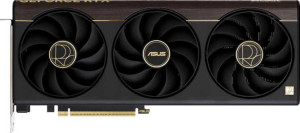
Asus ProArt GeForce RTX 5070 Ti OC Edition
Gigabyte GeForce RTX 5070 Ti Gaming OC

Asus ProArt GeForce RTX 5070 Ti OC Edition Gigabyte GeForce RTX 5070 Ti Gaming OC

Overview

Welcome to our in-depth specification comparison between the Asus ProArt GeForce RTX 5070 Ti OC Edition and the Gigabyte GeForce RTX 5070 Ti Gaming OC. Both cards are built on the same Blackwell architecture and share identical core performance figures, yet they diverge in ways that could matter depending on your setup. In this comparison, we examine their connectivity options and physical dimensions to help you decide which card fits your system best.

Common Features

  • Both cards have a GPU clock speed of 2295 MHz.
  • Both cards have a GPU turbo speed of 2588 MHz.
  • Both cards have a pixel rate of 248.4 GPixel/s.
  • Both cards deliver 46.38 TFLOPS of floating-point performance.
  • Both cards have a texture rate of 724.6 GTexels/s.
  • Both cards have a GPU memory speed of 1750 MHz.
  • Both cards have 8960 shading units.
  • Both cards have 280 texture mapping units (TMUs).
  • Both cards have an effective memory speed of 28000 MHz.
  • Both cards have a maximum memory bandwidth of 896 GB/s.
  • Both cards feature 16GB of VRAM.
  • Both cards use GDDR7 memory.
  • Both cards have a 256-bit memory bus width.
  • ECC memory is supported on both cards.
  • Both cards support DirectX 12 Ultimate.
  • Both cards support OpenGL version 4.6.
  • Both cards support OpenCL version 3.
  • Multi-display technology is supported on both cards.
  • Ray tracing is supported on both cards.
  • DLSS is supported on both cards.
  • 3D support is available on both cards.
  • XeSS (XMX) support is not available on either card.
  • Both cards include one HDMI 2.1b output.
  • Neither card has DVI outputs.
  • Neither card has mini DisplayPort outputs.
  • Both cards are based on the Blackwell GPU architecture.
  • Both cards have a Thermal Design Power (TDP) of 300W.
  • Both cards use PCIe version 5.
  • Both cards are built on a 5 nm semiconductor process.
  • Both cards have 45600 million transistors.
  • Neither card uses air-water cooling.

Main Differences

  • DisplayPort outputs total 2 on the Asus ProArt GeForce RTX 5070 Ti OC Edition and 3 on the Gigabyte GeForce RTX 5070 Ti Gaming OC.
  • USB-C port support is present on the Asus ProArt GeForce RTX 5070 Ti OC Edition but not available on the Gigabyte GeForce RTX 5070 Ti Gaming OC.
  • Card width is 304 mm on the Asus ProArt GeForce RTX 5070 Ti OC Edition and 340 mm on the Gigabyte GeForce RTX 5070 Ti Gaming OC.
  • Card height is 126 mm on the Asus ProArt GeForce RTX 5070 Ti OC Edition and 140 mm on the Gigabyte GeForce RTX 5070 Ti Gaming OC.
Specs Comparison
Asus ProArt GeForce RTX 5070 Ti OC Edition

Asus ProArt GeForce RTX 5070 Ti OC Edition

Gigabyte GeForce RTX 5070 Ti Gaming OC

Gigabyte GeForce RTX 5070 Ti Gaming OC

Performance:
GPU clock speed 2295 MHz 2295 MHz
GPU turbo 2588 MHz 2588 MHz
pixel rate 248.4 GPixel/s 248.4 GPixel/s
floating-point performance 46.38 TFLOPS 46.38 TFLOPS
texture rate 724.6 GTexels/s 724.6 GTexels/s
GPU memory speed 1750 MHz 1750 MHz
shading units 8960 8960
texture mapping units (TMUs) 280 280
render output units (ROPs) 96 96
Has Double Precision Floating Point (DPFP)

When comparing the Performance specs of the Asus ProArt RTX 5070 Ti OC and the Gigabyte RTX 5070 Ti Gaming OC, the data tells a remarkably clear story: these two cards are built on an identical performance foundation. Both share the same 2295 MHz base clock and 2588 MHz boost clock, the same 8960 shading units, 280 TMUs, and 96 ROPs, resulting in precisely equal pixel rates, texture rates, and floating-point throughput of 46.38 TFLOPS.

In practice, this means a user should expect no measurable difference in raw rendering output between the two cards. The identical TMU and ROP counts ensure that texture throughput and pixel fill rate scale equally, so neither card holds an advantage in geometry-heavy or resolution-intensive workloads. The shared 1750 MHz memory speed further confirms that memory bandwidth — a frequent bottleneck in high-resolution gaming and compute tasks — will behave identically on both boards.

On performance alone, this is a dead tie. Every metric provided is numerically identical, down to double-precision floating-point support, which both cards include. The differentiating factors between these two products will lie entirely in areas outside this spec group — such as cooling design, power delivery, software features, or pricing — rather than in any measurable performance gap.

Memory:
effective memory speed 28000 MHz 28000 MHz
maximum memory bandwidth 896 GB/s 896 GB/s
VRAM 16GB 16GB
GDDR version GDDR7 GDDR7
memory bus width 256-bit 256-bit
Supports ECC memory

When comparing the memory specifications of the Asus ProArt GeForce RTX 5070 Ti OC Edition and the Gigabyte GeForce RTX 5070 Ti Gaming OC, the two products are identical in every aspect. Both have an effective memory speed of 28000 MHz, a maximum memory bandwidth of 896 GB/s, and 16GB of VRAM. Additionally, both feature GDDR7 memory and a memory bus width of 256-bit.

Both the Asus and Gigabyte models also support ECC memory (Error-Correcting Code), which ensures more reliable and accurate memory performance for critical workloads.

In summary, for the memory specifications, there is no difference between the Asus ProArt and Gigabyte GeForce RTX 5070 Ti models; they share the same memory performance characteristics.

Features:
DirectX version DirectX 12 Ultimate DirectX 12 Ultimate
OpenGL version 4.6 4.6
OpenCL version 3 3
Supports multi-display technology
supports ray tracing
Supports 3D
supports DLSS
has XeSS (XMX)
AMD SAM / Intel Resizable BAR Intel Resizable BAR Intel Resizable BAR
has LHR
has RGB lighting
supported displays 4 4

The Asus ProArt GeForce RTX 5070 Ti OC Edition and the Gigabyte GeForce RTX 5070 Ti Gaming OC are identical in their feature sets. Both products support DirectX 12 Ultimate, OpenGL 4.6, and OpenCL 3. They also support multi-display technology, ray tracing, 3D, and DLSS, ensuring a feature-rich experience for modern applications and games. Both models do not have XeSS (XMX) support.

Both products also include Intel Resizable BAR (AMD SAM) support, enhancing performance in certain configurations. Neither model includes LHR (Lite Hash Rate) restrictions, and both feature RGB lighting for customization.

In terms of display support, both the Asus and Gigabyte models can handle up to 4 displays simultaneously, offering flexibility for multi-monitor setups.

Ports:
has an HDMI output
HDMI ports 1 1
HDMI version HDMI 2.1b HDMI 2.1b
DisplayPort outputs 2 3
USB-C ports 1 0
DVI outputs 0 0
mini DisplayPort outputs 0 0

In terms of ports, both the Asus ProArt GeForce RTX 5070 Ti OC Edition and the Gigabyte GeForce RTX 5070 Ti Gaming OC offer similar connectivity. Both products include an HDMI output with 1 HDMI port, supporting HDMI 2.1b. However, there is a slight difference in the number of DisplayPort outputs. The Asus ProArt model has 2 DisplayPort outputs, while the Gigabyte Gaming OC has 3.

Additionally, the Asus model includes 1 USB-C port, while the Gigabyte model does not provide any USB-C ports. Neither product features DVI or mini DisplayPort outputs.

In summary, while both models offer essential HDMI and DisplayPort outputs, the Asus ProArt includes a USB-C port, whereas the Gigabyte model has one extra DisplayPort output but lacks USB-C connectivity.

General info:
GPU architecture Blackwell Blackwell
release date September 2025 January 2025
Thermal Design Power (TDP) 300W 300W
PCI Express (PCIe) version 5 5
semiconductor size 5 nm 5 nm
number of transistors 45600 million 45600 million
Has air-water cooling
width 304 mm 340 mm
height 126 mm 140 mm

In the general specifications, both the Asus ProArt GeForce RTX 5070 Ti OC Edition and the Gigabyte GeForce RTX 5070 Ti Gaming OC share identical GPU architecture (Blackwell), Thermal Design Power (TDP) of 300W, PCIe version 5, semiconductor size of 5 nm, and a transistor count of 45.6 billion. Additionally, both models lack air-water cooling solutions.

The key difference between the two products lies in their physical dimensions. The Asus model measures 304 mm in width and 126 mm in height, while the Gigabyte model is slightly larger, measuring 340 mm in width and 140 mm in height.

In summary, aside from the size difference, the general specifications of both products are essentially identical, offering the same performance and architectural features.

Comparison Summary & Verdict

After reviewing all available specifications, the Asus ProArt GeForce RTX 5070 Ti OC Edition and the Gigabyte GeForce RTX 5070 Ti Gaming OC are essentially performance equals, sharing identical clock speeds, memory configuration, and feature support. The decision between them comes down to connectivity and form factor. The Asus ProArt stands out with its USB-C output and more compact dimensions of 304 mm x 126 mm, making it ideal for creators and users with tight case clearances or multi-device workflows. The Gigabyte Gaming OC, on the other hand, offers an extra DisplayPort output (three total) and a larger cooler footprint at 340 mm x 140 mm, which may benefit users running three-monitor setups who do not require USB-C connectivity.

Asus ProArt GeForce RTX 5070 Ti OC Edition
Buy Asus ProArt GeForce RTX 5070 Ti OC Edition if...

Buy the Asus ProArt GeForce RTX 5070 Ti OC Edition if you need a USB-C display output or require a more compact card that fits smaller cases more easily.

Gigabyte GeForce RTX 5070 Ti Gaming OC
Buy Gigabyte GeForce RTX 5070 Ti Gaming OC if...

Buy the Gigabyte GeForce RTX 5070 Ti Gaming OC if you want to connect three monitors via DisplayPort and do not have strict case size limitations.