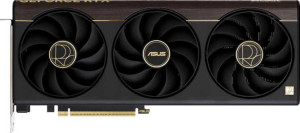
At first glance, the Asus ProArt RTX 5070 Ti OC appears competitive on clock speeds, running a base of 2295 MHz and boosting to 2588 MHz versus the RTX 5090's 2010 MHz / 2410 MHz. However, clock speed is only one dimension of GPU performance — it tells you how fast each unit runs, not how many units are running. Once you look at the underlying execution resources, the gap becomes immediately apparent.
The RTX 5090 houses 21,760 shading units, 680 TMUs, and 176 ROPs, compared to 8,960 / 280 / 96 on the 5070 Ti OC — roughly 2.4× more of each. That raw parallelism is what drives the 5090's 104.9 TFLOPS of floating-point throughput versus 46.38 TFLOPS on the 5070 Ti OC, and its texture fill rate of 1,638.8 GTexels/s versus 724.6 GTexels/s. In practice, this translates to significantly higher sustained performance in compute-heavy workloads, complex shading, and 4K-and-beyond rendering — areas where the 5070 Ti OC's clock-speed advantage cannot compensate for the sheer difference in core count. Both cards share identical 1750 MHz memory speed and support for Double Precision Floating Point, so those factors do not differentiate them here.
The RTX 5090 holds a decisive performance advantage in this group. The 5070 Ti OC's higher clocks are a meaningful engineering achievement for its tier, but they close only a fraction of the gap created by the 5090's far larger shader array. Users prioritizing maximum throughput — whether for high-resolution gaming, 3D rendering, or AI-accelerated workloads — will find the 5090 in a different performance class entirely.