Asus ProArt GeForce RTX 5080 OC Edition
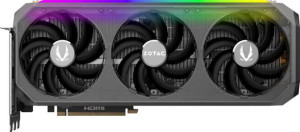
Zotac Gaming GeForce RTX 5080 AMP Extreme Infinity Ultra

Asus ProArt GeForce RTX 5080 OC Edition Zotac Gaming GeForce RTX 5080 AMP Extreme Infinity Ultra

Overview

Welcome to our in-depth spec comparison between the Asus ProArt GeForce RTX 5080 OC Edition and the Zotac Gaming GeForce RTX 5080 AMP Extreme Infinity Ultra. Both cards are built on the Blackwell architecture with identical memory configurations, but they diverge when it comes to boost clock speeds, physical dimensions, and connectivity options. Read on to discover which card fits your setup best.

Common Features

  • Both cards share a base GPU clock speed of 2295 MHz.
  • Both cards have a GPU memory speed of 1875 MHz.
  • Both cards feature 10752 shading units.
  • Both cards have 336 texture mapping units (TMUs).
  • Both cards have 112 render output units (ROPs).
  • Double Precision Floating Point (DPFP) is supported on both cards.
  • Both cards have an effective memory speed of 30000 MHz.
  • Both cards offer a maximum memory bandwidth of 960 GB/s.
  • Both cards come with 16GB of VRAM.
  • Both cards use GDDR7 memory.
  • Both cards feature a 256-bit memory bus width.
  • ECC memory is supported on both cards.
  • Both cards support DirectX 12 Ultimate.
  • Both cards support OpenGL version 4.6.
  • Both cards support OpenCL version 3.
  • Multi-display technology is supported on both cards.
  • Ray tracing is supported on both cards.
  • 3D output is supported on both cards.
  • DLSS is supported on both cards.
  • XeSS (XMX) support is not available on either card.
  • Both cards include one HDMI 2.1b output.
  • Neither card has DVI outputs.
  • Neither card has mini DisplayPort outputs.
  • Both cards are built on the Blackwell GPU architecture.
  • Both cards have a Thermal Design Power (TDP) of 360W.
  • Both cards use PCIe version 5.
  • Both cards are manufactured on a 5 nm semiconductor process.
  • Both cards contain 45600 million transistors.
  • Air-water cooling is not available on either card.

Main Differences

  • GPU turbo clock speed is 2700 MHz on the Asus ProArt GeForce RTX 5080 OC Edition and 2730 MHz on the Zotac Gaming GeForce RTX 5080 AMP Extreme Infinity Ultra.
  • Pixel rate is 302.4 GPixel/s on the Asus ProArt GeForce RTX 5080 OC Edition and 305.8 GPixel/s on the Zotac Gaming GeForce RTX 5080 AMP Extreme Infinity Ultra.
  • Floating-point performance is 58.06 TFLOPS on the Asus ProArt GeForce RTX 5080 OC Edition and 58.71 TFLOPS on the Zotac Gaming GeForce RTX 5080 AMP Extreme Infinity Ultra.
  • Texture rate is 907.2 GTexels/s on the Asus ProArt GeForce RTX 5080 OC Edition and 917.3 GTexels/s on the Zotac Gaming GeForce RTX 5080 AMP Extreme Infinity Ultra.
  • DisplayPort outputs number 2 on the Asus ProArt GeForce RTX 5080 OC Edition and 3 on the Zotac Gaming GeForce RTX 5080 AMP Extreme Infinity Ultra.
  • A USB-C port is present on the Asus ProArt GeForce RTX 5080 OC Edition but is not available on the Zotac Gaming GeForce RTX 5080 AMP Extreme Infinity Ultra.
  • Card width is 304 mm on the Asus ProArt GeForce RTX 5080 OC Edition and 332.1 mm on the Zotac Gaming GeForce RTX 5080 AMP Extreme Infinity Ultra.
  • Card height is 126 mm on the Asus ProArt GeForce RTX 5080 OC Edition and 137.5 mm on the Zotac Gaming GeForce RTX 5080 AMP Extreme Infinity Ultra.
Specs Comparison
Asus ProArt GeForce RTX 5080 OC Edition

Asus ProArt GeForce RTX 5080 OC Edition

Zotac Gaming GeForce RTX 5080 AMP Extreme Infinity Ultra

Zotac Gaming GeForce RTX 5080 AMP Extreme Infinity Ultra

Performance:
GPU clock speed 2295 MHz 2295 MHz
GPU turbo 2700 MHz 2730 MHz
pixel rate 302.4 GPixel/s 305.8 GPixel/s
floating-point performance 58.06 TFLOPS 58.71 TFLOPS
texture rate 907.2 GTexels/s 917.3 GTexels/s
GPU memory speed 1875 MHz 1875 MHz
shading units 10752 10752
texture mapping units (TMUs) 336 336
render output units (ROPs) 112 112
Has Double Precision Floating Point (DPFP)

At their cores, the Asus ProArt RTX 5080 OC and the Zotac Gaming RTX 5080 AMP Extreme Infinity Ultra share identical silicon configurations: the same 10,752 shading units, 336 TMUs, 112 ROPs, and a base clock of 2295 MHz. This means both cards are drawing from the same fundamental compute architecture, and neither holds a structural advantage in terms of raw parallelism or memory throughput at 1875 MHz.

The only meaningful divergence emerges in the boost clock: the Zotac reaches 2730 MHz versus the Asus at 2700 MHz — a 30 MHz difference. Small as it sounds, this cascades into slightly higher derived metrics across the board: the Zotac edges ahead with 58.71 TFLOPS of floating-point performance versus 58.06 TFLOPS, and a texture rate of 917.3 GTexels/s compared to 907.2 GTexels/s. In practice, these margins are below 1.2% and will be imperceptible in real-world gaming or rendering workloads — no benchmark will reliably separate them on this basis alone.

The edge goes narrowly to the Zotac on paper, purely due to its higher factory boost clock. However, this advantage is negligible in any practical scenario. Both cards support double-precision floating point, which is a noteworthy inclusion for users doing GPU-accelerated compute tasks alongside graphics work. For most buyers, the performance group is essentially a tie, and the decision between these two cards should hinge on other factors such as cooling design, power delivery, or price.

Memory:
effective memory speed 30000 MHz 30000 MHz
maximum memory bandwidth 960 GB/s 960 GB/s
VRAM 16GB 16GB
GDDR version GDDR7 GDDR7
memory bus width 256-bit 256-bit
Supports ECC memory

When it comes to memory, the Asus ProArt RTX 5080 OC and the Zotac Gaming RTX 5080 AMP Extreme Infinity Ultra are carbon copies of each other. Both carry 16GB of GDDR7 VRAM across a 256-bit bus, delivering a maximum bandwidth of 960 GB/s at an effective speed of 30,000 MHz. There is no differentiator to analyze here — the memory subsystem is identical in every measurable way.

That said, the specifications themselves deserve context. GDDR7 represents a generational leap in memory technology, and the 960 GB/s bandwidth figure is substantial — enough to keep even demanding 4K textures and large generative AI workloads well-fed. The 256-bit bus width is the standard for this GPU tier, striking a balance between die area cost and throughput. Meanwhile, ECC memory support on both cards is a meaningful inclusion for users who push these GPUs into professional or compute-adjacent tasks, as it enables error correction that safeguards data integrity during long rendering or inference jobs.

This group is an unambiguous tie. Neither card has any memory advantage over the other, and any purchasing decision should rest entirely on factors outside of this specification group.

Features:
DirectX version DirectX 12 Ultimate DirectX 12 Ultimate
OpenGL version 4.6 4.6
OpenCL version 3 3
Supports multi-display technology
supports ray tracing
Supports 3D
supports DLSS
has XeSS (XMX)
AMD SAM / Intel Resizable BAR Intel Resizable BAR Intel Resizable BAR
has LHR
has RGB lighting
supported displays 4 4

Feature parity is total between the Asus ProArt RTX 5080 OC and the Zotac Gaming RTX 5080 AMP Extreme Infinity Ultra. Both support DirectX 12 Ultimate and ray tracing, which are the twin pillars of modern GPU feature requirements — DX12 Ultimate ensures compatibility with the full suite of current and near-future rendering techniques, while hardware ray tracing enables physically accurate lighting in supported titles without relying purely on software fallbacks.

DLSS support on both cards is a significant practical asset, as it leverages AI-based upscaling to recover frame rates at higher resolutions with minimal perceptible quality loss — particularly valuable when ray tracing is enabled. Both cards also support up to 4 simultaneous displays and include Intel Resizable BAR, which allows the CPU to access the full VRAM pool at once rather than in smaller chunks, yielding measurable performance gains in many modern titles. The absence of LHR on either card is also worth noting for users who run GPU-intensive compute workloads alongside gaming.

There is no feature-based differentiator between these two products — every capability listed is shared identically. This group is a complete tie, and buyers should look to other specification groups, such as cooling, dimensions, or price, to inform their choice.

Ports:
has an HDMI output
HDMI ports 1 1
HDMI version HDMI 2.1b HDMI 2.1b
DisplayPort outputs 2 3
USB-C ports 1 0
DVI outputs 0 0
mini DisplayPort outputs 0 0

Port layout is where these two cards finally diverge in a way that could directly influence a buying decision. Both the Asus ProArt RTX 5080 OC and the Zotac Gaming RTX 5080 AMP Extreme Infinity Ultra share a single HDMI 2.1b output — the latest HDMI revision, capable of handling 4K at high refresh rates and 8K output. Beyond that shared port, their configurations split.

The Zotac opts for 3 DisplayPort outputs and no USB-C, while the Asus trades one of those DisplayPort slots for a USB-C port, leaving it with 2 DisplayPorts. For users building a pure multi-monitor desktop setup with standard DisplayPort cables, the Zotac's layout is marginally more convenient — no adapters needed for a three-display configuration. The Asus, however, brings added flexibility for users who need to connect a USB-C monitor, a VR headset, or a high-bandwidth peripheral directly from the GPU, which the Zotac cannot accommodate at all.

Neither layout is strictly superior — the right choice depends entirely on the user's display ecosystem. The Zotac has the edge for traditional multi-monitor setups, while the Asus is the better fit for anyone who relies on USB-C connectivity from their GPU. Both cards top out at 4 supported displays regardless of port configuration.

General info:
GPU architecture Blackwell Blackwell
release date August 2025 January 2025
Thermal Design Power (TDP) 360W 360W
PCI Express (PCIe) version 5 5
semiconductor size 5 nm 5 nm
number of transistors 45600 million 45600 million
Has air-water cooling
width 304 mm 332.1 mm
height 126 mm 137.5 mm

Beneath the surface, these two cards are built on identical foundations. Both the Asus ProArt RTX 5080 OC and the Zotac Gaming RTX 5080 AMP Extreme Infinity Ultra are based on the Blackwell architecture, manufactured on a 5nm process with 45.6 billion transistors, and draw the same 360W TDP. They also share PCIe 5.0 connectivity, ensuring neither card is bottlenecked by the interface on any current-generation platform. In short, the silicon story is identical.

Where this group does produce a concrete, practical difference is physical size. The Zotac measures 332.1 mm × 137.5 mm, while the Asus comes in at a noticeably more compact 304 mm × 126 mm — roughly 28mm shorter and 11.5mm narrower. For builders working with mid-tower cases or those with tight GPU clearance constraints, that gap is meaningful. The Asus is the easier card to fit, and its smaller footprint may also improve airflow dynamics inside more confined chassis.

On fundamentals like power envelope and architecture, this group is a tie. But on physical dimensions, the Asus holds a clear advantage for space-constrained builds. Users with full-tower cases and ample clearance will find the size difference irrelevant, while those working within tighter limits should weigh it seriously.

Comparison Summary & Verdict

Both the Asus ProArt GeForce RTX 5080 OC Edition and the Zotac Gaming GeForce RTX 5080 AMP Extreme Infinity Ultra share the same 16GB GDDR7 memory, 360W TDP, and Blackwell architecture foundation, making them near-equals in most workloads. However, the Zotac edges ahead with a slightly higher GPU turbo of 2730 MHz, marginally better floating-point performance at 58.71 TFLOPS, and an extra DisplayPort output for multi-monitor setups. The Asus, on the other hand, wins on compact dimensions and includes a USB-C port that the Zotac lacks. Choose according to your priorities: connectivity versatility or physical footprint.

Asus ProArt GeForce RTX 5080 OC Edition
Buy Asus ProArt GeForce RTX 5080 OC Edition if...

Buy the Asus ProArt GeForce RTX 5080 OC Edition if you need a more compact card that fits smaller cases, or if a USB-C display output is important for your monitor setup.

Zotac Gaming GeForce RTX 5080 AMP Extreme Infinity Ultra
Buy Zotac Gaming GeForce RTX 5080 AMP Extreme Infinity Ultra if...

Buy the Zotac Gaming GeForce RTX 5080 AMP Extreme Infinity Ultra if you want the slightly higher boost clock and floating-point performance, or if you need three DisplayPort outputs for a multi-monitor workstation.