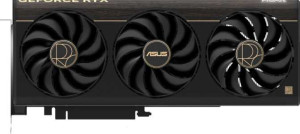
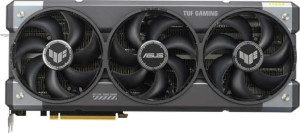
The most striking contrast between these two cards lies in raw computational muscle. The Asus TUF Gaming RTX 5090 doubles up on nearly every processing resource: its 21,760 shading units and 680 TMUs dwarf the ProArt RTX 5080's 10,752 shaders and 336 TMUs. This translates directly into the floating-point performance gap — 104.8 TFLOPS on the 5090 versus 56.28 TFLOPS on the 5080 — meaning the 5090 can process nearly twice as many parallel compute tasks per second. For workloads like real-time ray tracing, AI-accelerated rendering, or high-resolution rasterization, that gap is tangible and significant.
Where the ProArt 5080 pushes back is on clock speed. Its base clock of 2295 MHz and turbo of 2617 MHz outpace the TUF 5090's 2017 MHz base and 2407 MHz boost. A higher clock means each individual shader core cycles faster, which benefits workloads that are more serial or latency-sensitive. Similarly, the 5080's 1875 MHz memory speed edges out the 5090's 1750 MHz. However, the 5090's larger shader array and 176 ROPs (vs 112) more than compensate in throughput-bound scenarios — its pixel rate of 423.6 GPixel/s and texture rate of 1,637 GTexels/s are roughly 1.4–1.9× higher, making it substantially faster at filling frames and applying textures at high resolutions.
Both cards support Double Precision Floating Point (DPFP), which matters for scientific or professional compute tasks. Overall, the TUF Gaming RTX 5090 holds a clear performance advantage in this group: its superior shading throughput, pixel fill rate, and floating-point compute make it the stronger card for demanding rendering, gaming at extreme resolutions, and GPU compute workloads. The ProArt 5080's clock speed lead offers modest benefits in specific scenarios but cannot overcome the 5090's fundamental architectural scale advantage.